


How AI Assistant Development Works: Key Steps for Building Smarter Business Solutions
Businesses are increasingly using artificial intelligence to automate repetitive work, improve customer experiences, and help employees access information faster. One of the most practical applications is an AI assistant that can understand requests, process information, and respond based on a company’s specific needs.
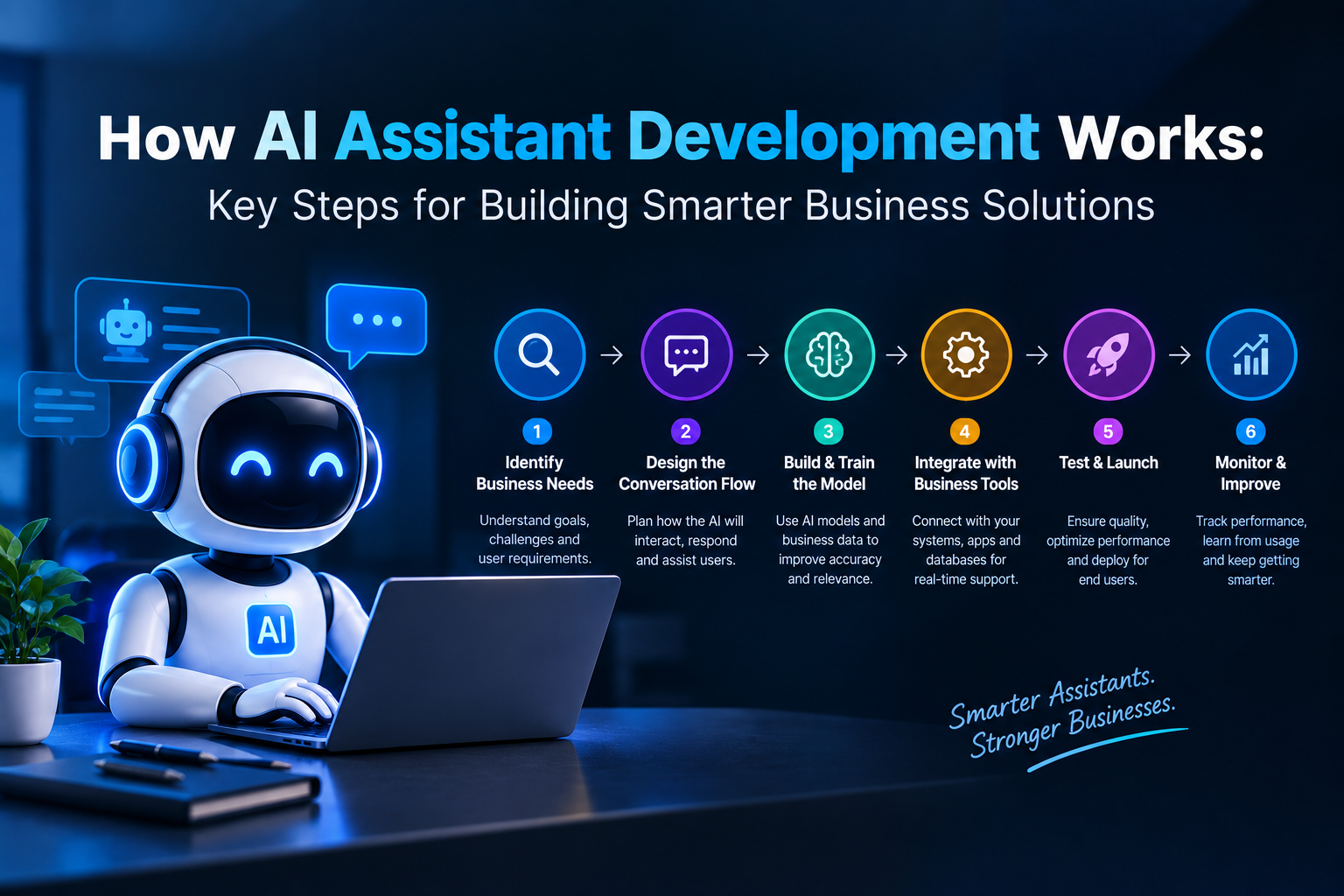
However, building an effective assistant requires more than connecting a chatbot to an AI model. AI Assistant Development involves several stages, from identifying business requirements to integrating data, testing responses, and continuously improving performance. Understanding these steps can help organizations determine what type of AI solution fits their workflows.
What Is an AI Assistant?
An AI assistant is a software application designed to interact with users through natural language and help them complete specific tasks. Depending on its purpose, it may answer questions, retrieve information, summarize documents, create content, support employees, or assist customers.
An AI Virtual Assistant, for example, can handle routine conversations and provide information through websites, applications, or internal platforms. More advanced assistants can connect with business systems and perform actions rather than simply providing answers.
The effectiveness of an assistant depends on factors such as its underlying AI model, available business data, integrations, instructions, security controls, and user experience.
Key Steps in AI Assistant Development
1. Define the Business Use Case
The first step is identifying the problem the assistant should solve. Businesses should avoid starting with technology and instead focus on specific workflows.
For example, an assistant could help employees find information in internal documentation, support customer-service teams, qualify incoming inquiries, or automate frequently requested tasks.
A clearly defined use case makes it easier to establish requirements and measure whether the final solution delivers useful results.
2. Identify Users and Their Requirements
The next step is understanding who will interact with the assistant and what they expect from it.
Customer-facing assistants may need simple language, multilingual support, and integration with customer-service platforms. Internal assistants may require access to company documents, project information, or knowledge bases.
At this stage, teams should also identify common questions, expected conversation flows, permissions, and situations where human assistance will be required.
3. Choose the Right AI Architecture
Different business requirements can call for different technical approaches. Some assistants may rely primarily on a large language model, while others may require retrieval systems, databases, APIs, workflow automation, or multiple AI components.
An AI-Powered Assistant can combine these technologies to understand user requests and provide context-aware responses. For knowledge-based applications, retrieval-augmented generation can help the assistant retrieve relevant information before generating an answer.
The architecture should be selected according to the required accuracy, complexity, scalability, security, and cost.
4. Prepare and Connect Business Data
An assistant is only as useful as the information it can reliably access. Businesses may need to connect documents, knowledge bases, CRM systems, ticketing platforms, databases, or other internal sources.
Data should be organized and reviewed before being used. Outdated, duplicated, or inaccurate information can negatively affect responses.
Access controls are also important. An assistant should only retrieve information that a particular user is authorized to access.
5. Design the Conversation Experience
Good AI assistants need clear interaction patterns. Users should understand what the assistant can do and what information they need to provide.
Teams can design prompts, conversation flows, fallback responses, and escalation rules to make interactions more predictable.
An Intelligent AI Assistant should also recognize when it does not have enough information instead of confidently generating an unsupported response. For sensitive or complex requests, handing the conversation to a human can be an important part of the experience.
6. Build and Integrate the Assistant
Once the architecture and data requirements are established, developers can begin implementation.
This may include connecting the AI model to business applications, developing APIs, creating authentication systems, implementing retrieval mechanisms, and building the user interface.
For organizations with specialized requirements, a Custom AI Assistant can be developed around particular workflows rather than relying on a generic chatbot. This approach can provide more control over functionality, integrations, and business-specific processes.
7. Test Accuracy, Security, and Performance
Testing is a critical part of AI assistant development. Teams should evaluate how the assistant handles normal questions, ambiguous requests, incorrect information, unexpected inputs, and potentially sensitive scenarios.
Testing should also cover response accuracy, latency, security, access permissions, and integration reliability.
Real-world testing with representative users can reveal problems that may not appear during technical testing alone.
8. Monitor and Improve Over Time
Launching an assistant is not the final step. User requirements, business information, and AI technologies continue to change.
Organizations should monitor conversations and performance indicators while protecting user privacy. Feedback can help identify unanswered questions, confusing interactions, and areas where workflows can be improved.
This continuous improvement process helps an assistant remain useful as business needs evolve.
Understanding AI Assistant Services
Organizations can approach implementation in different ways depending on their technical capabilities and objectives. AI Assistant Services may cover areas such as strategy, design, development, integration, testing, and ongoing optimization.
Similarly, AI Assistant Development Services can support businesses that need specialized assistants connected to existing applications and data sources.
The right approach depends on the complexity of the use case, available resources, security requirements, and long-term goals.
Conclusion
Building a smarter business assistant requires a structured process rather than simply adding an AI model to an application. From defining the use case and preparing business data to designing conversations, integrating systems, testing performance, and monitoring results, each stage contributes to the overall quality of the solution.
Companies exploring AI assistants can also work with experienced development teams when they need help with architecture, integrations, or specialized functionality. CodeCones, for example, works across AI and software engineering to help businesses develop digital products around practical business requirements.
The most effective AI assistant is ultimately one that solves a clearly defined problem, provides reliable information, integrates smoothly into existing workflows, and continues improving based on real user needs.

 English
 Arabic
 French
 Spanish
 Portuguese
 Deutsch
 Turkish
 Dutch
Dutch
 Italiano
 Russian
 Romaian
 Greek
Greek
