


Dolby Atmos Home Theatre: Setup, Speakers & Cost Guide
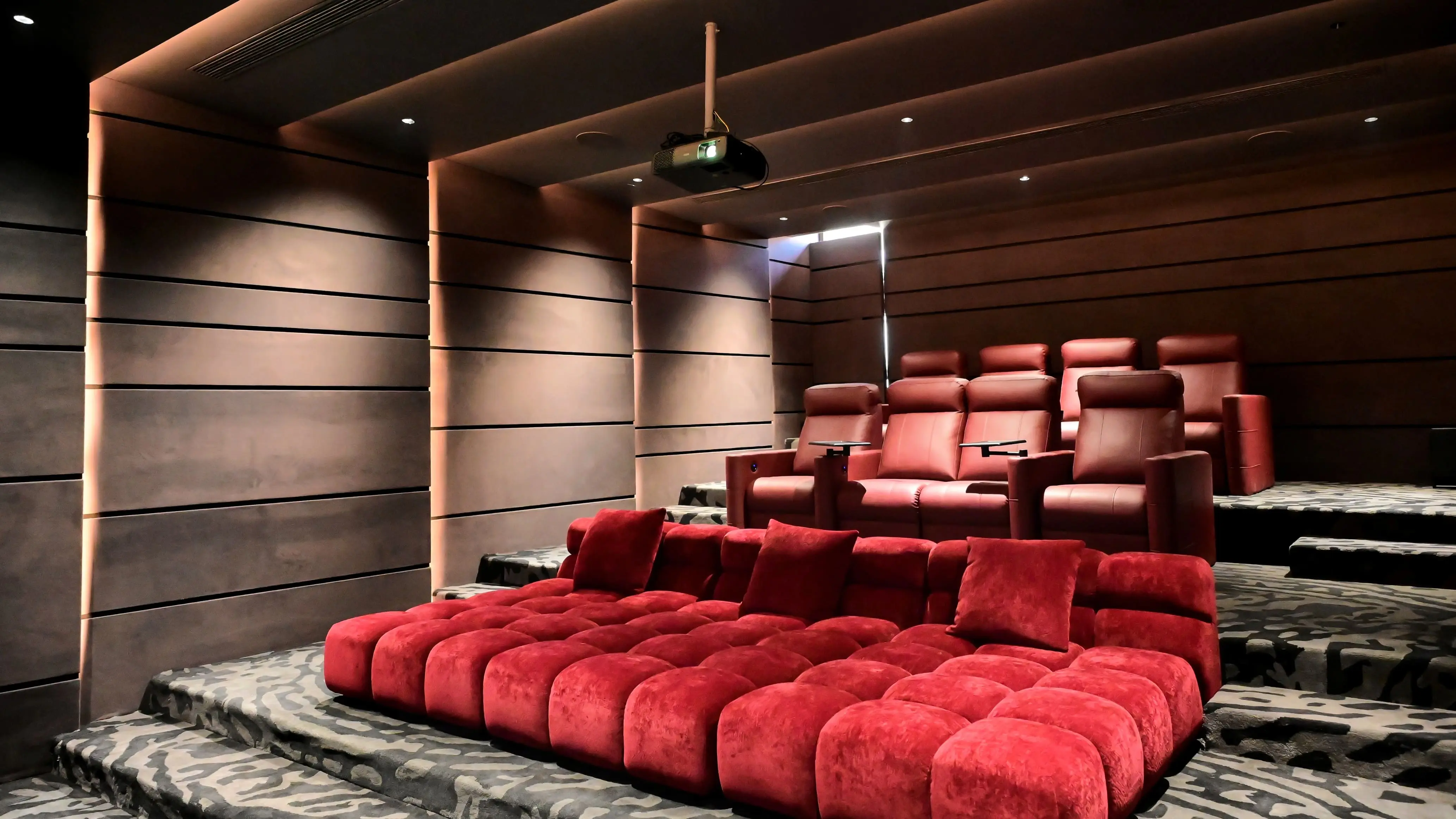
A Dolby Atmos home theatre adds height speakers, in the ceiling or up-firing, to a surround system so sound moves above you as well as around you. Popular layouts are 5.1.2 for living rooms and 7.1.4 for cinema rooms. You need an Atmos AV receiver, well-placed speakers and calibration. Indicative costs start around Rs 2.5 lakh.
Rain that sounds like it is falling on your roof. A helicopter that actually flies over your head. That is what Atmos does when it is set up well.
When it isn't, you get an expensive 5.1 system with two speakers nobody notices. The difference is planning.
Who is this guide for?
- Villa and penthouse owners planning a dedicated cinema room
- Homeowners renovating a living room or media room
- Architects and interior designers who need speaker positions fixed before the false ceiling goes in
- Anyone choosing between a soundbar and a full system
What is Dolby Atmos and how is it different from surround sound?
Dolby Atmos is an object-based audio format that places sounds in three-dimensional space, including overhead.
Traditional 5.1 and 7.1 systems are channel-based, with every sound mixed to a fixed speaker. In Atmos, the mixer places a bird or a raindrop as an "object" in 3D space, and your AV receiver decides which speakers in your room play it.
The result is a dome of sound: dialogue stays on screen while effects move around and above you.
Which Dolby Atmos speaker layout is right for your room?
An Atmos layout is written as three numbers: ear-level speakers, subwoofers and height speakers. So 7.1.4 means seven ear-level speakers, one subwoofer and four height speakers.
| Layout | Ear-level | Sub | Height | Best suited for |
|---|---|---|---|---|
| 5.1.2 | 5 | 1 | 2 | Living rooms and media rooms |
| 7.1.4 | 7 | 1 | 4 | Dedicated cinema rooms |
| 7.2.4 / 9.2.6 | 7–9 | 2 | 4–6 | Large cinemas with two seating rows |
Planning a cinema room in a villa or penthouse? At Brightmatic, we typically recommend 7.1.4. Four height speakers let sound travel front to back overhead, which two can't fully do.
In-ceiling, up-firing or soundbar: which is better for Atmos?
In-ceiling speakers give the most accurate overhead sound because they play directly from above.
In-ceiling speakers sit flush in the false ceiling and must be planned before it is closed. See our in-ceiling vs in-wall speakers guide. For premium rooms we often specify TruAudio architectural speakers.
Up-firing (Atmos-enabled) speakers sit on top of the front speakers and bounce sound off the ceiling. They generally work best with a flat, hard ceiling at typical residential height. Coves, wooden panels or slopes weaken the effect.
Atmos soundbars simulate height with processing and suit bedrooms or secondary TVs. Our soundbar vs home theatre comparison explains the trade-off.
| In-ceiling | Up-firing | Atmos soundbar | |
|---|---|---|---|
| Height accuracy | Highest | Moderate | Simulated |
| Ceiling work needed | Yes | No | No |
| Visibility | Flush, near-invisible | Visible on speakers | Single bar |
| Best for | Cinema and living rooms | Rooms with fixed ceilings | Bedrooms, secondary TVs |
What equipment do you need for Dolby Atmos?
An Atmos system needs four things: a receiver that decodes Atmos, the right speakers, an Atmos source and a display.
- AV receiver. It must decode Atmos and handle your channel count (7.1.4 needs 11 channels). Look for room correction such as Dirac Live or Audyssey.
- Matched speakers. Keep all speakers from one brand family. The centre speaker carries most dialogue, so don't compromise there.
- Subwoofer. One minimum; two give more even bass across seats.
- Atmos content. Netflix (Premium plan), Apple TV+, Prime Video and JioHotstar offer selected Atmos titles. 4K Blu-ray delivers lossless Dolby TrueHD Atmos.
- HDMI eARC. Needed to pass lossless Atmos from your TV to the receiver.
- Display. A large 4K TV or a laser projector. Our projector vs TV guide helps you choose.
How should you plan the room for Dolby Atmos?
Room planning matters more than the speaker price tag. A well-planned mid-range system will outperform an expensive one in an untreated room.
Fix speaker positions early. Dolby's setup guidelines generally recommend height speakers slightly in front of and behind the main seat for a .4 layout. For .2, slightly in front of the listener. Fix back boxes and conduits at the false ceiling stage. Dolby's speaker setup guides are a useful reference.
Treat the acoustics. Marble, glass and bare walls cause echo that blurs overhead effects. Absorption panels and bass traps fix most of it. See our acoustic soundproofing guide.
Calibrate professionally. An uncalibrated Atmos system often sounds worse than a well-tuned 5.1.
Add lighting scenes. One-touch "Movie" and "Interval" scenes with dimmable cove and step lights can be linked to the AV system through smart lighting control.
How much does a Dolby Atmos home theatre cost in India?
A Dolby Atmos home theatre in India indicatively costs between Rs 2.5 lakh and Rs 40 lakh or more, depending on layout, brands and room work.
Indicative estimates only, not actual quotes.
| Setup | What's included | Indicative cost |
|---|---|---|
| Atmos soundbar | Soundbar, sub, rear speakers | Rs 50,000 – Rs 2 lakh |
| 5.1.2 system | AV receiver, 7 speakers, 1 sub, installation | Rs 2.5 – 5 lakh |
| 7.1.4 system | 11-channel receiver, 4 in-ceiling speakers, 1–2 subs, calibration | Rs 6 – 12 lakh |
| 7.2.4 cinema room | Above plus acoustics, projector, screen, lighting scenes | Rs 15 – 35 lakh |
| 9.2.6 premium cinema | Separate processor and amps, premium speakers, full acoustic design | Rs 40 lakh+ |
For screen, seating and interiors, see our home cinema installation cost guide.
Not sure which layout your room can take? Share your room size and we'll suggest one →
Is a Dolby Atmos home theatre worth it?
- Is it expensive? A 5.1.2 upgrade costs far less than a new room, and you can grow later.
- Is it complicated to use? Not when it's integrated. One button can switch on the projector, receiver and lighting scene.
- What can go wrong? Poor speaker placement and untreated rooms. Both are avoidable at the design stage.
What mistakes should you avoid?
- Closing the false ceiling before speaker positions are planned
- Using up-firing speakers under a cove or sloped ceiling
- Mixing speaker brands at random
- Skipping acoustic treatment in hard-floored rooms
- Buying a receiver with too few channels to upgrade later
- Skipping calibration
A common myth: more speakers always mean better sound. Four well-placed height speakers in a treated room will beat six badly placed ones.
Expert recommendation from Brightmatic
For a dedicated cinema room, we recommend 7.1.4 with in-ceiling height speakers, one or two quality subwoofers, basic acoustic treatment and professional calibration. For a living room, a well-placed 5.1.2 gives you most of the Atmos experience without crowding the space.
Plan the speaker layout alongside the ceiling design, not after it. That one decision protects both your sound and your interiors.
At Brightmatic, we design Atmos rooms with acoustics, lighting and control built in from day one. Crafting Brighter Lives.
Originally Published at: https://www.brightmatic.in/insights/dolby-atmos-home-theatre

 Arabic
 French
 Spanish
 Portuguese
 Deutsch
 Turkish
 Dutch
Dutch
 Italiano
 Russian
 Romaian
 Portuguese (Brazil)
 Greek
Greek
