


How AI and Personalisation Are Changing Jewellery ECommerce Websites
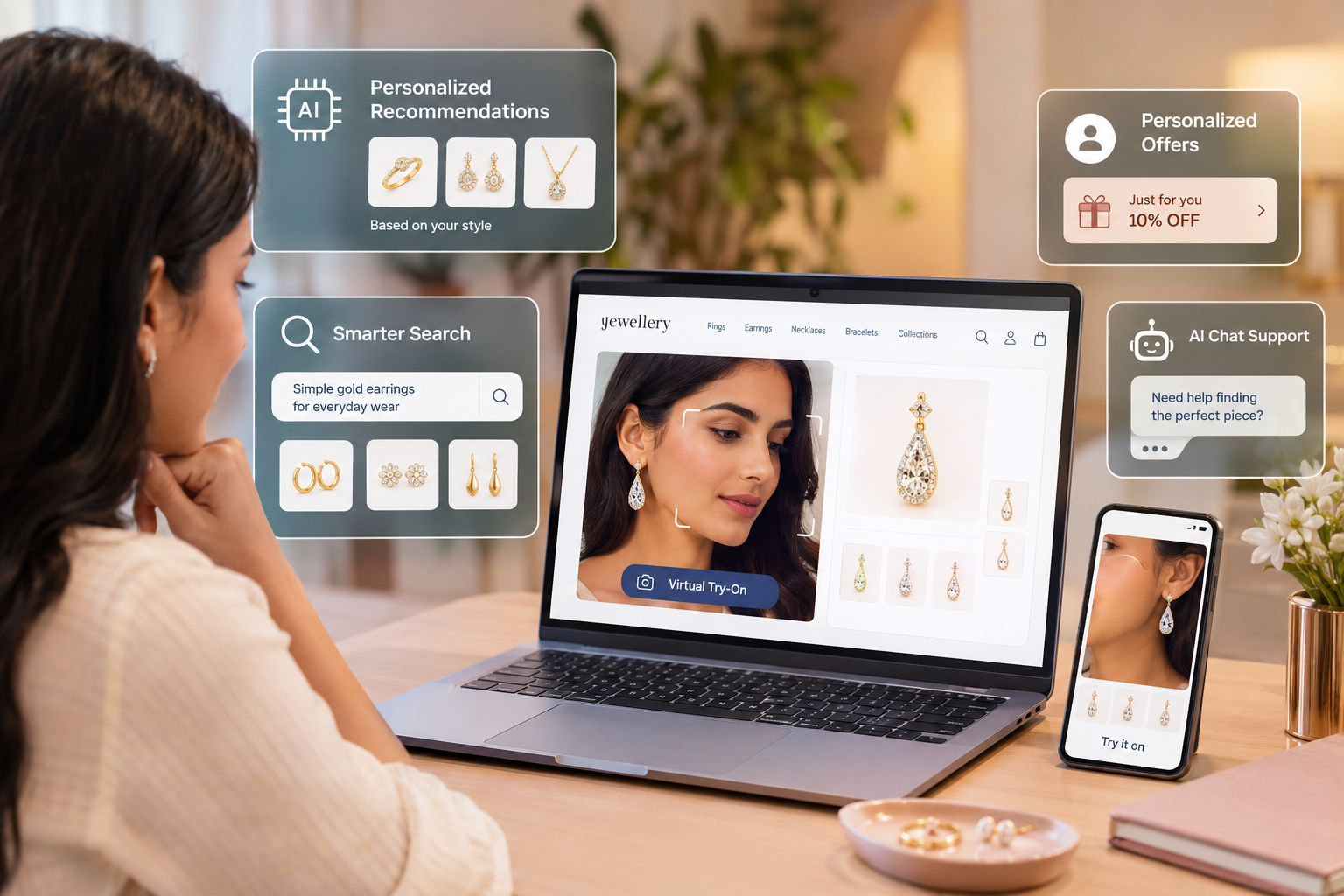
The online jewellery industry is becoming more personalised, visual, and technology-driven. Customers no longer want to browse hundreds of products without guidance. They expect online stores to understand their preferences, offer relevant recommendations, provide detailed product information, and simplify the buying journey.
Artificial intelligence (AI) and personalisation are helping jewellery brands create these experiences. From product recommendations and virtual try-ons to personalised search and automated customer support, these technologies are changing how shoppers discover and purchase jewellery online.
For jewellery businesses, adopting these technologies is not simply about following a digital trend. It is about creating a shopping experience that feels relevant and trustworthy while helping customers make confident purchase decisions.
What Does AI Mean for Online Jewellery Shopping?
AI refers to technologies that can analyse information, identify patterns, and generate useful responses or predictions. In an online jewellery store, AI can study customer interactions such as searches, product views, preferences, and purchasing behaviour.
For example, if a shopper repeatedly views minimalist gold earrings, an AI-powered system can recommend similar earrings, matching necklaces, or new arrivals in the same style.
AI can support several areas of an online jewellery business, including:
- Personalized product recommendations
- Intelligent search
- Virtual jewellery try-ons
- Customer service chatbots
- Product discovery
- Personalized marketing
- Inventory insights
- Customer behaviour analysis
- Content and product tagging
The goal isn't to replace the human side of jewellery shopping. Instead, AI can make it easier for customers to find products that match their needs.
Personalisation Makes Jewellery Shopping More Relevant
Jewellery is highly personal. Customers shop based on their style, occasion, budget, metal preference, gemstone choice, or cultural preferences. A generic online shopping experience may not address these differences.
Personalisation lets an eCommerce store adapt the experience to individual interests.
For example, a first-time visitor might see popular collections, while a returning customer could receive recommendations based on products they previously viewed or purchased.
Personalisation can be applied to:
- Product recommendations
- Search results
- Homepage collections
- Promotional offers
- Email campaigns
- Recently viewed products
- Related jewellery suggestions
- Occasion-based recommendations
When implemented thoughtfully, personalisation can reduce the amount of time customers spend searching for suitable products.
AI-Powered Product Recommendations
Product recommendations are among the most practical applications of AI in jewellery eCommerce.
Instead of displaying unrelated products, recommendation engines can identify connections between products and customer behaviour. For example, a customer viewing a diamond pendant may receive suggestions for matching earrings, rings, or complementary collections.
Recommendations can be based on factors such as:
- Previous purchases
- Browsing behaviour
- Product popularity
- Price range
- Jewellery category
- Material and gemstone
- Customer preferences
- Similar customer behaviour
This creates opportunities for both better discovery and cross-selling. However, recommendations should remain relevant. Showing too many unrelated products can make the shopping experience feel automated rather than personalised.
Virtual Try-On Can Improve Buying Confidence
One of the biggest challenges of buying jewellery online is visualising how a piece will look when worn.
AI-powered virtual try-on technology can help address this challenge. Depending on the technology used, customers may use their smartphone camera to visualise earrings, necklaces, rings, or other jewellery on themselves.
This can make product discovery more interactive and help customers understand proportions, placement, and overall appearance.
Virtual try-on can be particularly useful for products where size and visual appearance influence purchasing decisions. It doesn't fully replace the experience of trying on jewellery in person, but it can add an extra layer of confidence during online shopping.
Smarter Search for Jewellery Products
Traditional website search often depends on exact keywords. AI can make search more flexible by understanding intent and product characteristics.
For example, instead of searching only for "gold earrings", a customer might type "small earrings for a wedding" or "simple diamond earrings for everyday wear".
An intelligent search system can interpret these queries and present more relevant products.
Jewellery websites can also use filters for:
- Jewellery type
- Metal
- Purity
- Gemstone
- Price
- Occasion
- Design style
- Collection
- Gender
- Size
Combining intelligent search with detailed filters can make large product catalogues easier to navigate.
Personalisation Starts with Better Website Design
Technology works best when a well-planned website structure supports it. A jewellery store needs attractive visuals, clear navigation, informative product pages, fast loading, and a smooth checkout process.
When businesses design jewellery ecommerce website experiences, they should balance aesthetics and functionality. A premium visual appearance may attract visitors, but customers also need practical information before buying.
A strong product page can include:
- Multiple product images
- Zoom functionality
- Product specifications
- Metal and gemstone information
- Size details
- Certification information where applicable
- Shipping and return details
- Customer reviews
- Related products
- Personalized recommendations
Combining design, information, and personalisation can create a more complete shopping experience.
The Role of Jewellery ECommerce Website Designers
Implementing AI features requires more than adding a recommendation tool to an existing website. The technology needs to fit naturally into the overall customer journey.
Experienced jewellery eCommerce website designers can help businesses plan layouts, navigation, product pages, mobile experiences, and personalisation features around customer behaviour.
For example, personalisation shouldn't complicate the homepage. Recommendations should appear where they are useful without distracting customers from the main product information.
Good design should also keep AI-driven features easy to understand. Customers should know what they are viewing and why a particular product is being recommended.
AI Chatbots and Customer Support
Customers often have questions while shopping for jewellery. They may want to know about delivery timelines, sizing, customisation, returns, product materials, or payment options.
AI-powered chatbots can answer frequently asked questions immediately. They can also help visitors navigate categories and locate products.
For example, a customer could ask:
"Show me lightweight earrings suitable for everyday use."
Depending on the system's capabilities, the chatbot could guide the customer toward relevant products.
However, automated support should have clear boundaries. Transfer complex questions, high-value purchases, complaints, and situations requiring human judgment to a customer service representative.
Personalisation Across Mobile Shopping
A significant part of online shopping happens through mobile devices. Jewellery websites therefore need to provide a consistent experience across smartphones, tablets, and desktops.
AI-based personalisation can make mobile shopping more efficient by highlighting relevant categories, recently viewed items, recommendations, and personalised searches.
Mobile users also benefit from:
- Simple navigation
- Fast-loading product pages
- Easy filters
- Large product images
- Clear call-to-action buttons
- Simple checkout
- Mobile-friendly payment options
Personalisation should improve convenience, not add unnecessary complexity to the mobile interface.
Data and Privacy Matter
AI and personalisation depend on data, so responsible data management matters.
Jewellery businesses should clearly communicate how they collect and use customer information. Personalisation should follow appropriate data practices and include suitable security measures.
Businesses should also avoid excessive personalisation. Customers may appreciate relevant recommendations, but overly detailed assumptions about their behaviour can feel intrusive.
A balanced approach provides value while respecting customer expectations and privacy.
AI and Jewellery ECommerce Website Development
AI is becoming part of modern jewellery eCommerce website development, but it should be treated as one component of a broader digital strategy.
Before implementing AI features, businesses should identify their actual objectives. A growing jewellery brand may benefit more from intelligent product search and recommendations than from implementing multiple advanced technologies at once.
The development process may involve:
- Understanding customer journeys
- Planning website architecture
- Organising product data
- Selecting appropriate AI tools
- Integrating personalisation features
- Testing customer interactions
- Monitoring performance
- Improving recommendations over time
This approach lets technology solve real customer problems instead of being added simply because it is popular.
What the Future May Look Like
The future of online jewellery shopping is likely to become increasingly interactive and personalised. AI could help customers discover designs based on style preferences, occasions, previous purchases, or even conversational descriptions.
Customers may increasingly expect online stores to act more like digital jewellery advisors rather than simple product catalogues.
At the same time, visual technologies such as 3D product views, augmented reality, virtual try-ons, and interactive customisation can make digital shopping more engaging.
The most successful jewellery brands will likely combine these technologies with strong product quality, transparent information, attractive design, and dependable customer service.
Final Thoughts
AI and personalisation are changing how customers discover, evaluate, and purchase jewellery online. Intelligent recommendations, smarter search, virtual try-ons, AI chatbots, and personalised shopping experiences can make an online jewellery store more useful and engaging.
However, technology alone does not create a successful eCommerce business. It needs to work alongside thoughtful design, accurate product information, mobile responsiveness, secure transactions, and customer-focused service.
For jewellery brands planning their digital growth, the goal should be simple: use AI to make jewellery shopping more relevant, convenient, and confident without losing the personal experience that makes jewellery special.

 English
 Arabic
 French
 Spanish
 Portuguese
 Deutsch
 Dutch
 Italiano
 Russian
 Romaian
 Portuguese (Brazil)
 Greek
