


Magnetic Track Lighting for Homes: Cost & Design Guide
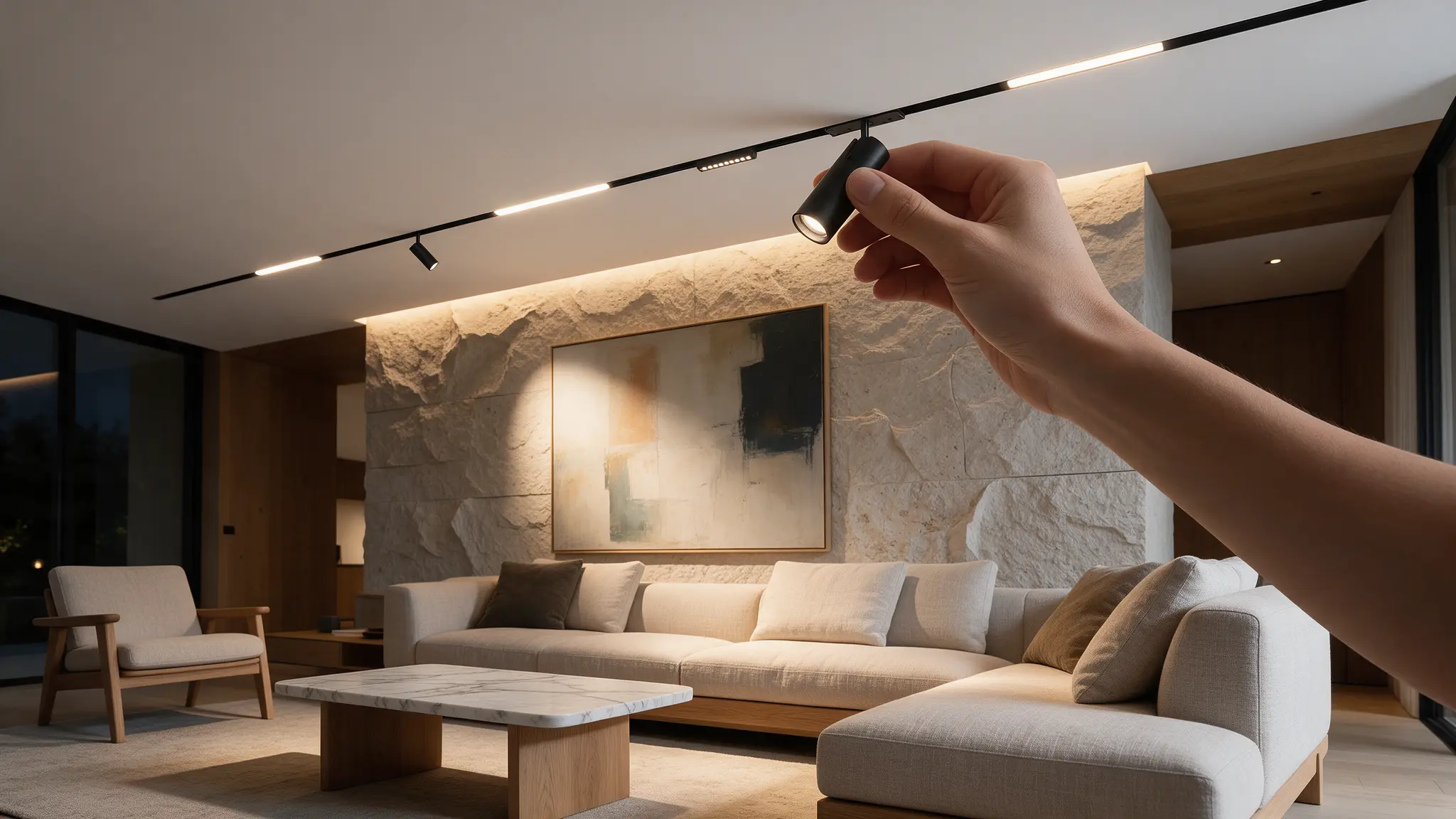
Magnetic track lighting is a low-voltage track, usually 48V, recessed or mounted on the ceiling, where spotlights, linear lights and pendants snap on magnetically and can be moved anytime. For homes in India, it indicatively costs Rs 50,000 to 1.5 lakh for a living room and Rs 2 to 6 lakh for a full 3 BHK.
You’ve just rearranged the living room. The sofa now faces the window, a new painting hangs on the wall, and the downlights you planned so carefully two years ago are lighting an empty corner.
With fixed downlights, that’s where the story ends. With magnetic track lighting, you simply slide a spotlight along the track, click it into place and aim it at the painting.
That flexibility, combined with a clean, minimal look, is why magnetic tracks have moved from boutiques into living rooms, kitchens and walk-in wardrobes. This guide explains how they work, how to design with them and what they cost.
Who is this guide for?
- Homeowners renovating or building who want a modern, minimal ceiling
- Villa and apartment owners who love art, collectables or changing layouts
- Interior designers and architects specifying flexible residential lighting
- Anyone comparing magnetic tracks with downlights and profile lights
What is magnetic track lighting?
Magnetic track lighting is a low-voltage lighting system where fittings attach to a slim track using magnets, so they can be added, removed or repositioned without tools or rewiring.
The track carries low-voltage DC power, most commonly 48V, from a driver hidden in the ceiling. Fittings simply snap on and draw power through contacts in the track. Because the voltage is low, modules can be handled safely and the tracks can be very slim, often just 20–35 mm wide.
Which types of magnetic track and modules are there?
There are three ways to mount the track and four main types of light module.
| Track mounting | What it looks like | Best for |
|---|---|---|
| Recessed (trimless) | Flush with the false ceiling, almost invisible | New builds, premium interiors |
| Surface-mounted | Fixed directly onto the ceiling | Retrofits, concrete ceilings |
| Suspended | Hangs on wires from a high ceiling | Double-height spaces, dining areas |
| Module type | What it does |
|---|---|
| Spotlights | Focused beams for art, shelves and accents |
| Linear flood | Soft, even general light along the track |
| Grille lights | Multiple small adjustable lenses, a precise architectural look |
| Pendants | Drop-down lights that plug into the track |
At Brightmatic, we often combine linear flood modules for general light with a few spotlights for accents. That gives one track the job of both downlights and accent lights.
Where does magnetic track lighting work best at home?
It works best where lighting needs to be flexible, minimal or focused on objects.
- Living rooms: general light plus spotlights on art and feature walls
- Kitchens: linear modules over counters and islands
- Dining areas: a suspended track with pendants that can move with the table
- Walk-in wardrobes: focused light on shelves and hanging rails
- Corridors and galleries: one continuous line that guides the eye
- Home offices: even task light with no glare on screens
It works beautifully as part of layered lighting, where ambient, task and accent light come from the same clean line.
How do you design with magnetic track lighting?
Good track design starts with the ceiling plan, not the modules.
1. Plan the lines. Run tracks parallel to walls or furniture, so they look intentional. A few long lines look calmer than many short ones.
2. Decide recessed depth early. Trimless tracks usually need a false ceiling depth of around 50–80 mm, plus space for the driver. This must be planned before the ceiling is built.
3. Mix module types. Use linear floods for general light and spots for focal points.
4. Choose warm, consistent colour. 2700K–3000K suits most homes. Keep the same colour temperature and a high colour rendering index (CRI 90+) across all modules.
5. Plan dimming and control. Magnetic systems are available with DALI, Zigbee, Bluetooth or phase dimming. The DALI Alliance explains the DALI standard.
How much does magnetic track lighting cost?
Costs depend on track length, the number and type of modules, driver capacity and the control system.
Indicative estimates only, not actual quotes.
| Item | Indicative cost |
|---|---|
| Recessed or surface track | Rs 1,000 – 3,500 per metre |
| Spotlight module | Rs 1,500 – 5,000 each |
| Linear flood module | Rs 2,500 – 8,000 each |
| Grille module | Rs 3,000 – 9,000 each |
| 48V driver (non-dimmable to smart dimmable) | Rs 2,000 – 10,000 each |
| Installation | Rs 300 – 800 per metre |
| Space | Typical setup | Indicative cost |
|---|---|---|
| Living room | 6–10 m track, 8–12 modules | Rs 50,000 – 1.5 lakh |
| Kitchen or dining | 3–6 m track, 4–8 modules | Rs 30,000 – 90,000 |
| Full 3 BHK | Tracks in main living areas | Rs 2 – 6 lakh |
| Villa | Multiple zones with dimming | Rs 6 – 15 lakh+ |
Smart dimming typically adds 20–40% to the cost. For control system budgets, see our lighting control system cost guide.
Planning a renovation or new home in Noida or Delhi NCR? Share your ceiling plan early, because trimless tracks are far easier to build in than to add later.
Want a track layout for your space? Share your floor plan →
How does magnetic track compare with downlights and profile lights?
Magnetic tracks offer the most flexibility, while downlights and profiles suit fixed layouts.
| Factor | Downlights | Profile lights | Magnetic track |
|---|---|---|---|
| Flexibility | Fixed | Fixed | Move and change anytime |
| Look | Dots in the ceiling | Clean lines of light | Clean lines with adjustable heads |
| Accent lighting | Limited | Limited | Excellent |
| Upgrade later | Needs new holes | Difficult | Snap on new modules |
| Cost | Lowest | Medium | Medium to high |
Is magnetic track lighting worth it?
- Is it expensive? More than basic downlights. But one track can replace downlights and accent lights, and it adapts as your home changes.
- Is it complicated? Not to use. Planning the ceiling depth and drivers needs expertise.
- What can go wrong? Mixing brands that aren’t compatible, overloading drivers and cheap modules with poor colour.
What mistakes should you avoid?
- Deciding on recessed tracks after the false ceiling is built
- Mixing modules and tracks from different, incompatible brands
- Undersizing the driver for the total wattage
- Using only spotlights, so the room feels patchy
- Choosing cool white or low-CRI modules for living spaces
- Forgetting dimming and control until the end
A common myth: magnetic track lighting is only for shops and offices. In reality, trimless tracks with warm, dimmable modules look elegant and calm in modern homes.
Expert recommendation from Brightmatic
For most homes, we recommend trimless recessed 48V tracks planned with the false ceiling, a mix of linear flood and spot modules, 2700K–3000K with CRI 90+, drivers sized with spare capacity, and DALI or smart dimming linked to lighting scenes. Buy tracks and modules from the same system, so you can add pieces later.
Brightmatic designs and installs architectural lighting, including magnetic track lighting, for homes, villas and premium interiors.
Design magnetic track lighting with Brightmatic
Brightmatic designs and installs magnetic track lighting for apartments, villas and premium homes in Noida, Delhi NCR & across India.
Originally Published at: https://www.brightmatic.in/insights/magnetic-track-lighting-for-homes

 English
 Arabic
 French
 Spanish
 Portuguese
 Deutsch
 Turkish
 Dutch
 Italiano
 Russian
 Portuguese (Brazil)
 Greek
