


How Intent Classification Helps Automate Customer Service Workflows
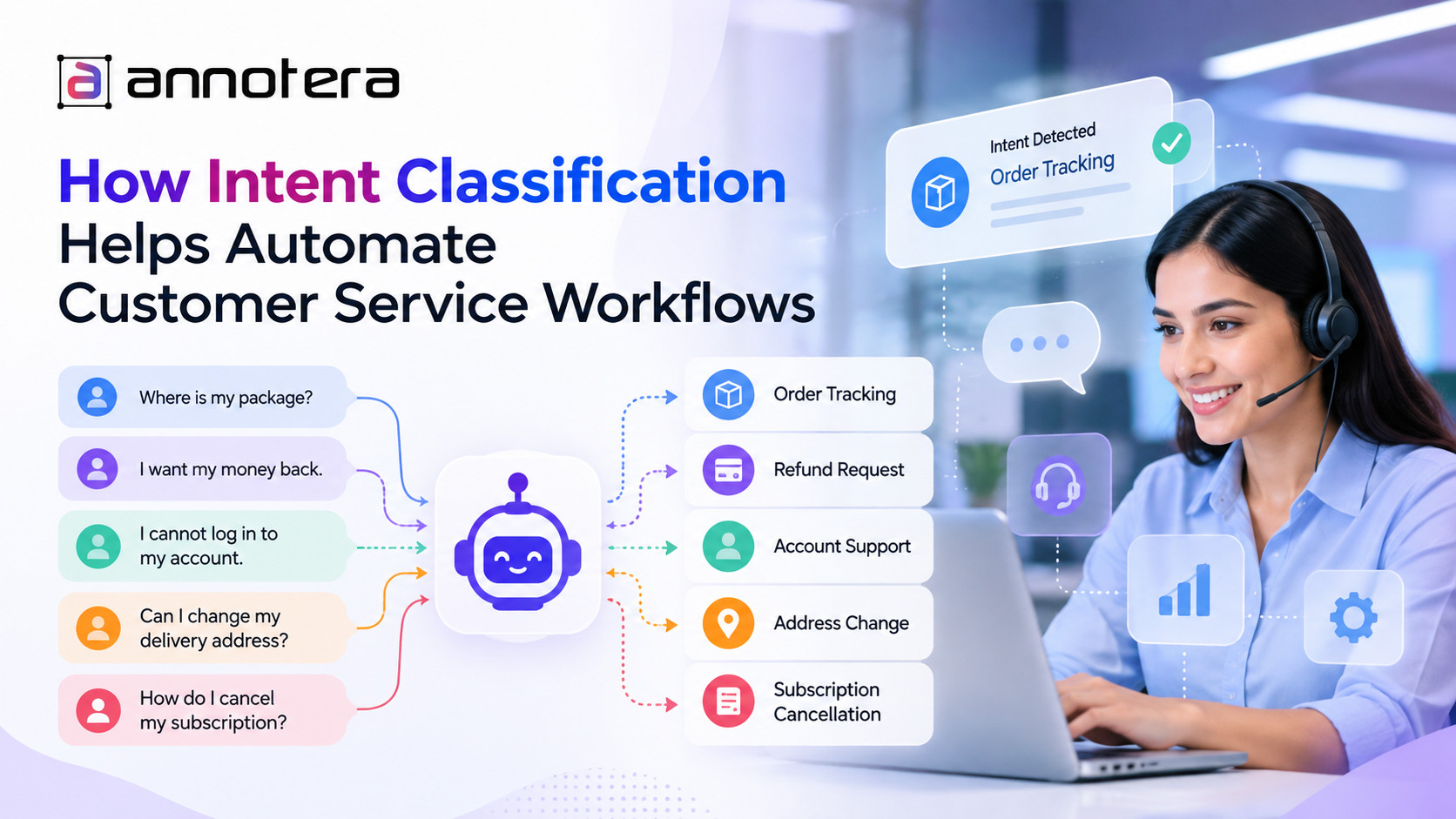
Customer service teams handle thousands of customer interactions across emails, live chats, messaging platforms, and support tickets every day. From tracking orders and processing refunds to troubleshooting technical issues, each request requires the right response at the right time. Managing these interactions manually can increase response times, create operational bottlenecks, and put pressure on support teams.
Intent classification helps organizations automate these processes by identifying what customers want to accomplish through their messages. By categorizing customer queries into predefined intent labels, artificial intelligence (AI) systems can route requests, trigger automated actions, and deliver relevant responses with minimal human intervention.
However, effective automation depends on accurately labeled training data. This is where high-quality text annotation becomes essential for building reliable customer service workflows.
What Is Intent Classification in Customer Service?
Intent classification is a natural language processing (NLP) technique that identifies the purpose behind a customer's message. Rather than simply recognizing individual words, an AI model analyzes the meaning and context of a query to determine the action or information the customer needs.
For example, consider these customer messages:
-
"Where is my package?" — Order tracking
-
"I want my money back." — Refund request
-
"I cannot log in to my account." — Account access issue
-
"Can I change my delivery address?" — Address modification
-
"How do I cancel my subscription?" — Subscription cancellation
Although customers may express similar needs using different words, an intent classification model groups these messages into appropriate categories.
These categories enable customer service platforms to determine the next step automatically, whether that means retrieving order information, initiating a workflow, assigning a support ticket, or connecting the customer with a human agent.
5 Ways Intent Classification Automates Customer Service Workflows
1. Automating Query Routing and Ticket Assignment
One of the most practical applications of intent classification is intelligent ticket routing. Traditional support systems often rely on manual review or basic keyword rules to assign customer requests. These approaches can struggle with ambiguous language and variations in how people communicate.
Intent-based routing allows AI systems to categorize incoming messages and direct them to the appropriate department.
For example, a billing-related query can be routed to the finance support team, while a technical issue can be assigned to technical support. Delivery-related questions can be directed to logistics or order management.
This reduces manual triage, minimizes unnecessary transfers, and helps support teams prioritize their workloads more effectively.
2. Enabling AI Chatbots and Automated Responses
Customer service chatbots can use intent classification to understand incoming messages and select appropriate responses from a knowledge base or predefined response library.
When a customer asks about business hours, password recovery, return policies, or payment methods, the system can identify the intent and provide relevant information immediately.
More advanced systems can connect classified intents to conversational AI models, customer databases, and workflow automation tools. This enables chatbots to handle multi-step interactions instead of merely responding to frequently asked questions.
For example, a chatbot may identify a password-reset request, verify the customer's identity through an approved process, and initiate the password recovery workflow.
Automating repetitive interactions allows human agents to focus on complex requests that require judgment, empathy, or specialized expertise.
3. Accelerating Refunds, Returns, and Order Management
Many customer service requests involve predictable business processes. Refund inquiries, order cancellations, address changes, and product returns often follow established rules and procedures.
Intent classification can identify these requests and trigger the appropriate workflow.
A typical automated process might involve:
-
Receiving a customer message through chat or email.
-
Classifying the message as a refund request.
-
Extracting relevant details, such as the order number, where required.
-
Checking eligibility through the organization's order management system.
-
Initiating the approved refund process or escalating the request for review.
-
Sending the customer an appropriate status update.
The classification model identifies the customer's intent, while connected business systems execute the corresponding actions.
Organizations must establish appropriate validation, authorization, and escalation rules before allowing automated systems to perform sensitive or irreversible actions.
4. Prioritizing Urgent and High-Impact Requests
Not every customer query has the same urgency. A general product question may require a routine response, while a payment failure, account security concern, or service outage may need immediate attention.
Intent classification helps support systems distinguish between different request types and apply predefined prioritization rules.
When combined with sentiment analysis, urgency detection, and business rules, it can help identify interactions that require faster intervention.
For instance, a message reporting unauthorized account access could be classified as an account security issue and routed to a specialized team. A complaint about a delayed shipment could be directed to the appropriate support queue.
This approach helps organizations allocate resources more efficiently without relying entirely on manual review.
5. Improving Customer Service Analytics
Intent classification also transforms unstructured customer conversations into structured operational data.
When organizations consistently categorize support interactions, they can identify recurring problems, analyze service demand, and uncover opportunities for process improvement.
For example, a growing number of billing-related queries may indicate confusing invoices or recurring payment failures. An increase in product troubleshooting requests could reveal a documentation gap or a product usability issue.
Customer service managers can use these insights to improve self-service resources, update support procedures, and identify issues that require attention from other departments.
Over time, intent-based analytics can help organizations move beyond resolving individual complaints toward addressing the underlying causes of customer dissatisfaction.
Why High-Quality Text Annotation Matters for Intent Classification
The effectiveness of an intent classification model depends heavily on the quality and diversity of its training data. If customer messages are incorrectly labeled, inconsistently categorized, or insufficiently representative of real-world conversations, the model may struggle to recognize customer needs accurately.
Text annotation addresses this challenge by assigning meaningful labels to customer messages according to clearly defined guidelines.
A reliable annotation process should include the following practices:
-
A well-defined intent taxonomy: Establish clear categories for common requests, including order tracking, refunds, complaints, technical support, and account management.
-
Consistent labeling guidelines: Define how annotators should handle ambiguous messages, overlapping intents, incomplete requests, and out-of-scope queries.
-
Representative training examples: Include variations in wording, spelling, grammar, language, and conversational style.
-
Quality assurance: Use expert review, agreement measurements, and adjudication procedures to identify and resolve labeling inconsistencies.
-
Continuous dataset improvement: Incorporate new customer queries and emerging intents as products, services, and customer expectations evolve.
Organizations can work with a specialized text annotation company to develop structured datasets that support their customer service automation objectives.
By leveraging text annotation outsourcing services, businesses can access trained annotation teams, established quality control processes, and scalable data preparation capabilities without building every aspect of their annotation operations internally.
How Annotera Supports Intent Classification for Customer Service AI
Building reliable customer service automation requires more than deploying an AI model. Organizations also need carefully prepared datasets that reflect how customers communicate across different channels and scenarios.
Annotera supports AI development through structured text annotation services designed to help organizations prepare high-quality training data for natural language processing applications.
For intent classification projects, annotation workflows can be aligned with specific business requirements, including customer query categorization, chatbot training, support ticket routing, and conversational AI development.
A structured approach to annotation can help AI teams establish consistent intent labels, handle linguistic variations, and improve dataset quality through appropriate review processes.
As customer interactions become more diverse and automated workflows become more sophisticated, dependable training data remains a critical component of effective AI implementation.
Organizations evaluating text annotation outsourcing services can consider Annotera as a partner for preparing text datasets that support their AI and customer service automation initiatives.
Challenges to Address Before Implementing Intent-Based Automation
Despite its benefits, intent classification requires careful implementation.
Overlapping intent categories can confuse models, while insufficient training examples may cause poor performance on unfamiliar queries. Customer messages can also contain multiple requests, making single-label classification inadequate for certain use cases.
To address these challenges, organizations should regularly evaluate model performance using relevant metrics, review misclassified messages, refine their intent taxonomies, and expand training datasets where necessary.
Human oversight is particularly important when interactions involve financial disputes, account security, sensitive personal information, or exceptions to standard business policies.
Organizations should also monitor changing customer behavior and introduce new intent categories when existing labels no longer capture emerging needs.
Conclusion
Intent classification is a valuable foundation for automating customer service workflows. By identifying customer needs and connecting them to appropriate actions, organizations can streamline ticket routing, improve chatbot interactions, accelerate routine processes, and generate actionable service insights.
However, automation is only as reliable as the data used to train and evaluate the underlying models. Consistent labels, representative examples, and rigorous quality assurance help AI systems recognize customer intent more effectively.
With structured text annotation and a well-designed automation strategy, businesses can build customer service systems that are more efficient, responsive, and scalable.
Ready to strengthen your customer service AI with high-quality training data? Connect with Annotera to explore text annotation solutions tailored to your intent classification and conversational AI requirements.

 Arabic
 French
 Spanish
 Portuguese
 Deutsch
 Turkish
 Dutch
 Italiano
 Russian
 Romaian
 Portuguese (Brazil)
 Greek
