


Competitive Dynamics on the Digital Edge: Analyzing Market Share Until 2035
A Crowded and Diverse Competitive Field
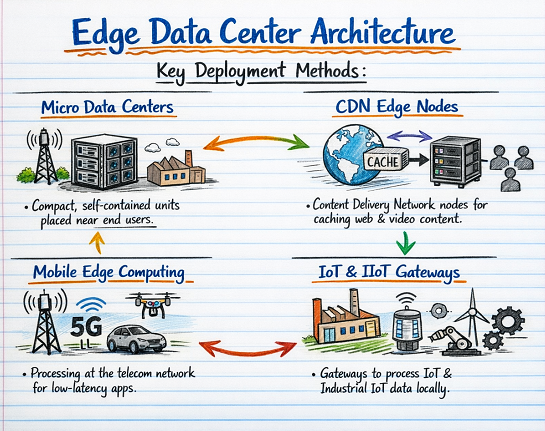
The race to build out the network edge has created a fascinating and highly competitive landscape. The distribution of the Edge Data Center Market Share is fragmented among a diverse set of players, each approaching the market with a unique strategy and set of advantages. This includes established telecommunication giants, dominant hyperscale cloud providers, specialized colocation and infrastructure companies, and a host of hardware and software vendors. Unlike the more consolidated hyperscale cloud market, the edge market is inherently more distributed, creating opportunities for a wider range of participants. Market share is currently being contested on multiple fronts, including the availability of strategic real estate, the breadth of service offerings, the strength of ecosystem partnerships, and the ability to manage highly distributed infrastructure efficiently. The ultimate winners will be those who can successfully navigate this complex ecosystem and deliver reliable, scalable, and cost-effective edge solutions.
Role of Telecommunication Giants (Telcos)
Telecommunication companies are uniquely positioned to capture a significant share of the edge market. Their greatest asset is their vast portfolio of real estate, which includes thousands of central offices, network aggregation points, and cell tower sites located in close proximity to end-users in metropolitan and rural areas alike. This real estate is prime territory for deploying edge data centers. Telcos like Verizon, AT&T, and Vodafone are actively converting these sites into Multi-access Edge Computing (MEC) locations, integrating compute and storage resources directly into their 5G networks. This allows them to offer ultra-low-latency services to their mobile and enterprise customers, creating new revenue streams beyond basic connectivity. By leveraging their existing network infrastructure and customer relationships, telcos are formidable competitors, aiming to become the default platform for network-sensitive edge applications and services.
Hyperscalers and Their Edge Strategies
The dominant public cloud providers—Amazon Web Services (AWS), Microsoft Azure, and Google Cloud—are not ceding the edge to the telcos. They are aggressively extending their cloud platforms to the network edge to provide a consistent development and operational experience for their customers. Their strategy involves creating specialized edge services like AWS Wavelength (which embeds AWS compute within telco 5G networks), Azure Edge Zones, and Google Distributed Cloud Edge. These offerings allow developers to deploy applications at the edge using the same familiar tools, APIs, and management consoles as they use in the central cloud. This approach is highly attractive to enterprises that are already heavily invested in a particular cloud ecosystem. By partnering with telcos and deploying their hardware in edge locations, the hyperscalers are effectively bringing their cloud services closer to users, aiming to maintain their dominance across the entire compute continuum, from the core to the edge.
The Rise of Specialized Edge Colocation Providers
A third category of key players consists of specialized infrastructure and colocation companies, some of which are entirely focused on the edge market. Companies like EdgeConneX, Vapor IO, and American Tower are building and operating networks of neutral-host edge data centers. Unlike telcos or hyperscalers, these providers offer carrier-neutral and cloud-neutral facilities, allowing any service provider, enterprise, or cloud company to lease space and power at their edge locations. This neutrality is a major selling point, as it provides customers with maximum flexibility and avoids vendor lock-in. These companies often focus on acquiring strategic real estate and developing innovative infrastructure designs, such as software-defined interconnection fabrics that make it easy to connect to various networks and clouds. By providing the physical "landing spots" for the edge, these specialized providers are building the foundational real estate and connectivity layer upon which the entire edge ecosystem depends.
M&A, Partnerships, and Future Share Shifts
The dynamic nature of the edge market is leading to a flurry of strategic partnerships, mergers, and acquisitions (M&A) that are constantly reshaping the competitive landscape. No single company owns all the necessary components to win at the edge, making collaboration essential. We are seeing partnerships form between telcos and hyperscalers, between hardware vendors and software platforms, and between colocation providers and managed service firms. Consolidation is also a major trend, as larger players acquire smaller, innovative companies to quickly gain new technology, talent, or market access. Looking toward 2035, market share will likely shift towards those players who can build the most effective and extensive partnership ecosystems. The ability to offer integrated, end-to-end solutions that are easy to consume will be critical. The lines between competitor types will continue to blur, leading to a complex but vibrant market where collaboration is as important as competition.
➤ In-Depth Market Studies by Market Research Future:
United States Cryptocurrency Market

 English
 Arabic
 French
 Spanish
 Portuguese
 Deutsch
 Turkish
 Dutch
 Italiano
 Romaian
 Portuguese (Brazil)
 Greek