


How Can Students Improve Their Chances of Successful Research Paper Submission?
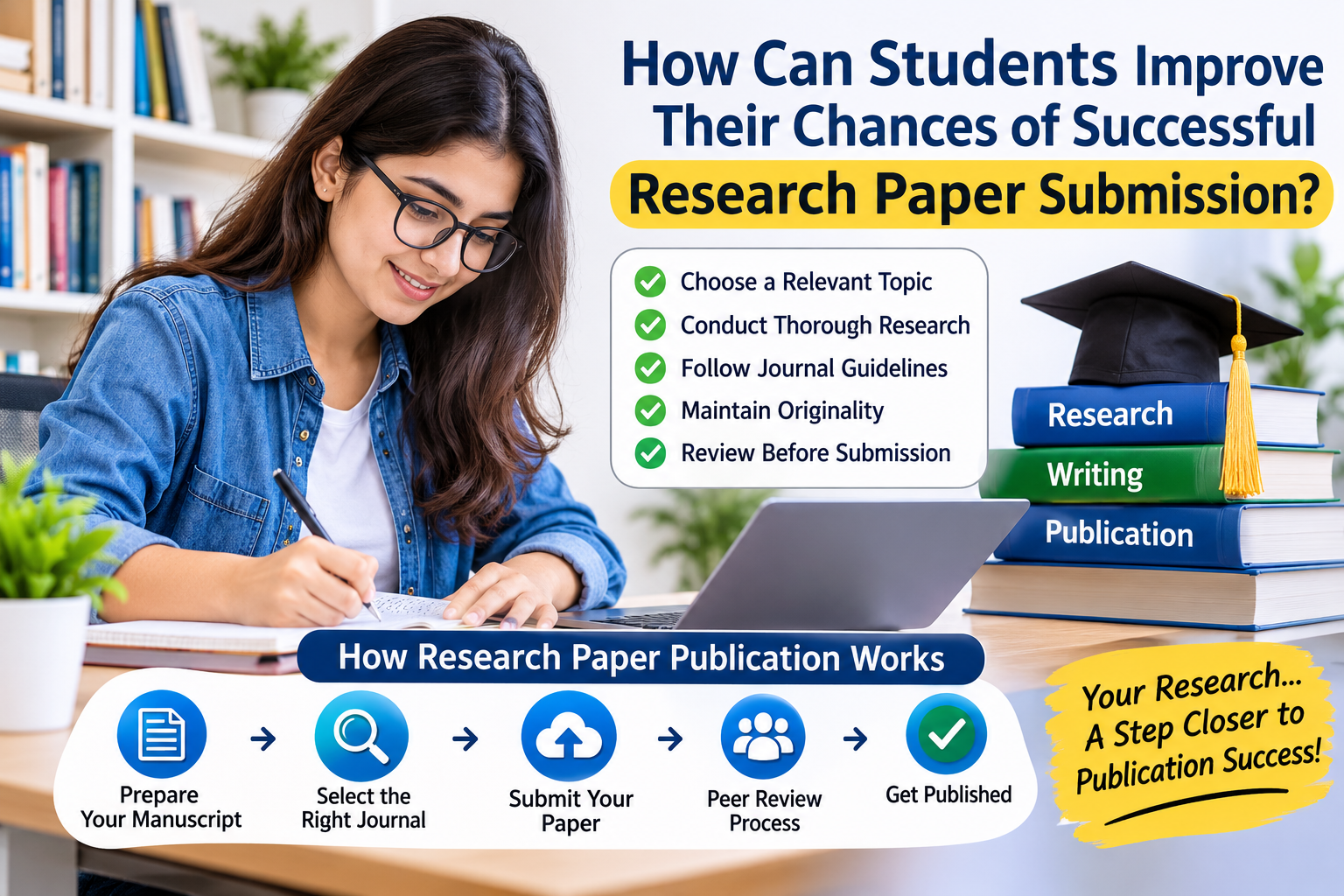
Publishing your first research paper is a significant achievement in terms of expanding your academic base, improving your research capabilities, and building a solid professional reputation. No matter what level of education you have achieved (undergraduate, graduate, doctoral), publishing allows you to share your results with a larger group of researchers. However, producing a well-written paper is just the first step. To successfully publish, you must also be familiar with journal requirements, follow submission procedures, and present original research.
The process of successfully Process of research paper submission depends upon proper preparation, focus on details, and having knowledge of what is expected from authors when submitting to journals. When students use a structured approach to writing, they will likely produce better quality manuscripts and experience less difficulty during the submission process. Below are several ways to improve your likelihood of having your research paper accepted for review.
Choose a Relevant and Researchable Topic
In order for students to publish successfully, they need to select the correct topic. Students must find a subject matter that aligns with their area of interest and is relevant to the field of study.
To find what has already been done in your area of study, look at previously published articles from journals, conferences, etc., as well as other relevant literature (e.g., reports). This will provide insight into what is missing from current knowledge and where additional research is needed.
A good research topic should be:
- Relevant to your academic discipline.
- Specific and clearly defined.
- Supported by available research resources.
- Capable of generating meaningful findings.
Interesting enough to maintain your research motivation.
In addition, do not pick a topic that is too large, as this may be hard for you to manage your research.
Conduct Thorough Literature Research
A good quality research paper will be based upon a thorough understanding of the current body of knowledge that exists within the area of study. Prior to writing your paper, you should find relevant journal articles, books, conference proceedings, and other credible academic resources.
A literature review allows you to learn from prior research, find gaps in existing knowledge, and provide a basis for your own research project.
When studying different materials, make sure you take appropriate notes on who wrote it, when it was published, what method they used to study the subject matter, and some of their major discoveries. Taking such notes will help you when you cite these sources later, and it will also prevent accidental plagiarism.
To find pertinent literature you can utilize various academic databases like Google Scholar, PubMed, and institutional research repositories.
Follow the Correct Research Paper Structure
A poorly organized paper is much harder to read and comprehend than an organized one. Although each journal has different formatting guidelines, most scholarly research papers contain the following sections:
Title: Clearly explains the research topic.
Abstract: Provides a brief overview of the research.
- Introduction: Explains the research background and objectives.
- Literature Review: Discusses existing studies.
- Methodology: Describes the research approach and methods.
- Results: Presents the research findings.
- Discussion: Explains the meaning and importance of the findings.
- Conclusion: Summarises the key outcomes.
- References: Lists all cited academic sources.
The structure of your paper is important to both the reader (to make it easier to read) and the journal (to ensure you are meeting the journal's submission requirements).
Select the Right Journal for Submission
Students must select which journal to use for publishing their research. The selection process will be a critical decision in academic publishing. Students need to find journals that consistently publish articles about the same topics as those studied by the students.
Before submitting your manuscript, consider the following factors:
- Journal scope and subject relevance.
- Publication guidelines and formatting requirements.
- Peer-review process.
- Indexing and reputation.
- Publication charges, if applicable.
- Expected review timelines.
Always make sure you check if the journal is legitimate and stay away from predatory publishers who say they will publish your work, no matter how bad it is.
Submission of your manuscript to an appropriate journal enhances the probability that it will find the correct scholarly readership.
Maintain Originality and Avoid Plagiarism
The most basic standard for conducting academic research is to be original. In addition to presenting your own original data, findings and interpretations, you must acknowledge the work of prior researchers.
You should use plagiarism detection software prior to submitting your work to locate accidental matches. All quoted material, paraphrased material, research materials and references used in your work must be properly cited.
In addition to avoiding submitting the same manuscript to more than one journal at once (unless there is explicit authorization in the applicable publishing policy), students are discouraged from doing so.
The establishment of credibility and demonstration of proper research conduct are both established through the maintenance of academic integrity.
Follow Journal Submission Guidelines Carefully
Academic journals have individual manuscript preparation and submission guidelines. Some of these are likely to include: length restrictions (word limits), preferred style of citation, formatting rules, requirements for figures, and identification of authors.
Before you submit your final research article, please make sure that you have read and understood all of the author guidelines for the journal.
- Prepare all required documents, including:
- Final research manuscript.
- Abstract and keywords.
- Author details and affiliations.
- Cover letter, if required.
- Figures, tables, and supplementary files.
Ethical approval or disclosure statements, where applicable.
The best-written manuscript can be sent back to you without a review if you missed a critical requirement for submission.
Review and Edit Your Research Paper Before Submission
Proofreading is the last stage of the writing process. Grammatical errors, poorly structured sentences, inconsistent references and formatting mistakes will negatively impact the quality of how you present your findings.
Ask for input from a mentor, research advisor, or senior academic on the manuscript. This will allow them to point out flaws with the reasoning behind your arguments, methods used, and general organization of the paper.
Before you submit your final copy to the journal through their submission portal, make sure that you have made all of the required changes.
Frequently Asked Questions (FAQs)
Q1. What steps can students take to increase the likelihood of submitting a successful research paper?
Students must choose appropriate research topics, review existing literature completely, create original work, abide by journal requirements, and properly edit their papers prior to submitting.
Q2. What is the first step in research paper submission?
The first step is to write a Benefits of publish paper in journal and identify an appropriate scholarly journal for your area of study and its scope.
Q3. How Research Paper Publication Works?
Research paper publication is a process which usually includes preparing the manuscript, choosing the journal, submitting the manuscript, having it screened by the editor, going through a peer-review process, making revisions if necessary, being accepted, and then published. This process can vary from one journal to another.
Q4. Can students submit research papers without a professor?
Yes, students may submit research papers on their own if they meet the journal's submission guidelines and academic standards. Journals will often have specific requirements regarding who can be an author and/or what type of institution is allowed to publish in them.
Q5. How long does the research paper submission process take?
The time it takes for a journal to make its final decision will depend on which journal you are submitting to, the field of study that your research falls under, the editorial screening process of that journal and the peer review process of that journal. This process can range from a few weeks to many months before a final decision is made.
Q6. What happens if a research paper gets rejected?
After receiving the editor's and reviewers' comments on your manuscript, you will want to make revisions based on those suggestions and then possibly submit your revised manuscript to a different journal that accepts manuscripts with similar topics as yours. To be successful when submitting to a new journal, you need to follow their specific guidelines for publishing.
Conclusion
Successful academic publishing is about much more than just doing research and then writing up a paper. In order to be published successfully, students should concentrate on being original, formatting properly, choosing the right journal to publish in, maintaining academic honesty, and adhering to the journal's submission rules. If they do so, researchers will have made better choices when it comes to publishing their work, which will lead to a higher quality publication. Additionally, a properly written research paper provides the opportunity to gain academic recognition, as well as providing students with the chance to enhance their critical thinking, analytical, and professional research capabilities.

 English
 Arabic
 French
 Spanish
 Portuguese
 Deutsch
 Turkish
 Dutch
 Italiano
 Russian
 Romaian
 Greek
