


AI Home Automation in India: What's Real and What's Hype
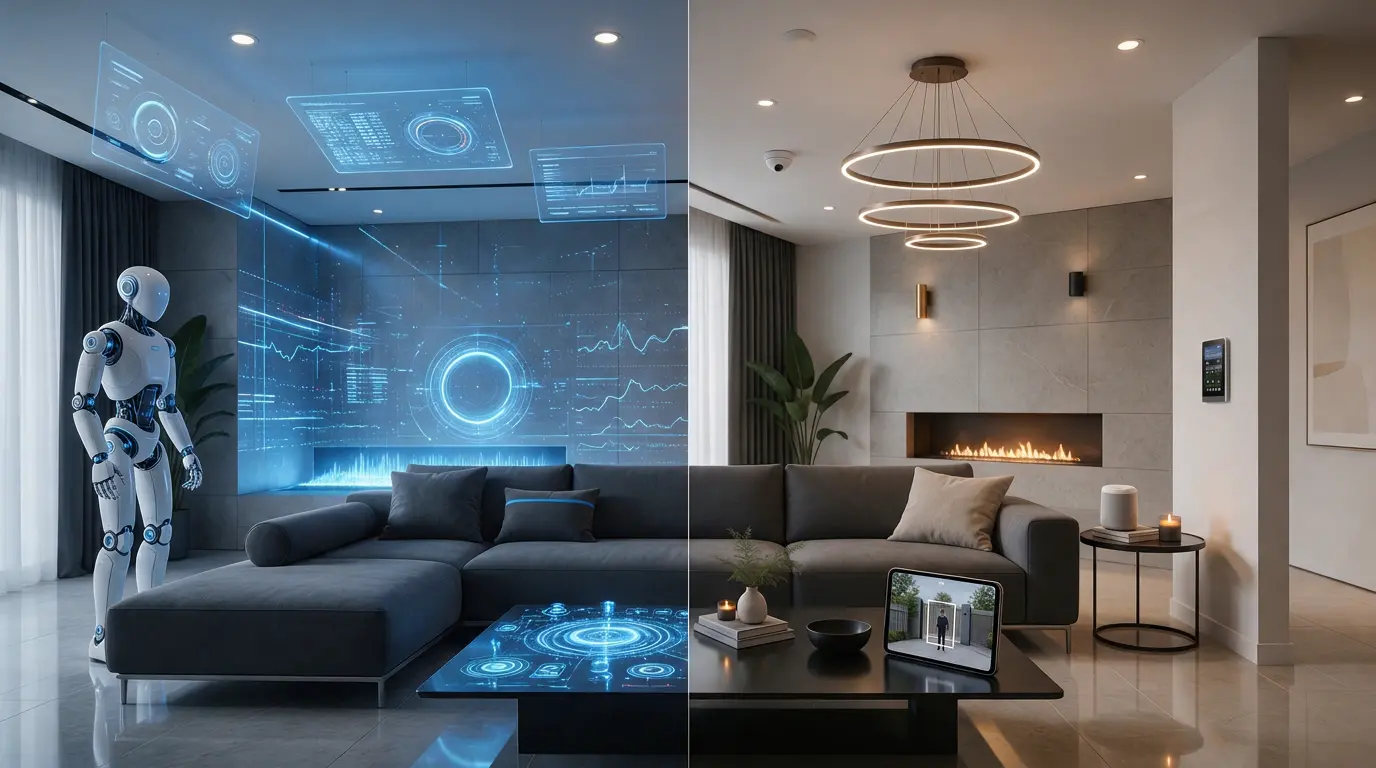
AI home automation in India is real in specific areas: AI cameras that tell people from pets and cars, voice control in English and Hindi, presence sensors that detect someone sitting still, and energy monitoring. A home that fully learns you without setup is still mostly hype. The “smart” feeling comes mainly from good design, sensors and programming.
The sample flat brochure said “AI-powered smart home”. The family moved in excited.
Three months later, the app has 42 buttons nobody understands. The motion sensor switches the study lights off while someone is reading. The camera sends twenty alerts a day for a swaying plant. And everyone has quietly gone back to the wall switches.
The technology wasn’t fake. It was just sold as magic, and installed without a plan.
AI is genuinely improving smart homes, but not in the way most advertisements suggest. This guide separates what works today from what is still marketing, so you can spend on the parts that actually make life easier.
Who is this guide for?
- Homeowners building or renovating who keep hearing “AI smart home”
- Villa and apartment buyers comparing builder smart home packages
- Families with existing smart devices that feel more annoying than helpful
- Architects and interior designers advising clients on automation
What is AI home automation?
AI home automation refers to smart home features that use machine learning or pattern recognition to detect, predict or respond to what is happening in a home, rather than following fixed rules only.
Most smart homes still run mainly on rules: “at sunset, turn on the facade lights” or “when the door unlocks, run the Welcome scene”. AI adds recognition and prediction on top, such as identifying a person on camera or understanding a spoken request. Both matter, but well-designed rules still do most of the everyday work.
What AI home automation is real today?
Several AI features are reliable and genuinely useful in Indian homes right now.
- AI cameras: detect people, vehicles and sometimes faces, so you get fewer false alerts from pets, shadows and trees.
- Voice control: natural commands in English and increasingly in Hindi through popular voice assistants.
- Presence sensors: newer sensors can detect someone sitting still, so lights don’t switch off while you read. Our lighting sensors guide explains the types.
- Energy monitoring: tracks consumption by circuit or appliance and highlights waste.
- Adaptive routines: schedules based on sunset, occupancy and time of day, such as an Evening scene that starts when it gets dark.
What is still mostly hype?
The biggest promises are usually the least reliable.
- A home that fully “learns” you with no setup. Some systems suggest routines, but useful automation still needs thoughtful configuration.
- AI replacing professional programming. Scenes, keypads and integrations still need someone to design them around your family.
- One app that controls every brand perfectly. Standards are improving, but mixing many brands still causes gaps.
- Fully autonomous security. AI cameras reduce false alerts, but they don’t replace good camera placement, recording and monitoring.
How do real and hyped features compare?
Real AI features solve one clear problem well. Hype promises to solve everything at once.
| Feature | What’s real today | What’s still hype |
|---|---|---|
| Cameras | Person and vehicle detection, smarter alerts | Predicting intruders before they act |
| Lighting | Presence-aware lights, sunset scenes | Lights that perfectly guess your mood |
| Voice | Reliable commands for lights, curtains, AC | Long, complex conversations with your home |
| Energy | Usage tracking and alerts | Fully automatic bill optimisation |
| Whole home | Scenes linking lights, curtains and AV | A home that runs itself with no setup |
At Brightmatic, we typically find that families are happiest with a few well-designed lighting scenes, good sensors and clear keypads. AI features work best as helpers on top of that foundation, not as a replacement for it.
How much do real AI features cost?
Most real AI features are affordable individually. The value comes from integrating them properly.
Indicative estimates only, not actual quotes.
| Feature | Indicative cost |
|---|---|
| AI-enabled security camera | Rs 4,000 – 15,000 per camera |
| Video door phone or doorbell with smart detection | Rs 8,000 – 25,000 |
| Presence sensor (wireless to KNX) | Rs 3,000 – 25,000 each |
| Energy monitoring system | Rs 5,000 – 40,000 |
| Voice assistant integration and programming | Rs 5,000 – 30,000 |
For complete systems, see our home automation cost guide.
Planning a smart home in Noida or Delhi NCR? We can show you which AI features suit your home and which ones you can skip.
Want an honest recommendation? Share your floor plan →
What about privacy?
AI features often process video, voice and usage data, so it matters where that data goes.
- Ask whether processing happens on the device or in the cloud.
- Prefer systems that work locally for core functions, like wired KNX, so lights and security keep working without internet.
- Change default passwords and keep firmware updated.
- India’s data protection rules are evolving. The Ministry of Electronics and Information Technology publishes updates on personal data protection.
Is AI home automation worth it?
- Is it expensive? Individual AI features are affordable. The cost is mostly in the system that ties them together.
- Is it complicated? It shouldn’t be. Good design hides complexity behind simple keypads and a few scenes.
- What can go wrong? Too many disconnected apps, sensors in the wrong places, cloud-only systems and false alerts.
What mistakes should you avoid?
- Buying gadgets for the “AI” label instead of a real need
- Mixing many brands with separate apps
- Placing sensors and cameras without a plan
- Relying only on voice or app control, with no wall keypads
- Choosing cloud-only systems for core lighting and security
- Skipping professional programming and handover
A common myth: a truly smart home needs AI everywhere. In reality, the homes that feel smartest are the ones where lighting, curtains and security simply respond the way the family expects.
Expert recommendation from Brightmatic
We recommend building on a reliable foundation first: wired or well-planned lighting control, labelled keypads, presence sensors and scenes. Then add AI where it clearly helps: smart-detection cameras and video door phones for security, voice control for convenience and energy monitoring for savings. Keep core functions working locally.
Brightmatic designs and installs home automation, lighting control and security systems, with partner brands like ABB, Core and Ajax.
Still unsure what’s worth it? Talk to our smart home expert. We’ll give you an honest recommendation, free.
Build a genuinely smart home with Brightmatic
Brightmatic designs and installs smart lighting, automation and security for homes and villas in Noida, Delhi NCR & across India.
Originally Published at: https://www.brightmatic.in/insights/ai-home-automation-india-real-vs-hype

 English
 Arabic
 Spanish
 Portuguese
 Deutsch
 Turkish
 Dutch
 Italiano
 Russian
 Romaian
 Portuguese (Brazil)
 Greek
