


Facility Management Market Evolution Transforming Workplace Operations, Smart Infrastructure, and Digital Maintenance Strategies Worldwide
Industry Overview and Workplace Modernization Dynamics
The global Facility Management Market has emerged as an indispensable strategic pillar of modern corporate real estate and industrial asset administration, enabling organizations to orchestrate complex physical and digital workplace operations with unprecedented precision. Valued at substantial multi-billion-dollar figures, the industry is projected to expand significantly over the coming decade at a robust compound annual growth rate. Enterprises across diverse commercial, healthcare, and educational sectors increasingly rely on integrated digital suites to automate space utilization, preventive maintenance scheduling, vendor management, and energy consumption tracking. Rather than juggling disconnected spreadsheets, paper work orders, and manual maintenance logs, modern facility directors now utilize centralized cloud environments that synchronize building automation systems with enterprise asset management pipelines.
Furthermore, the proliferation of hybrid workforces and distributed corporate real estate portfolios has permanently elevated flexible workspace management, compelling software vendors to embed high-definition occupancy sensors, interactive floor mapping, and employee wellness tracking directly into their core platforms.
Core Functional Capabilities Driving Enterprise Adoption
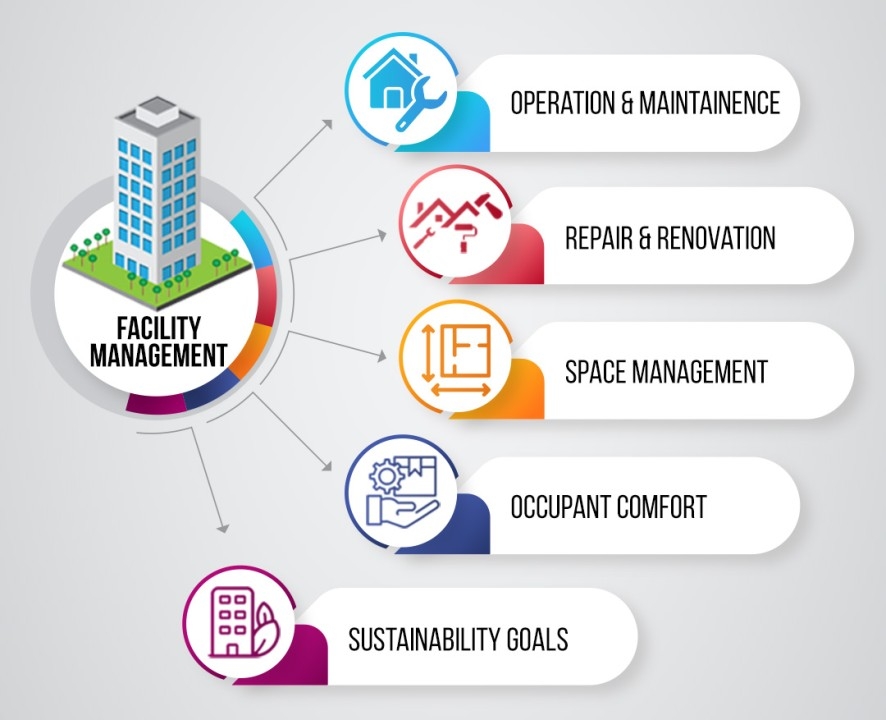
Modern facility management ecosystems consolidate numerous operational workflows into unified, user-friendly interfaces designed for both administrative leadership and frontline maintenance technicians. At the strategic planning stage, space management and workplace utilization modules facilitate dynamic workstation booking, portfolio optimization, and hybrid seating allocations that minimize excess square footage overhead. During daily execution, computerized maintenance management systems empower technicians with mobile work orders, digital equipment manuals, barcode asset scanning, and instant parts-requisition capabilities directly from rugged handheld devices. Preventive maintenance modules—which capture substantial operational revenue—streamline scheduled equipment servicing, calibration routines, and regulatory safety inspections across commercial office towers and industrial manufacturing plants alike.
Simultaneously, integrated vendor and procurement portals support contractor bidding, service-level agreement tracking, and automated invoice verification while maintaining strict compliance with international building codes and financial regulations. For corporate real estate executives managing dozens of regional facilities alongside flagship global headquarters, multi-building portfolio dashboards ensure consistent brand governance, occupant safety, and centralized budget oversight. By eliminating repetitive manual data entry and reducing human error across logistical touchpoints, these comprehensive capabilities allow facility teams to redirect their energy toward curating sustainable, high-performance environments.
Deployment Architectures and Organizational Scalability
The architectural landscape of facility technology is overwhelmingly dominated by cloud-based Software-as-the-Service models, which capture the vast majority of industry adoption. Cloud deployment allows distributed facility managers, external contractors, and corporate real estate executives to collaborate in real time from any internet-connected device without investing in dedicated on-premise server infrastructure. Moreover, elastic cloud computing effortlessly absorbs sudden data surges from thousands of Internet of Things sensors deployed across smart buildings, guaranteeing uninterrupted system availability and real-time anomaly detection.
While large multinational corporations utilize enterprise-tier cloud subscriptions to manage intricate compliance protocols and custom enterprise resource planning integrations, small and medium-sized enterprises account for a major share of license volume due to accessible freemium tiers and flexible per-square-foot pricing structures. Conversely, on-premise deployments remain vital for government agencies, military installations, and high-security research laboratories bound by stringent data-sovereignty and internal firewall mandates. Across both deployment paradigms, robust cybersecurity frameworks featuring end-to-end encryption, role-based access controls, and compliance certifications have become non-negotiable prerequisites. This architectural versatility ensures that organizations of every scale can deploy secure, tailored facility infrastructure aligned with their operational budgets.
Regional Adoption Patterns and Sectoral Demand
Geographic expansion across the global facility management landscape reflects varying levels of digital maturity, real-estate capitalization, and infrastructure modernization. North America maintains a commanding leadership position, underpinned by early cloud adoption, dense concentrations of multinational corporate headquarters, and an entrenched culture of outsourced property services. Europe represents another mature hub, capturing a substantial proportion of global revenue as facility directors prioritize stringent carbon-reduction mandates, energy efficiency directives, and circular economy building practices.
Meanwhile, Asia-Pacific is emerging as the fastest-growing regional market, propelled by rapid urbanization, massive commercial construction, and government-backed smart-city initiatives across China, India, Japan, and Singapore. Similarly, the Middle East and Africa region is experiencing accelerated momentum, propelled by ambitious national economic diversification programs, mega-project developments, and high-end tourism infrastructure investments. Across end-user verticals, commercial office buildings generate a major share of total revenue, while healthcare facilities and educational institutions represent fast-growing verticals driven by strict sanitation standards and energy retrofitting programs.
Competitive Ecosystem and Strategic Outlook
Competition among leading facility management providers has intensified as buyers increasingly favor unified end-to-end platforms over fragmented point solutions. Established industry pioneers—such as Sodexo, Aramark, CBRE Group, ISS A/S, JLL, and Mitie—continually enhance their service ecosystems through artificial intelligence integration, strategic technology acquisitions, and deep IoT sensor interoperability. Vendors are actively embedding generative AI analytics copilots that predict equipment failures weeks before occurrence, optimize cleaning schedules based on real-time foot traffic, and deliver hyper-personalized workplace comfort recommendations to individual occupants.
➤ Featured Insights from Market Research Future:
Biometric Data Encryption Device Market

 English
 Arabic
 French
 Spanish
 Portuguese
 Turkish
 Dutch
 Italiano
 Russian
 Romaian
 Portuguese (Brazil)
 Greek