


Accessibility Consultant UAE: Transforming Spaces for Everyone
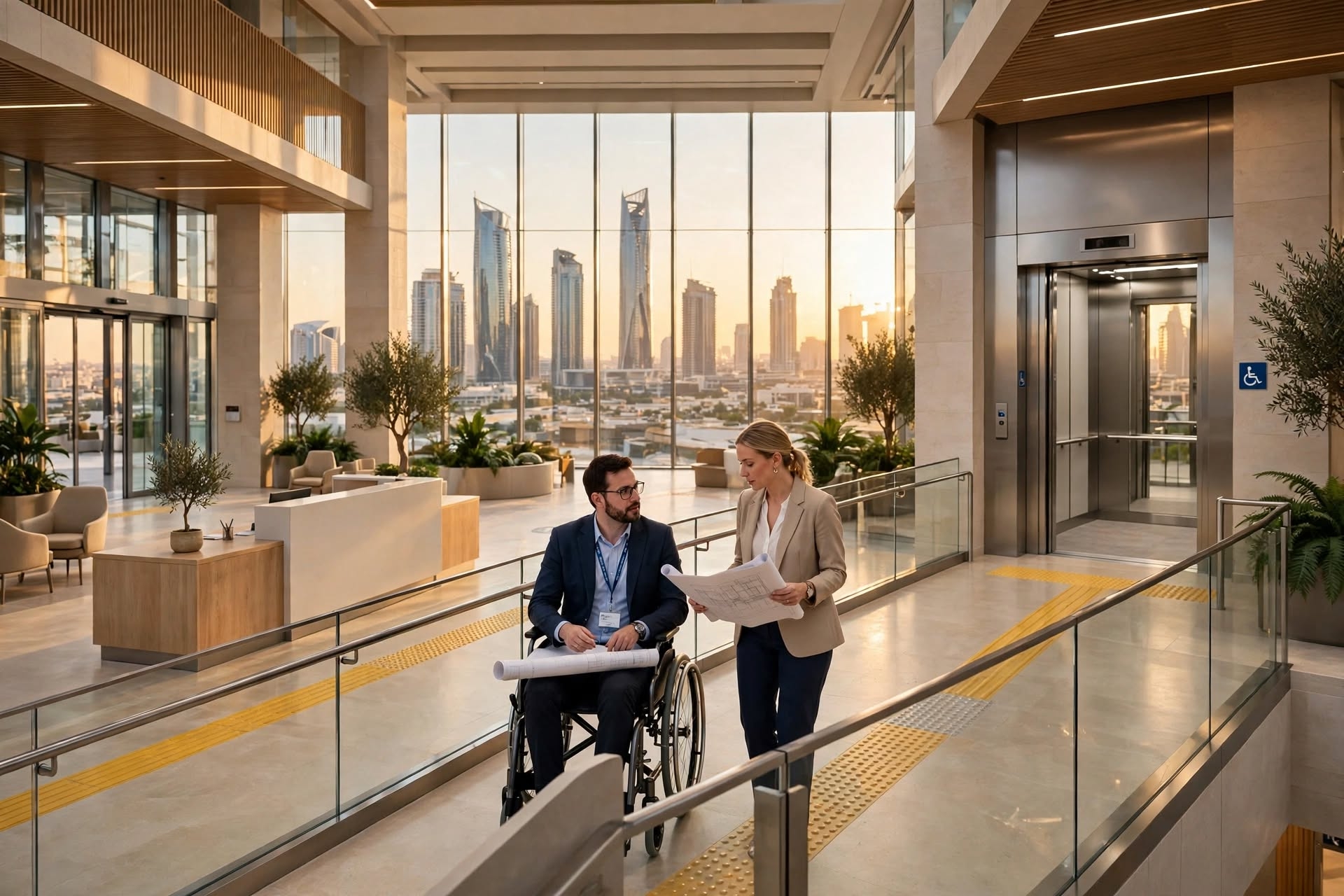
The right accessibility consultant UAE project teams hire can protect your budget and programme, but only if their experience matches your emirate, stage and building type. That makes the questions you ask before hiring more important than any brochure. Here are four, along with the facts you need to judge the answers.
Do They Know Your Emirate's Requirements?
Start with geography. In Dubai, the Dubai Universal Design Code has applied to all newly authorised public and private projects since 2017, enforced by Dubai Municipality and the RTA. Existing buildings may instead need to prepare for Dubai Municipality's Wosool accessibility assessment, and a Dubai Health Authority checklist from June 2025 covers new and relocated hospitals, day surgery centres and outpatient clinics.
Abu Dhabi works differently. Master plans, public spaces and buildings are guided through the Sahel rating system, from design submission to construction audit. Above both sit Federal Law No. 29 of 2006 and emirate-level codes, which place clear obligations on owners and designers.
Ask how the consultant handles both emirates and where local code stops. ISO 21542:2021, BS 8300 and the US ADA Standards often fill the gaps, especially for global hotel and retail brands, so a strong consultant maps them against local code and applies the stricter rule.
Can They Step In at Your Stage?
Vortex Access steps in from masterplan and concept through to operational buildings, across residential, retail, hospitality, healthcare, education and transport projects. Match that range to your stage:
-
Design reviews check drawings against the Dubai Universal Design Code, Abu Dhabi requirements and international standards, catching issues while they are still cheap to fix
-
Audits inspect existing buildings, follow the full user journey from drop-off to washroom and end in a ranked action plan your team can budget for
-
Training gives designers, facility managers and frontline staff the habits to serve People of Determination every day
Timing affects cost directly. Adding a ramp, lift or accessible washroom after handover costs far more than drawing it in at concept stage, so an UAE accessibility consultant owners bring in early protects budget and programme. Dubai Metro shows the range: accessibility and universal design input covered the passenger journey from station entry to emergency egress.
Will the Findings Hold Up at Approval?
Authority sign-off depends on evidence, not good intentions. Code-referenced drawings and clear reports mean fewer comments from Dubai Municipality or the Department of Municipalities and Transport, and fewer resubmissions. Look for a report that gives you:
-
The clause each finding fails
-
A ranking by risk and cost, so urgent fixes come first
-
A practical checklist mapped to your drawings
A UAE audit should follow a visitor's full route through parking, entrances, ramps and lifts, washrooms, wayfinding and emergency exits. If a sample report only lists general observations, expect more questions from the authority later.
Dignity is part of the test. A wheelchair user, a parent with a pram and an older visitor with low vision should all arrive, move around and leave without needing to ask for help.
Can They Prepare You for Certification?
Some projects carry a certification target alongside local approvals. Vortex Access undertakes certification readiness reviews to assess whether a design, completed development or existing facility is prepared for accessibility certification, authority review or project-specific approval. For owners planning RHFAC certification readiness work, this is the review to ask about.
A typical review covers the applicable requirements, a desktop review of drawings and documents, a site readiness review where applicable, missing evidence, non-compliances and approval risks, and practical recommendations before formal submission. It also checks routes, entrances, parking, toilets, vertical circulation, signage, wayfinding, service areas, emergency provisions and documentation.
The payoff is better submission quality, less late-stage redesign, gaps addressed before formal review and stronger confidence. For projects aiming at it, RHFAC certification readiness belongs in the brief from the start, not as a late add-on.
Finally, check credentials. Vortex Access lists Rick Hansen Foundation Accessibility Certification, ISO 9001, IAAP CPACC and IAAP Professional Member among its accreditations, with offices in Dubai and Abu Dhabi. Any accessibility consultant UAE clients shortlist should be able to show credentials like these.
Conclusion
A strong consultant knows your emirate, fits your project stage, writes findings an authority can follow and prepares you for any certification target. Use the four questions above to compare providers, and ask each how they would handle RHFAC certification readiness alongside your local approvals. If you would like a second opinion, the Vortex Access team is happy to talk it through.
FAQs
1. When should a UAE project bring in a specialist?
At the concept or masterplan stage, before layouts are fixed, because Wosool and Sahel both check accessibility from the design stage.
2. Is the Dubai Universal Design Code mandatory?
Yes. Since 2017, it has applied to all newly authorised public and private projects in Dubai.
3. Do we need a design review or an audit?
A design review checks drawings, so it suits new builds and refurbishments. An audit inspects a finished building, so it suits Wosool assessments, acquisitions and fit-outs. Many projects need both.
4. Which standards apply beyond local codes?
ISO 21542:2021, BS 8300 and the US ADA Standards often fill the gaps, especially for global hotel and retail brands.

 Arabic
 French
 Spanish
 Portuguese
 Deutsch
 Turkish
 Dutch
 Italiano
 Russian
 Romaian
 Portuguese (Brazil)
 Greek
