


Business Formation Attorney Arlington, VA: Choosing the Right Business Structure in 2027
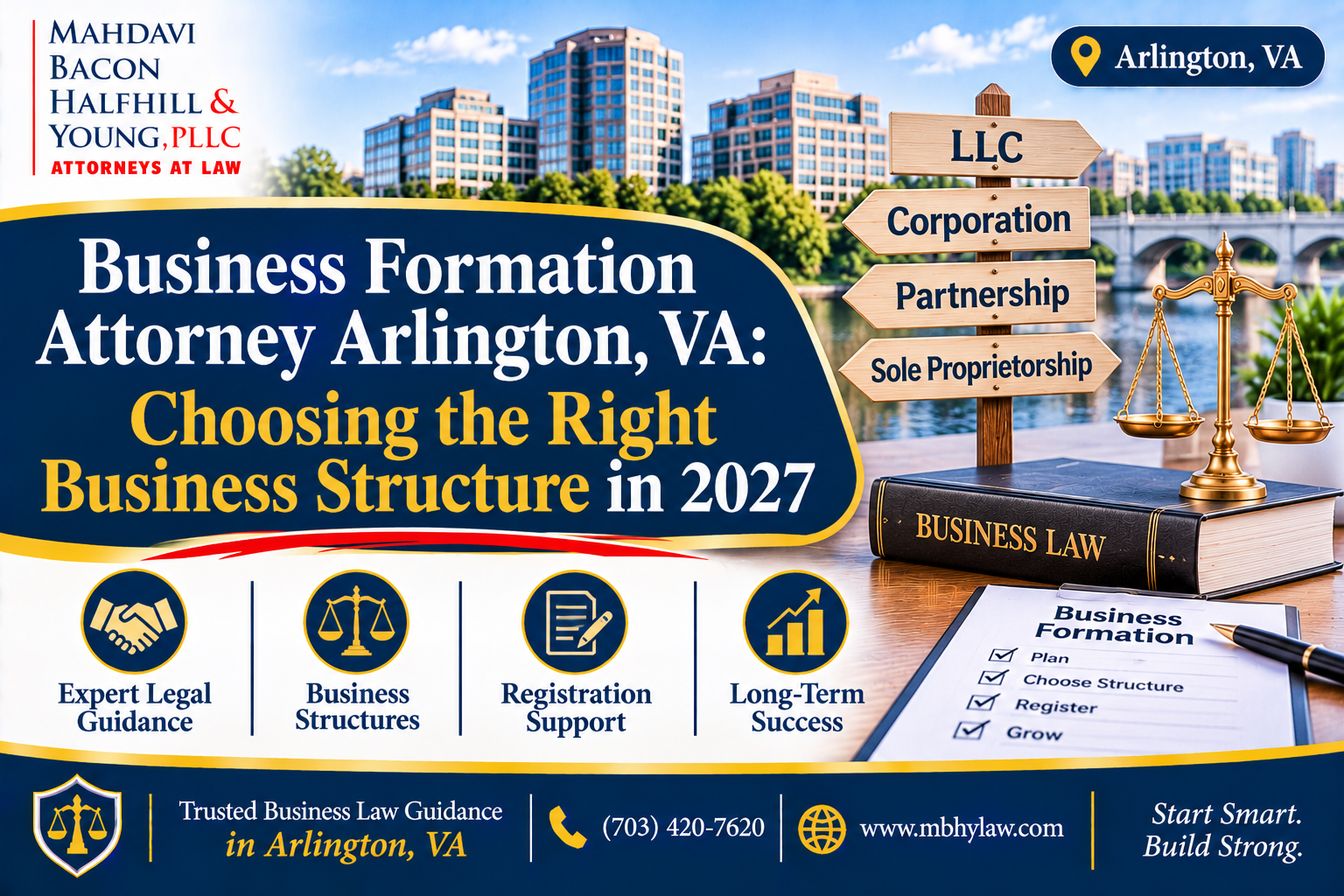
Starting a business in Arlington, Virginia, involves several important decisions. Entrepreneurs must develop a business plan, identify their customers, arrange financing, and decide how the company will operate. One of the earliest legal decisions is selecting the right business structure.
The structure you choose can affect ownership, management, personal liability, taxation, recordkeeping, and the ability to attract investors. A decision that works for a solo consultant may not be appropriate for a growing technology company with several founders or a business planning to raise outside capital.
For entrepreneurs preparing to launch a company in 2027, a Business Formation Attorney in Arlington, VA can clarify available structures and the legal steps involved in establishing a business.
This guide explains common business structures, key considerations, and practical registration issues for companies planning to operate in Arlington County.
1. Why Does Your Business Structure Matter?
A business structure determines how a company is legally organized and how ownership and management responsibilities are arranged.
It may influence:
-
The personal liability of owners.
-
How business decisions are made.
-
How profits and losses are allocated.
-
Federal and state tax treatment.
-
Recordkeeping and filing obligations.
-
The ability to bring in investors.
-
Procedures for transferring ownership.
-
What happens when an owner leaves the business?
Choosing a structure should involve more than selecting the option with the simplest filing process. Business owners should consider their expected operations, financial arrangements, risk exposure, and long-term goals.
For example, a single-person consulting business may have different needs from a company with three founders, employees, intellectual property, and plans to seek investment.
2. What Business Structures Are Available in Virginia?
Virginia recognizes several common business structures. The appropriate choice depends on the company's circumstances and applicable legal and tax requirements.
Sole Proprietorship
A sole proprietorship is generally an unincorporated business owned by one individual.
It can be relatively simple to establish, but the business and owner are generally not separate legal entities for liability purposes. The owner may be personally responsible for business debts and obligations.
This structure may suit certain low-complexity businesses, but entrepreneurs should consider the risks before operating without a separate entity.
General Partnership
A general partnership typically involves two or more people carrying on a business together.
Partners may share profits, responsibilities, and management authority. Depending on the applicable law and circumstances, general partners may have personal liability for partnership obligations.
A written partnership agreement is important because it can establish ownership percentages, capital contributions, management authority, profit allocation, and procedures for resolving disputes.
Limited Liability Company (LLC)
An LLC is a separate legal entity formed under state law. It is owned by members and may be managed by its members or by appointed managers.
Virginia's State Corporation Commission explains that an LLC is generally structured so that members and managers are not personally liable for the company's obligations solely because of their status as members or managers, subject to applicable law and circumstances.
Potential advantages include:
-
Flexible management arrangements.
-
A separate legal identity.
-
An operating agreement to establish internal rules.
-
Ownership arrangements that can accommodate one or more members.
-
Tax classification options subject to applicable federal and state rules.
An LLC may be appropriate for consultants, professional service businesses where permitted, family-owned companies, and many small or growing businesses.
However, an LLC does not automatically protect an owner from personal guarantees, their own wrongful conduct, or every possible business liability.
Corporation
A corporation is a separate legal entity with a more formal governance structure.
A stock corporation generally has shareholders, a board of directors, and officers responsible for management and operations.
Potential benefits may include:
-
A formal ownership structure.
-
The ability to issue shares.
-
Established governance procedures.
-
A structure that may be suitable for certain investment plans.
-
Continuity that is not necessarily dependent on one owner's participation.
Corporations also involve formal organizational and recordkeeping requirements. Owners should consider whether the additional governance responsibilities fit their business plans.
Limited Partnership
A limited partnership generally includes at least one general partner and one limited partner.
The general partner typically manages the business and may have personal liability for partnership obligations, while limited partners generally have liability protection subject to applicable law and their role in the business.
This structure may be relevant for certain investment or ownership arrangements, but it requires careful legal and tax planning.
3. LLC vs. Corporation: Which Structure Is Better for Your Arlington Business?
Entrepreneurs often compare an LLC with a corporation because both provide a separate legal entity and can offer liability protection under applicable law.
The choice should depend on how the business will be owned, financed, managed, and operated.
|
Consideration |
LLC |
Corporation |
|
Ownership |
Members |
Shareholders |
|
Management |
Member-managed or manager-managed |
Board and officers |
|
Governing documents |
Operating agreement |
Articles, bylaws, and corporate records |
|
Ownership interests |
Membership interests |
Shares of stock |
|
Formalities |
Generally flexible, subject to law |
More formal governance requirements |
|
Investment planning |
Can accommodate investment, depending on structure |
Often suitable for share-based investment arrangements |
|
Tax treatment |
Depends on classification and elections |
Depends on corporate tax classification and elections |
An LLC may appeal to owners who want flexible management and internal arrangements. A corporation may be more suitable for companies that anticipate issuing shares or adopting a formal board structure.
Tax consequences should be evaluated separately. An LLC's default federal tax classification may differ depending on the number of members, and eligible entities may make certain elections. A corporation may be taxed under different federal rules depending on its classification and eligibility.
A business attorney and tax professional can help evaluate the legal and financial implications before formation.
4. What Should You Consider Before Choosing a Business Structure?
Before registering a business in Arlington, consider the following questions.
How Many Owners Will the Business Have?
A solo founder may have different needs from a company with multiple partners. When there are several owners, the formation documents and internal agreements should clearly address ownership and management.
Will You Seek Outside Investment?
If the company expects to bring in investors, its ownership structure and governance documents should support the intended financing arrangements.
What Risks Does the Business Face?
Businesses operating in construction, technology, consulting, retail, and professional services may face different contractual and operational risks.
A separate entity may provide certain liability protections, but insurance, compliance, proper documentation, and responsible business practices remain important.
How Will Management Decisions Be Made?
Founders should decide who has authority to sign contracts, hire employees, approve major expenses, borrow money, and make strategic decisions.
What Are Your Long-Term Plans?
If you expect to sell the company, transfer ownership, bring in partners, or pass the business to family members, those plans should influence the initial structure.
5. What Are the Steps to Form a Business in Arlington, VA?
Business formation involves state-level and local requirements. The steps vary depending on the entity type and business activities.
Step 1: Choose a Business Name
Select a name that complies with Virginia's naming rules and check its availability through the State Corporation Commission.
If the business will operate under a different trade or assumed name, determine whether an additional filing is required.
Step 2: Select a Business Structure
Decide whether the company will operate as an LLC, corporation, partnership, or another permitted structure.
Consider ownership, liability, taxation, management, and future growth plans before filing.
Step 3: Identify a Registered Agent
Virginia entities that require a registered agent must designate an eligible person or business to receive official notices and service of process.
The registered agent must satisfy the applicable Virginia requirements.
Step 4: File Formation Documents With the Virginia SCC
An LLC generally files Articles of Organization. A corporation generally files Articles of Incorporation.
The Virginia State Corporation Commission provides online filing resources through its Clerk's Information System.
Visit the Virginia SCC – Start a New Business page for current registration instructions and filing information.
Step 5: Prepare Internal Governing Documents
After formation, prepare the documents needed to establish how the business will operate.
Depending on the structure, these may include:
-
LLC operating agreement.
-
Partnership agreement.
-
Corporate bylaws.
-
Initial resolutions.
-
Shareholder agreements.
-
Ownership and contribution records.
These documents can clarify responsibilities and reduce the risk of future misunderstandings.
Step 6: Obtain a Federal Employer Identification Number
Many businesses need an Employer Identification Number (EIN) from the IRS for tax administration, banking, and employment-related purposes.
Whether an EIN is required depends on the entity and its activities. Business owners should review current IRS guidance.
Step 7: Review Arlington County Licensing and Local Requirements
Registering an entity with Virginia does not automatically satisfy every local requirement.
Arlington County explains that new businesses may need to complete state registration, obtain an EIN, secure zoning or occupancy approvals, and apply for a local business license.
The County currently states that businesses operating in or from Arlington generally must register and obtain a business license within 75 days of starting operations. Businesses should confirm the applicable deadline and annual filing requirements for 2027 directly with the County.
Review Arlington County's New Business Resources before beginning operations.
6. Why Arlington Businesses Should Review Zoning, Permits, and Licensing
Choosing an entity and registering it with the SCC is only part of starting a business.
The proposed business activity and physical location may trigger separate local requirements.
For example:
-
A retail location may need appropriate occupancy approval.
-
A home-based business may need to comply with applicable home occupation rules.
-
A restaurant or food business may need health-related approvals.
-
A contractor may need state and local registrations or permits.
-
A business serving alcoholic beverages may require relevant alcohol licensing.
Arlington County directs new businesses to review applicable permits through its Department of Community Planning, Housing and Development before applying for a business license.
Entrepreneurs should evaluate the proposed location and business activity early. Signing a lease before confirming that the intended use is permitted can create avoidable complications.
7. Why an Operating Agreement or Shareholder Agreement Matters
Filing formation documents creates the legal entity, but it does not necessarily answer every question about how the owners will work together.
An LLC operating agreement can establish:
-
Each member's ownership interest.
-
Initial and future capital contributions.
-
Management authority.
-
Voting procedures.
-
Profit and loss allocations.
-
Transfer restrictions.
-
Buyout rights.
-
Procedures for resolving disputes.
-
Dissolution and winding-up arrangements.
Corporations may use bylaws and shareholder agreements to address governance, share transfers, voting rights, and other ownership matters.
Consider an Arlington startup with two founders who contribute different amounts of capital and perform different roles. Without a written agreement, disagreements may arise over compensation, decision-making, ownership, and future investment.
Written governing documents can help establish expectations before a disagreement develops.
8. Common Business Formation Mistakes to Avoid
Entrepreneurs sometimes focus on filing quickly without considering the legal arrangements needed to operate the company.
Common mistakes include:
-
Choosing an entity without evaluating business goals.
-
Using a business name without checking availability.
-
Failing to designate an eligible registered agent.
-
Operating without appropriate governing documents.
-
Ignoring ownership and management responsibilities.
-
Assuming state registration replaces local licensing.
-
Signing a commercial lease before reviewing permitted use.
-
Mixing personal and company finances.
-
Overlooking industry-specific permits.
-
Failing to track annual registration and tax obligations.
A careful formation process can help reduce these risks and establish a stronger foundation for future operations.
9. How a Business Formation Attorney in Arlington, VA Can Help
A business formation attorney can help entrepreneurs evaluate legal structures and prepare the documents needed to establish and organize a company.
Depending on the business and engagement, legal assistance may include:
Entity selection: Evaluating the legal implications of an LLC, corporation, partnership, or other structure.
Formation documents: Preparing and reviewing applicable organizational filings.
Operating and ownership agreements: Drafting documents that define management authority, ownership rights, and internal procedures.
Contract planning: Reviewing founder agreements, service contracts, vendor arrangements, and other important business documents.
Regulatory considerations: Identifying state and local licensing, registration, and compliance questions that should be addressed.
Growth and succession planning: Helping owners consider future investment, ownership transfers, acquisitions, or business sales.
Legal counsel can also coordinate with tax and accounting professionals when business structure decisions have financial implications.
10. Business Formation and Corporate Legal Services at MBHY Law
Mahdavi, Bacon, Halfhill & Young, PLLC (MBHY Law) provides business law and corporate legal services to businesses throughout the Washington metropolitan area, regionally, and nationally.
The firm's business law practice describes experience with business formation, incorporations, LLCs, partnerships, contracts and agreements, business litigation, purchase agreements, and planning for different stages of a company's life cycle.
For entrepreneurs planning to establish a business in Arlington, MBHY Law's Business Law and Corporate Attorney practice provides further information about its business-related legal services.
You can also visit the MBHY Law homepage to learn more about the firm.
Selecting a business structure is an important decision, but it is only the beginning. A well-planned formation process should also address ownership, management, contracts, local requirements, and the company's long-term objectives.
FAQs
What is the best business structure for a startup in Arlington, VA?
There is no single best structure for every startup. An LLC may offer management flexibility, while a corporation may be appropriate for a company planning to issue shares or seek certain types of investment. The right choice depends on ownership, liability, tax, and business goals.
How do I register an LLC in Virginia?
A Virginia LLC generally files Articles of Organization with the State Corporation Commission, designates an eligible registered agent, and completes other applicable organizational and local requirements.
Is an LLC better than a corporation?
Not necessarily. LLCs and corporations have different management, ownership, governance, and tax considerations. Entrepreneurs should evaluate the company's plans before choosing.
Do I need an Arlington County business license after forming an LLC?
State entity registration does not replace local licensing. Arlington County currently requires businesses operating in or from the County to register and obtain a business license within its applicable timeframe. Verify the current requirements directly with the County.
Do I need an operating agreement for my Virginia LLC?
An operating agreement is an important document for establishing the LLC's internal rules, ownership rights, management procedures, and transfer provisions. Even when a particular filing is not required, a written agreement can help prevent misunderstandings.
Can a business formation attorney help me choose between an LLC and corporation?
Yes. An attorney can explain legal differences, review ownership and management plans, prepare formation documents, and help identify issues to discuss with a tax professional.
Can I start a business in Arlington from my home?
Some businesses may operate from a residence, but home-based operations must comply with applicable zoning, licensing, and other requirements. Check Arlington County's current home occupation and business licensing rules before beginning operations.
Final Thoughts
Choosing the right business structure is one of the most important steps in launching a company in Arlington, Virginia. An LLC, corporation, partnership, or sole proprietorship may each serve different business objectives, but the decision should account for ownership, management, liability, taxes, and future growth.
Entrepreneurs preparing for 2027 should review Virginia registration requirements, Arlington County licensing and zoning rules, and the agreements needed to establish clear business relationships.
For assistance with entity formation, corporate documents, business agreements, and other legal matters, explore MBHY Law's Business Law and Corporate Attorney services.
New Client Inquiries: (703) 420-7620

 English
 Arabic
 French
 Spanish
 Deutsch
 Turkish
 Dutch
 Italiano
 Russian
 Romaian
 Portuguese (Brazil)
 Greek
