


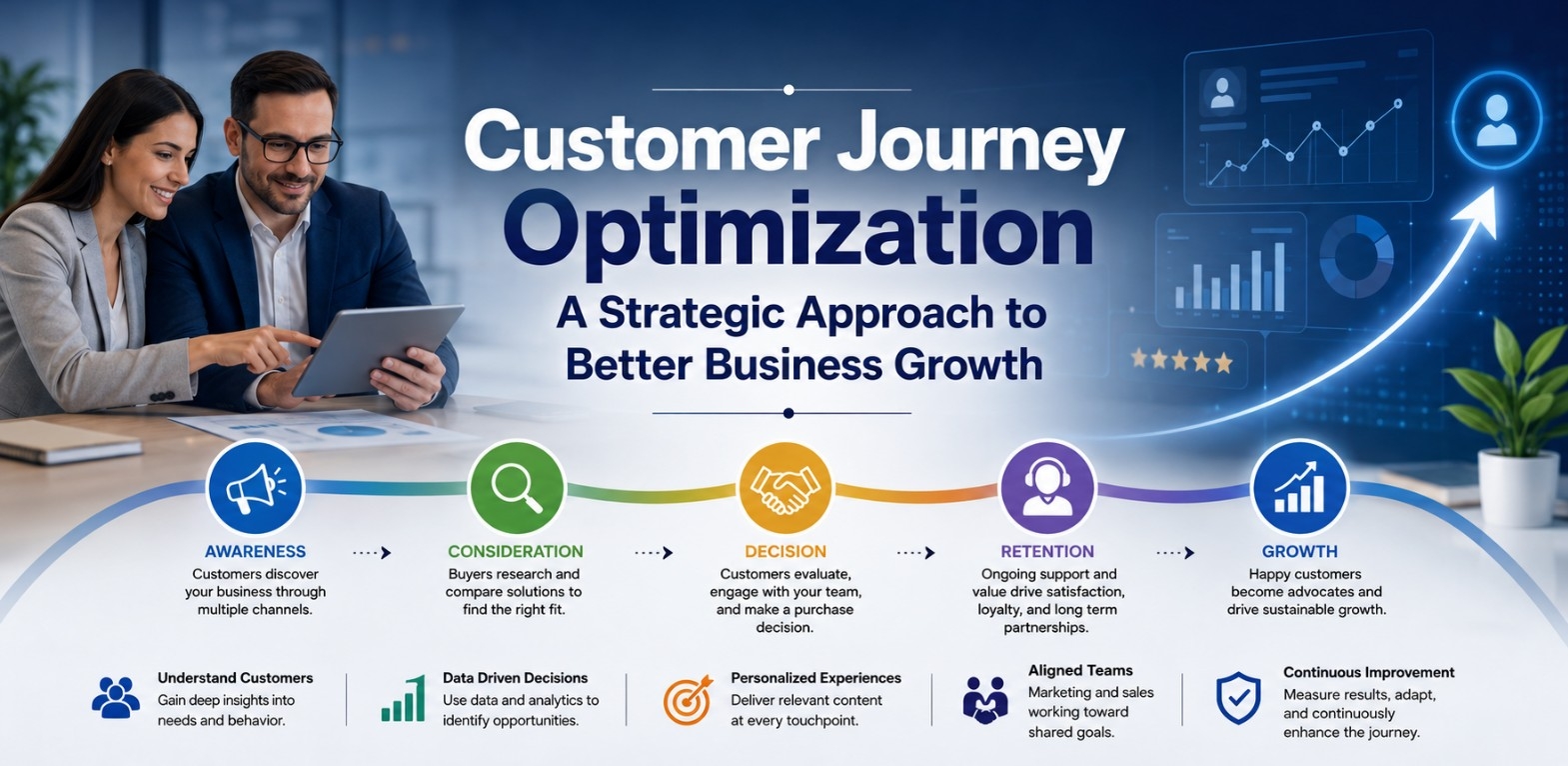
Customer Journey Optimization A Strategic Approach to Better Business Growth
In today's competitive business landscape, attracting new customers is only one part of the growth equation. Long term success depends on how effectively businesses guide prospects through every interaction, from the first point of awareness to post purchase engagement. This is where customer journey optimization becomes a powerful strategy for organizations that want to improve customer satisfaction, increase conversions, and build lasting relationships.
For companies, buying decisions are rarely made instantly. Multiple stakeholders, detailed research, and longer sales cycles make every touchpoint important. By understanding and improving the customer journey, businesses can create more meaningful experiences that encourage trust and drive measurable results.
Understanding Customer Journey Optimization
Customer journey optimization is the process of analyzing, improving, and personalizing every stage of a customer's interaction with a business. The goal is to remove friction, deliver relevant experiences, and ensure that customers receive value at every step.
Instead of focusing only on the final sale, this approach considers the complete experience. Every interaction, whether it involves a website visit, an email, a sales conversation, or customer support, contributes to the overall perception of the brand.
Organizations that optimize the customer journey are better equipped to understand customer expectations and respond with solutions that align with their needs.
Why It Matters for Organizations
The modern buyer expects a seamless and personalized experience. Decision makers conduct extensive research before contacting a sales team, making digital experiences more influential than ever.
An optimized customer journey helps businesses achieve several important objectives:
-
Improve lead quality by delivering relevant information at the right time.
-
Increase conversion rates through smoother buying experiences.
-
Strengthen customer relationships with consistent communication.
-
Encourage customer retention and repeat business.
-
Generate valuable insights for continuous improvement.
When every stage of the journey is aligned with customer expectations, businesses create stronger connections that translate into higher revenue and long term loyalty.
Key Stages of the Customer Journey
Understanding each phase of the customer journey is essential before making improvements.
Awareness
Potential customers first discover a business through search engines, industry publications, referrals, social platforms, or marketing campaigns. At this stage, educational and informative content helps establish credibility and attract qualified prospects.
Consideration
Once buyers identify a potential solution, they begin comparing providers. They evaluate expertise, industry knowledge, customer success stories, and product capabilities. Businesses that provide clear information and address customer concerns build confidence during this stage.
Decision
The decision stage involves final evaluations, product demonstrations, pricing discussions, and negotiations. A responsive sales process combined with transparent communication can significantly improve conversion rates.
Retention
Customer journey optimization does not end after the purchase. Successful onboarding, responsive support, regular communication, and ongoing value creation encourage customer satisfaction and long term partnerships.
Strategies for Effective Customer Journey Optimization
Successful optimization requires more than implementing new technology. It demands a customer focused strategy supported by accurate data and continuous improvement.
Create Detailed Customer Personas
Understanding your target audience is the foundation of an effective customer journey. Develop detailed customer personas based on industry, company size, business goals, pain points, and buying behavior.
These insights allow marketing and sales teams to deliver relevant messaging throughout every stage of the journey.
Map Every Customer Touchpoint
Document every interaction customers have with your business. This includes your website, email campaigns, social media presence, sales conversations, customer support, webinars, and onboarding processes.
Identifying gaps or unnecessary complexity helps businesses remove obstacles that could prevent conversions.
Use Data to Drive Decisions
Customer journey optimization should be guided by measurable insights rather than assumptions. Analyze website behavior, customer feedback, conversion metrics, and engagement patterns to identify opportunities for improvement.
Performance data enables businesses to make informed decisions and prioritize changes that deliver meaningful business outcomes.
Deliver Personalized Experiences
Personalization has become an expectation rather than a competitive advantage. Customers respond positively when businesses provide relevant recommendations, tailored content, and communication that reflects their specific needs.
Even simple personalization efforts can improve engagement and strengthen customer relationships.
Align Sales and Marketing Teams
One of the most common challenges in organizations is the disconnect between marketing and sales. Customer journey optimization requires both teams to work toward shared objectives.
Consistent messaging, shared customer insights, and collaborative planning ensure prospects experience a smooth transition throughout the buying process.
Measuring Success
Optimization is an ongoing process rather than a one time initiative. Businesses should regularly evaluate performance using meaningful metrics such as customer satisfaction, conversion rates, lead quality, customer retention, average sales cycle length, and customer lifetime value.
Regular reviews help organizations identify emerging trends, adapt to changing customer expectations, and continuously improve the customer experience.
Common Challenges
Many businesses struggle with fragmented customer data, inconsistent communication across channels, and limited visibility into customer behavior. Internal silos may also prevent teams from sharing valuable insights.
Addressing these challenges requires leadership commitment, integrated technology, and a culture that prioritizes customer experience across every department.
Organizations that invest in collaboration and continuous improvement often achieve stronger business performance and greater customer loyalty over time.
Conclusion
Customer journey optimization has become an essential business strategy for organizations seeking sustainable growth in today's competitive marketplace. Every interaction shapes customer perception, influences purchasing decisions, and affects long term loyalty.
By understanding customer behavior, mapping every touchpoint, leveraging data, and delivering personalized experiences, businesses can create seamless journeys that benefit both customers and the organization. Rather than focusing solely on acquiring new clients, successful companies invest in building meaningful experiences that generate trust, strengthen relationships, and create lasting business value.
Frequently Asked Questions
What is customer journey optimization?
Customer journey optimization is the process of improving every interaction a customer has with a business to create a smoother, more personalized, and more effective experience that increases satisfaction and conversions.
Why is customer journey optimization important for companies?
Buying decisions often involve multiple stakeholders and longer sales cycles. Optimizing the customer journey helps businesses build trust, improve engagement, and increase the likelihood of successful conversions.
What tools can support customer journey optimization?
Businesses commonly use customer relationship management platforms, marketing automation software, analytics tools, customer feedback systems, and data visualization platforms to better understand and improve customer interactions.
How often should businesses review their customer journey?
Customer journeys should be reviewed regularly. Quarterly assessments, combined with ongoing performance monitoring, help businesses identify changing customer expectations and continuously improve the overall experience.

 English
 French
 Spanish
 Portuguese
 Deutsch
 Turkish
 Dutch
Dutch
 Italiano
 Russian
 Romaian
 Portuguese (Brazil)
 Greek
Greek
