


How to Choose a Reliable Security Guard Agency in India: A Practical Guide for Businesses
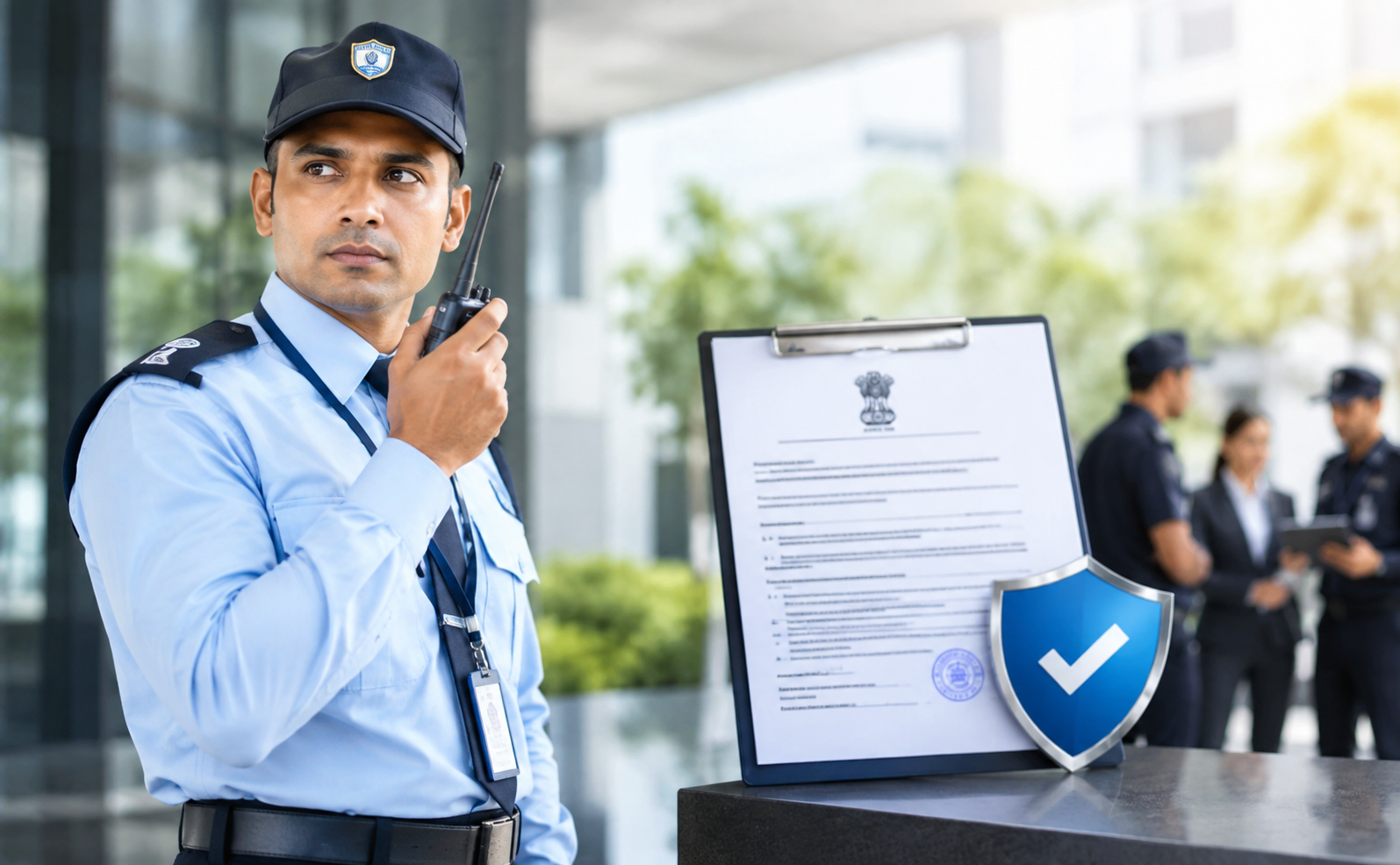
Hiring security guards is often treated as a routine administrative decision. In reality, choosing the right security agency can affect the safety of employees, visitors, customers, property, equipment and sensitive information.
A professional security guard is not simply someone standing at an entrance. A properly managed security team should understand access control, visitor management, incident reporting, emergency response and the specific risks associated with the site it protects.
For that reason, businesses should evaluate the security agency behind the guards, not just the number of personnel offered or the quoted monthly rate.
One of the first things to examine is whether the agency is operating under the regulatory framework applicable to private security services in India.
Understanding the Role of PSARA in Private Security
The Private Security Agencies (Regulation) Act, 2005, commonly known as PSARA, provides the statutory framework for regulating private security agencies in India. The Act requires a person or organisation carrying on the business of a private security agency to hold a licence issued under the applicable regulatory system.
This is important for customers because the licence is more than a company credential. It forms part of the regulatory structure governing how private security agencies operate.
The Ministry of Home Affairs also maintains the PSARA Act and related rules and guidance, while states and Union Territories implement the framework through their designated authorities and applicable rules.
Before entering into a security contract, businesses should therefore ask an agency to demonstrate that it is appropriately licensed for the location where services will actually be provided.
For a deeper explanation of the subject, see PSARA License Explained: Why It Matters for Hiring Security Guards.
Why the Cheapest Security Agency Is Not Always the Best Choice
Price is naturally important when managing a security budget. However, comparing agencies only on cost can create problems later.
A low quotation may reflect differences in supervision, staffing structure, training, technology, replacement arrangements or administrative support. Two agencies may quote similar-looking packages while offering very different levels of operational control.
Instead of asking only, “How much does one guard cost?”, decision-makers should ask:
What exactly am I receiving for that cost?
The answer should cover recruitment, verification, training, deployment, attendance monitoring, supervision, emergency replacement and ongoing account management.
A professional quotation should also make clear whether the price includes supervisors, security equipment, uniforms, technology or other operational requirements.
Check the Agency Before Checking the Guard
A common mistake is to interview individual guards without first assessing the company supplying them.
The agency should be able to explain how it recruits personnel and what procedures are followed before deployment. Businesses should also understand how the agency manages replacement staff, attendance issues, disciplinary matters and emergencies.
This matters because security is an ongoing operation. Even an excellent individual guard can become ineffective if there is no dependable supervision or replacement system behind them.
A reliable agency should have a documented process rather than depending entirely on individual relationships or informal instructions.
Background Verification Should Be a Priority
Security personnel may have access to offices, warehouses, residential communities, equipment, documents, vehicles and restricted areas.
That makes personnel screening a critical part of responsible security management.
The PSARA regulatory framework includes requirements concerning the suitability and verification of personnel. Government guidance also emphasises antecedent verification and training within the private security sector.
Before hiring an agency, ask what verification process it follows and what documentation it can provide within applicable privacy and legal requirements.
Do not rely solely on statements such as “all guards are verified.” A professional provider should be able to explain its process clearly.
Training Makes a Difference During Emergencies
A guard who knows how to respond to an emergency can be considerably more useful than someone whose only responsibility is to sit at an entrance.
Depending on the assignment, security personnel may need to understand:
- Access-control procedures
- Visitor management
- Fire and evacuation procedures
- First-response principles
- Incident reporting
- Crowd management
- Emergency escalation
- Communication protocols
- Protection of restricted areas
The appropriate training will vary by assignment. A corporate office, hospital, construction site, residential complex and industrial facility do not have identical security requirements.
The Ministry of Home Affairs publishes model rules and guidance relating to private security training and the licensing framework.
This is why businesses should evaluate whether the training provided by an agency matches the risks of the site.
Match the Security Plan to the Property
There is no universal security model that works equally well everywhere.
A small office may need controlled entry, visitor registration and after-hours monitoring. A warehouse may require vehicle checks, perimeter patrols and loading-area supervision. A residential society may require visitor verification, delivery management, parking control and emergency coordination.
Before selecting an agency, conduct a basic security-risk assessment.
Consider:
Property size: How many entry and exit points exist?
Operating hours: Is the property active 24/7?
Visitor volume: How many employees, contractors, customers or residents enter daily?
High-risk areas: Are there warehouses, server rooms, cash-handling points, machinery or restricted zones?
Emergency exposure: What types of incidents are realistically possible?
Technology: Are CCTV, access-control systems, alarms or visitor-management software already installed?
These answers help determine the number, deployment pattern and type of guards required.
Ask About Supervision, Not Just Deployment
One of the biggest differences between a basic manpower provider and a professionally managed security agency is supervision.
A guard may perform well during normal conditions, but security operations also need someone to monitor attendance, inspect posts, address problems and communicate with the client.
Ask prospective agencies:
Who supervises the guards?
How frequently are site inspections conducted?
Who should be contacted during an emergency?
How quickly can an absent guard be replaced?
How are incidents documented?
How are client complaints escalated?
These questions reveal how seriously the agency manages its responsibilities after the contract has been signed.
Technology Can Strengthen Traditional Security
Modern security does not necessarily mean replacing guards with technology. In many environments, the strongest approach combines trained personnel with appropriate security systems.
Depending on the property, technology can help with:
CCTV monitoring: Reviewing activity and supporting investigations.
Access-control systems: Restricting entry to authorised individuals.
Visitor-management systems: Creating a structured record of visitors and deliveries.
Digital attendance: Improving visibility into guard deployment and shift coverage.
Incident reporting: Creating documented records for management review.
Technology can improve consistency, but it does not eliminate the need for human judgement. Guards still have to interpret situations, communicate with people and respond appropriately when something unexpected happens.
Read the Contract Before Signing
A security agreement should clearly define what the agency is responsible for.
At a minimum, businesses should review provisions covering:
Guard deployment and shift timings
Number of personnel
Supervisory arrangements
Replacement of absent personnel
Scope of duties
Reporting procedures
Billing terms
Contract duration
Termination provisions
Compliance responsibilities
Emergency escalation
The more clearly responsibilities are documented, the less likely it is that disagreements will arise later.
A verbal promise such as “we will handle everything” is not a substitute for a well-defined service agreement.
Questions to Ask Before Hiring a Security Agency
Before finalising a provider, decision-makers can use this simple checklist:
Is the agency appropriately licensed for the relevant location?
Can it provide supporting licensing documentation?
How are guards recruited and verified?
What training do deployed personnel receive?
Who supervises the security team?
How are absences and emergencies handled?
What reporting will the client receive?
Can the agency scale the workforce when requirements change?
What technology or monitoring systems can it support?
Are all major responsibilities clearly stated in the contract?
A company that answers these questions confidently and transparently is generally easier to evaluate than one that focuses only on low prices and immediate deployment.
Choosing Security Is Choosing Accountability
Security services should be viewed as an operational partnership, not simply a manpower purchase.
The right agency should combine regulatory compliance, personnel verification, training, supervision, communication and site-specific planning. These factors matter because security failures are rarely caused by one issue alone. Poor recruitment, weak supervision, inadequate communication and unclear responsibilities can combine to create serious vulnerabilities.
PSARA is an important starting point for evaluating a private security agency, but it should not be the only consideration. Businesses should look beyond the licence and assess the agency's complete operating model.
For businesses in Delhi NCR and other parts of India, a careful evaluation process can make it easier to select a security provider that is capable of protecting people and property consistently.
Final Thoughts
A dependable security guard agency should give a client more than uniformed personnel at a gate. It should provide a structured system for recruitment, verification, training, deployment, supervision and accountability.
Before signing a contract, verify the agency's regulatory credentials, understand how guards are selected, inspect the proposed service structure and make sure expectations are documented.
Most importantly, choose security based on reliability and capability—not price alone.
For a detailed explanation of why PSARA matters specifically when selecting a security provider, read PSARA License Explained: Why It Matters for Hiring Security Guards.

 English
 Arabic
 French
 Spanish
 Portuguese
 Deutsch
 Dutch
Dutch
 Italiano
 Russian
 Romaian
 Portuguese (Brazil)
 Greek
Greek
