


GEO vs SEO: How to Make ChatGPT, Gemini & Google AI Recommend Your Brand
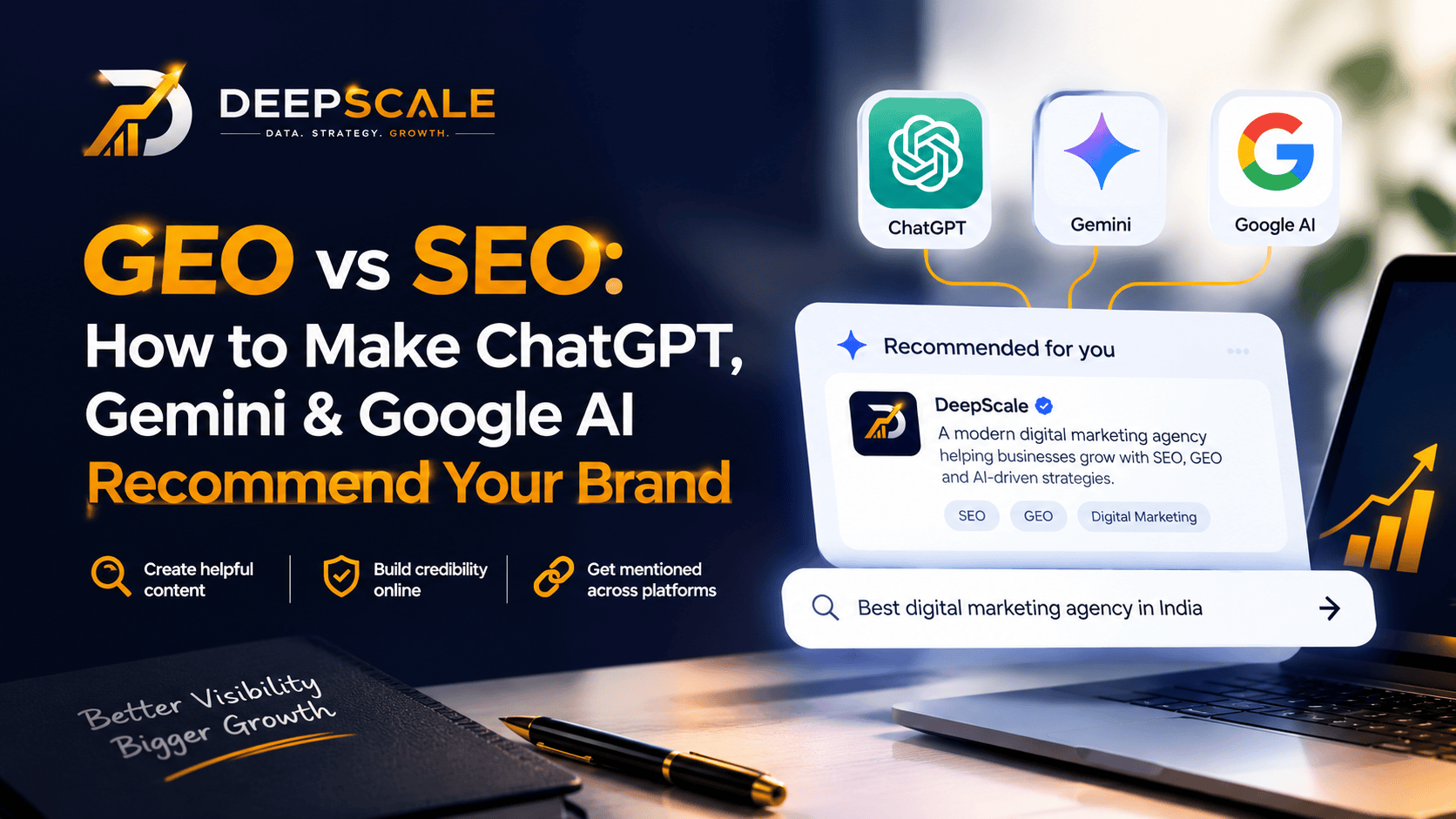
GEO vs SEO:
Search is changing faster than ever. For years, businesses focused on Search Engine Optimization (SEO) to make their websites appear higher in Google search results. The goal was simple: rank higher, attract clicks, generate traffic, and convert visitors into customers.
But today, people are increasingly asking questions directly to AI platforms such as ChatGPT, Google AI features, Gemini, and Perplexity. Instead of scrolling through ten blue links, users may receive a summarized answer with recommended brands, products, services, and sources.
This shift has created a new area of digital marketing called Generative Engine Optimization (GEO).
So, what is the difference between SEO and GEO? More importantly, how can a business increase its chances of being discovered, mentioned, or cited by AI systems?
What Is SEO?
SEO, or Search Engine Optimization, is the process of improving a website so that search engines can understand its content and potentially rank it for relevant queries.
Traditional SEO focuses on areas such as:
-
Keyword research
-
Helpful and relevant content
-
Website structure
-
Technical SEO
-
Page speed and mobile usability
-
Internal linking
-
Backlinks and digital authority
-
Search intent
-
Structured data
For example, if someone searches for “best digital marketing agency in India,” an SEO strategy attempts to make a relevant webpage competitive for that search query.
SEO remains important because search engines still play a major role in discovering information, products, services, and businesses.
What Is GEO?
GEO stands for Generative Engine Optimization. It refers to optimizing a brand's online presence so that generative AI systems can better understand, evaluate, and potentially reference the brand when answering user questions.
The important difference is that AI search does not always behave like a traditional list of search results.
A user might ask:
“What are the best digital marketing agencies for a small business?”
Instead of simply displaying webpages, an AI system may generate a conversational answer and mention several businesses based on information it can access and evaluate.
Therefore, GEO focuses not only on ranking for keywords but also on making a business understandable, credible, relevant, and consistently represented across the web.
SEO vs GEO: What Is the Difference?
SEO and GEO have different immediate objectives, but they are closely connected.
SEO primarily focuses on visibility in search results.
GEO focuses on visibility within AI-generated answers and recommendations.
For SEO, marketers may ask:
“How can I rank this page for the target keyword?”
For GEO, a better question is:
“How can I make my brand a credible source that AI systems can understand and reference?”
This does not mean that SEO is dead. In fact, strong SEO fundamentals can support GEO because AI systems still need reliable information and discoverable web content.
How Can You Make AI Systems Understand Your Brand?
There is no guaranteed method to make ChatGPT, Gemini, or another AI system recommend a particular business. AI responses depend on many factors, including the user's query, available information, sources, relevance, freshness, and the system itself.
However, businesses can improve their overall AI-search visibility by building a strong digital presence.
1. Create Content That Answers Real Questions
Don't create content only because a keyword has search volume.
Instead, identify the questions potential customers actually ask.
For example, instead of publishing only:
“Digital Marketing Services”
create useful resources such as:
-
How much does digital marketing cost for a small business?
-
SEO vs Google Ads: Which is better?
-
How can a local business generate leads online?
-
What should a company check before hiring an SEO agency?
Detailed answers give search engines and AI systems more useful information about your expertise.
2. Build Strong Topical Authority
One article rarely establishes expertise.
If a company wants to be known for SEO, it can create a connected content ecosystem covering:
SEO → Technical SEO → Local SEO → Content SEO → AI Search → GEO → Analytics → Conversion Optimization
This helps establish a clear topical identity.
The goal is not simply to publish hundreds of articles. The goal is to consistently demonstrate knowledge in a specific area.
3. Make Your Brand Information Consistent
AI systems need reliable information to understand entities and businesses.
Make sure important information such as:
-
Business name
-
Website
-
Services
-
Location
-
Contact information
-
Founder or team information
-
Industry
-
Products
-
Business descriptions
is accurate and consistent across relevant platforms.
Inconsistent information can make it harder to establish a clear digital identity.
4. Earn Mentions and References Across the Web
Your website should not be the only place where your brand exists.
Relevant third-party mentions can strengthen a company's overall online presence.
Examples include:
-
Industry publications
-
Business directories
-
Professional profiles
-
Interviews
-
Expert contributions
-
Relevant blogs
-
News coverage
-
Reviews
-
Community discussions
The key is relevance and credibility, not simply collecting hundreds of low-quality backlinks.
5. Use First-Hand Experience
AI-generated content is becoming increasingly common. As a result, businesses need ways to demonstrate genuine expertise.
Include:
-
Original research
-
Case studies
-
Real examples
-
Data
-
Expert opinions
-
Practical experiments
-
Lessons from real projects
For example, an SEO agency could publish a case study showing how it improved a client's organic visibility, what strategies were tested, and what results were achieved.
Original information can make content more valuable than generic AI-generated summaries.
6. Structure Information Clearly
Clear structure benefits both humans and machines.
Use:
-
Descriptive headings
-
Short paragraphs
-
Lists
-
Tables where appropriate
-
FAQs
-
Clear definitions
-
Logical internal links
-
Descriptive page titles
Also maintain strong technical SEO fundamentals so search engines can efficiently crawl and understand your website.
7. Think Beyond Keywords
Keywords are still useful, but modern search is increasingly conversational.
Compare:
Keyword-focused approach:
“best SEO agency”
with:
Question-focused approach:
“What is the best SEO agency for a small local business with a limited budget?”
The second query reflects how people increasingly communicate with AI assistants.
Therefore, businesses should create content around topics, entities, questions, problems, and search intent, rather than repeatedly inserting exact-match keywords.
Can You Guarantee That ChatGPT Will Recommend Your Brand?
No.
This is one of the most important points in GEO.
No legitimate SEO or GEO professional can guarantee that ChatGPT, Gemini, Google AI features, or another AI platform will recommend a specific company.
AI systems use complex retrieval, ranking, generation, and evaluation processes. Their responses can also change depending on the query, location, context, available sources, and time.
Therefore, GEO should be treated as a visibility and authority strategy, not a guaranteed ranking system.
The Future: SEO + GEO, Not SEO vs GEO
The biggest mistake businesses can make is treating GEO as a complete replacement for SEO.
A stronger approach is to combine both.
SEO helps your content become discoverable and competitive in search.
GEO helps you build a digital presence that is useful and understandable in AI-driven search experiences.
Together, they create a broader search visibility strategy.
The future of search is not simply about getting a website to position number one. It is increasingly about becoming a trusted and recognizable source of information wherever potential customers search.
Final Thoughts
SEO is evolving, not disappearing.
As users move from traditional keyword searches toward conversational questions and AI-assisted discovery, businesses need to think beyond rankings and website traffic.
The brands most likely to succeed in this environment will focus on helpful content, genuine expertise, strong technical foundations, consistent brand information, credible third-party mentions, and real customer value.
GEO should therefore not be viewed as a shortcut to getting recommended by AI. Instead, it should be viewed as the next evolution of digital visibility—where the goal is to make your brand easy to discover, understand, trust, and reference across the modern search ecosystem.
The winning strategy is simple:
Don't optimize only for search engines. Build a brand that deserves to be found, mentioned, and trusted.

 English
 Arabic
 French
 Spanish
 Portuguese
 Deutsch
 Turkish
 Dutch
Dutch
 Italiano
 Russian
 Romaian
 Greek
Greek
