


Cell Therapy Packaging Market to Reach USD 5.3 Bn: Innovation Shapes the Future of Packaging
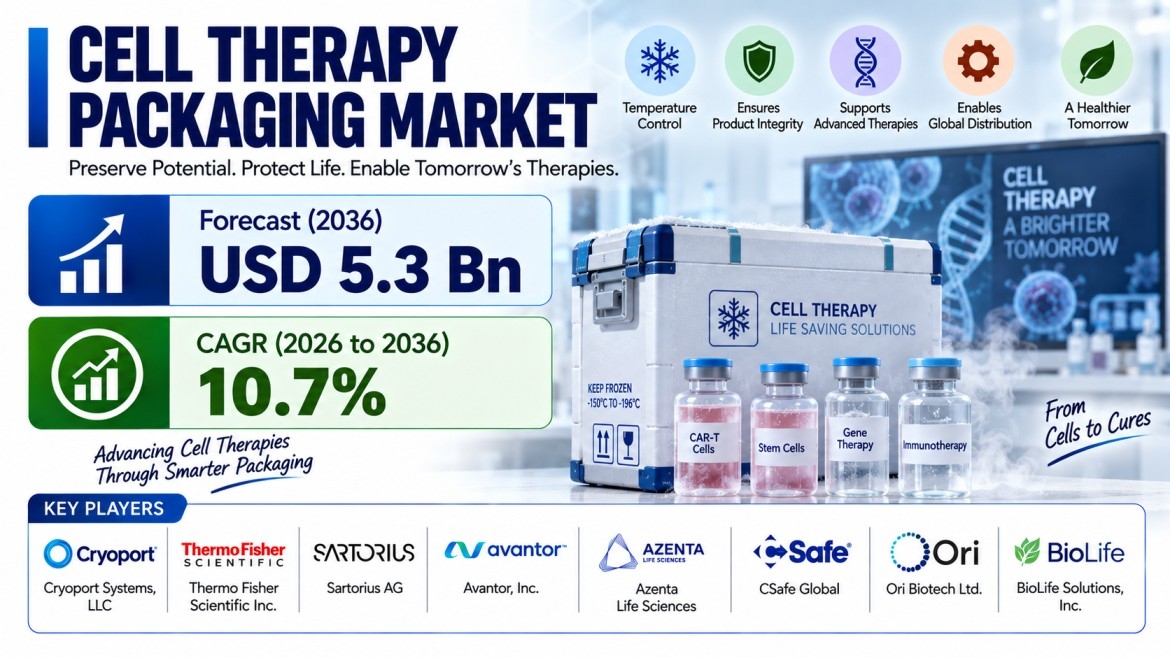
Newark, Delaware – September 17, 2026 — The global cell therapy packaging market is projected to grow from USD 1.9 billion in 2026 to USD 5.3 billion by 2036, expanding at a 10.7% CAGR, as expanding cell and gene therapy development increases demand for qualified cryogenic, sterile, temperature-controlled and traceable packaging systems.
The regulatory and development environment is expanding alongside the packaging requirement. In January 2026, the U.S. Food and Drug Administration said its Center for Biologics Evaluation and Research (CBER) had approved close to 50 cell and gene therapies during the preceding decade. The agency also announced a more flexible approach to chemistry, manufacturing and controls (CMC) requirements for these products.
In May 2026, FDA issued final guidance describing how sponsors can apply CMC flexibility when developing human cellular and gene therapy products for biologics license applications. The guidance addresses manufacturing and control requirements while retaining applicable statutory and regulatory standards.
For packaging suppliers, the implication is significant: as more therapies progress through clinical and commercial pathways, containers, closures, overpacks and temperature-control systems must be qualified as part of increasingly complex manufacturing and distribution workflows.
👉 Get Detailed Market Forecasts, Competitive Benchmarking, and Pricing Trends: https://www.futuremarketinsights.com/reports/sample/rep-gb-34521
Why Is Packaging Becoming a Critical Part of Cell Therapy Operations?
Cell therapies create packaging requirements that differ from conventional pharmaceutical distribution. Patient-specific materials may move between collection centers, manufacturing facilities, testing laboratories, logistics providers and treatment centers, creating multiple controlled handoffs.
The supplied FMI analysis estimates that cryogenic packaging will account for 38.0% of the market in 2026, reflecting the importance of frozen storage and transport. Autologous cell therapy represents 39.0%, while biopharmaceutical companies account for 36.0% of end-user demand.
Packaging therefore has to do more than contain a product. It must support product identity, sterility, thermal performance and documented handling throughout the journey.
How Are Closed Manufacturing Systems Changing Packaging Requirements?
The expansion of closed and automated cell-processing systems is increasing the importance of compatibility between manufacturing equipment and primary containers.
Thermo Fisher Scientific's Gibco CTS Compleo Fill and Finish System, for example, is designed as a functionally closed, modular system for automated formulation and filling in cell therapy manufacturing. Its documented output compatibility includes cryobags and vials, with sterile-weldable and luer-lock connections.
This type of integration creates a packaging qualification issue beyond material selection. Containers must work with filling equipment, sterile connections, handling procedures and downstream transportation systems without introducing additional manual interventions.
Why Is Cryogenic Shipping Driving Packaging Innovation?
Cryogenic logistics remains central to many cell therapy workflows. Packaging systems must protect temperature-sensitive products while limiting the risk of excursions during transport and transfer.
Cryoport Systems launched its Cryoport Express Cryogenic HV3 Shipping System in February 2025, describing it as a high-volume cryogenic enclosure for biologics and other temperature-sensitive materials.
The development illustrates how the market is moving toward specialized transport architectures rather than treating cold-chain packaging as a generic logistics component.
For cell therapy developers, qualification increasingly encompasses the complete system: primary container, secondary protection, thermal control, monitoring and shipping configuration.
What Role Does Patient Identity Play in Packaging Design?
Autologous therapies create a direct connection between the package and an individual patient. A packaging failure can therefore create consequences beyond physical product damage if identification or documentation is compromised.
Patient-linked labels, controlled handoffs, monitoring information and standardized receipt procedures become important elements of the packaging workflow. Treatment centers also need packaging configurations that accommodate scheduling changes while preserving identity throughout storage and transport.
This makes packaging qualification part of broader chain-of-identity and chain-of-custody controls rather than an isolated purchasing decision.
Which Regions Are Driving Market Expansion?
The supplied FMI forecast places the United States at 11.2% CAGR, Japan at 11.0%, Germany at 10.9%, the United Kingdom at 10.7%, Canada at 10.5% and South Korea at 10.1% through 2036.
The relatively narrow spread between these forecasts does not mean that packaging opportunities are identical. Qualification pathways, manufacturing concentration, treatment-center networks, logistics infrastructure and regulatory documentation can materially change supplier requirements from one country to another.
The United States remains an important reference market because of its established cell and gene therapy development ecosystem and continuing regulatory activity. FDA's current approved-products list includes a growing range of cellular and gene therapy products across autologous, allogeneic and gene-modified approaches.
Competitive Landscape
The market includes Cryoport Systems, Thermo Fisher Scientific, Sartorius, Avantor, Azenta Life Sciences, CSafe Global, Ori Biotech and BioLife Solutions.
Competition spans multiple layers of the value chain. Some suppliers focus on cryogenic storage and transportation, while others provide primary containers, bioprocessing equipment, sterile systems or integrated manufacturing technologies.
As cell therapy programs move toward commercial-scale networks, suppliers that can demonstrate compatibility across filling, storage, transportation and treatment-site workflows become increasingly relevant to qualification teams.
👉 Access the Complete Report in PDF Format: https://www.futuremarketinsights.com/reports/sample/rep-gb-34521
Market Snapshot
- Market size, 2026: USD 1.9 billion
- Forecast value, 2036: USD 5.3 billion
- CAGR, 2026–2036: 10.7%
- Cryogenic packaging share: 38.0%
- Autologous cell therapy share: 39.0%
- Biopharmaceutical company share: 36.0%
- Direct-sales share: 42.0%
Analyst Perspective
“Cell therapy packaging becomes a risk if seals or labels fail during the patient journey. Providers gain trust by linking freeze-thaw performance with chain-of-identity evidence across manufacturing and treatment-site receipt.”
— Nandini Roy Choudhury, Principal Consultant, Future Market Insights
Read the Full Report
For detailed market sizing, segment analysis, country forecasts, competitive benchmarking, and market methodology:
https://www.futuremarketinsights.com/reports/cell-therapy-packaging-market
Explore More Research Reports by FMI:
Paper-based Pallet Pads Market: https://www.futuremarketinsights.com/reports/paper-based-pallet-pads-market
Aluminum-Free Retort Pouches Market: https://www.futuremarketinsights.com/reports/aluminum-free-retort-pouches-market
Stretch Hood Film Market: https://www.futuremarketinsights.com/reports/stretch-hood-films-market
Media Contact
Future Market Insights, Inc.
Media & Communications Team
Website: https://www.futuremarketinsights.com/
About Future Market Insights
Future Market Insights (FMI) provides market intelligence and consulting services across industries and emerging technology markets. Its research combines primary research, secondary research, market sizing, forecasting, and data validation to support business and strategic decision-making.

 English
 Arabic
 French
 Spanish
 Portuguese
 Deutsch
 Turkish
 Dutch
Dutch
 Italiano
 Russian
 Romaian
 Greek
Greek
