


Geothermal System Installation in Dubuque, IA: What Homeowners Should Know
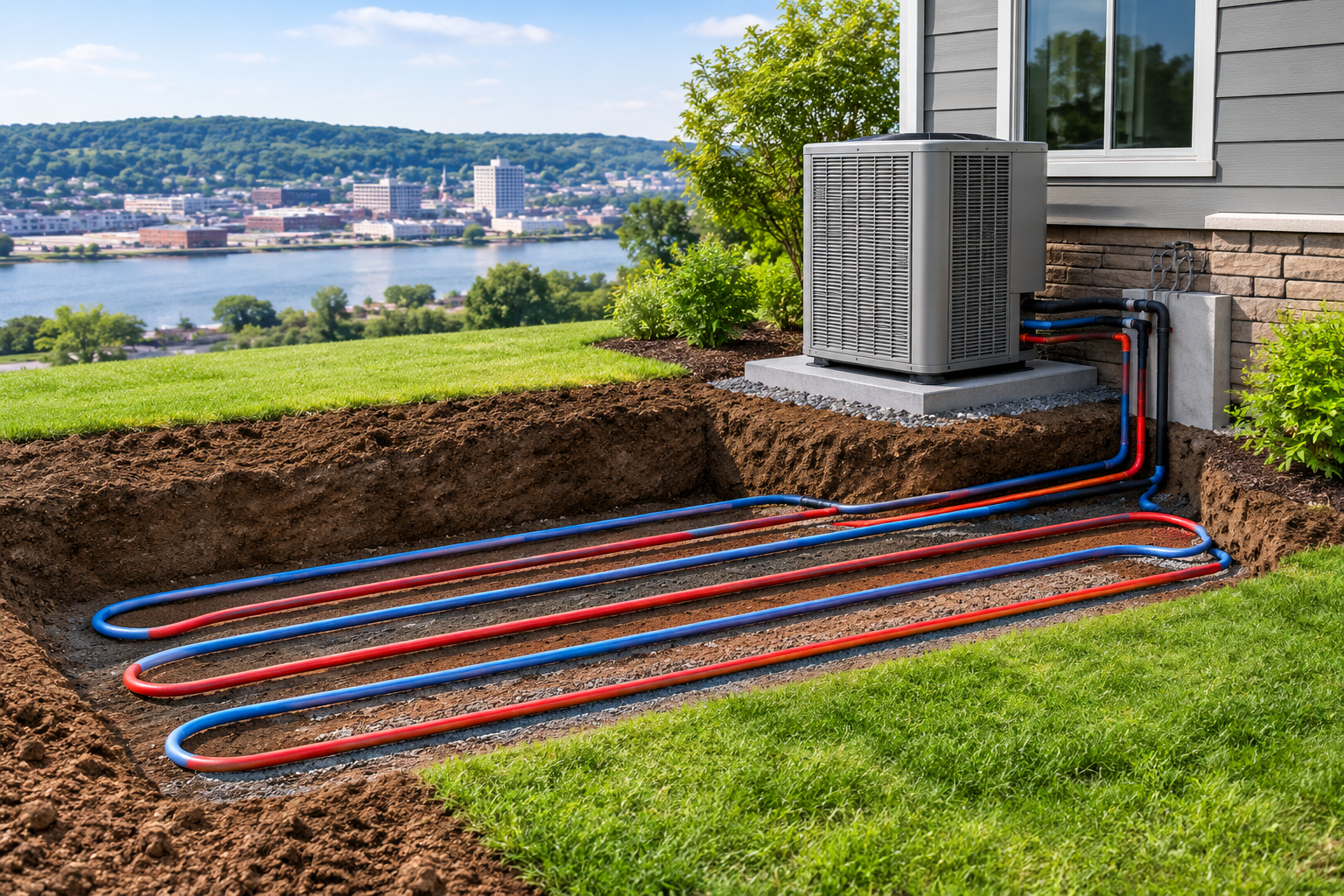
Heating and cooling account for a significant portion of household energy use. For homeowners in Dubuque, IA, changing outdoor temperatures create demand for dependable year-round climate control. Geothermal heat pumps offer an alternative approach by using the relatively stable temperature of the ground to transfer heat rather than relying entirely on outdoor air.
Before investing in geothermal system installation in Dubuque, IA, it is important to understand how the technology works and what the installation involves. A geothermal heat pump uses an underground loop system to exchange heat with the ground. During winter, the system transfers heat from the ground into the home. During summer, it reverses the process and moves indoor heat into the ground.
How Geothermal Heating and Cooling Works
A geothermal system has three primary components: the heat pump, the ground loop, and the indoor distribution system. The ground loop circulates a fluid through buried piping. This fluid transfers heat between the ground and the heat pump.
The system does not create heat through combustion. Instead, it uses electricity to move existing thermal energy. Depending on the property and equipment configuration, the loop system can be installed horizontally or vertically underground.
Is a Geothermal System Suitable for a Dubuque Home?
Property conditions play an important role in geothermal installation. Before installation begins, professionals evaluate several factors, including:
A.Available yard space
B.Soil conditions
C.Ground loop configuration
D.Existing ductwork
E.Household heating and cooling requirements
F.Electrical service
G.Local site conditions
A horizontal loop requires sufficient land for trenching, while a vertical system uses drilled boreholes and requires less surface area. Horizontal systems generally cost less to install but can require roughly 2,000 to 3,500 square feet of land per ton of capacity, while vertical systems may require about 150 to 220 feet of borehole depth per ton and typically cost more because of drilling. A pond or lake closed-loop system may be an economical option when a suitable water body is available, while an open-loop system can use groundwater as the heat exchange fluid.
Dubuque's geology also deserves specific attention. The area contains limestone and dolomite bedrock, and some Dubuque-area soils have limestone bedrock relatively close to the surface. These conditions can affect drilling requirements, loop design, and installation planning. A professional site evaluation should account for the property's actual soil, bedrock, groundwater, and karst conditions before selecting a loop configuration.
Benefits of Geothermal Systems in Dubuque
Geothermal heat pumps provide both heating and cooling from a single system. Because they transfer heat rather than generate it through combustion, they operate differently from traditional furnaces and standard air conditioners.
Additional benefits include:
Consistent Indoor Comfort
Ground temperatures remain more stable than outdoor air temperatures. This provides a consistent thermal source for the heat pump throughout changing seasons.
Year-Round Operation
A properly designed geothermal heat pump provides heating during cold weather and cooling during summer. One system therefore handles both major indoor temperature-control needs.
High Efficiency
Geothermal heat pump efficiency is commonly described using COP for heating and EER for cooling. ENERGY STAR-certified geothermal heat pumps must meet specified efficiency requirements, giving homeowners a useful benchmark when comparing equipment.
Domestic Hot Water Support
Some geothermal heat pump systems can also provide domestic hot water. Equipment with a desuperheater or related water-heating function can transfer available heat for household hot water production, adding another potential benefit beyond space heating and cooling.
Long Equipment Life
Geothermal systems can have a long service life. The U.S. Department of Energy estimates that indoor components can last up to about 24 years, while properly installed ground loops can last 50 years or more.
Geothermal Installation Costs and Payback
Geothermal installation requires a larger initial investment than many conventional HVAC replacements because the project includes both indoor equipment and underground loop work. Current industry estimates place typical residential geothermal installation costs around $15,000 to $40,000 or more, although Dubuque-area pricing can vary substantially based on system size, loop type, drilling conditions, ductwork, permits, and site access.
The higher upfront cost can be offset over time by lower operating costs. The U.S. Department of Energy notes that the additional installation cost may be recovered through energy savings in about 5 to 10 years, depending on energy prices and available incentives. Actual payback for a Dubuque home depends on the existing HVAC system, household energy use, utility rates, system efficiency, and installation cost.
Homeowners should also verify available state, utility, and local incentives because incentive programs can change.
Federal Tax Credit Status
The federal Residential Clean Energy Credit previously provided a 30% tax credit for qualifying geothermal heat pump property installed through December 31, 2025. However, the IRS states that the credit is not available for qualifying property placed in service after December 31, 2025. Homeowners reviewing a past qualifying installation or tax filing should consult the IRS Residential Clean Energy Credit guidance for eligibility and filing details.
What to Expect During Installation
Geothermal installation involves more planning than replacing a conventional HVAC unit. A professional assessment typically determines heating and cooling loads before the system is sized.
The installation process generally includes site evaluation, system design, ground loop installation, heat pump placement, connections to the home's distribution system, and operational testing. Ground excavation or drilling requires careful planning to minimize unnecessary disruption to the property.
Existing ductwork should also be evaluated. If ducts are undersized, damaged, or poorly sealed, addressing those issues improves the overall performance of the new system.
Maintaining a Geothermal System
Although geothermal ground loops require relatively little routine attention, the complete HVAC system still needs regular maintenance. Filters should be changed according to manufacturer recommendations. Indoor components should receive periodic inspection, while airflow and electrical connections should be checked as part of professional service.
Keep the area around indoor equipment accessible and monitor the system for unusual noises, inconsistent temperatures, or changes in performance.
Planning Geothermal System Installation in Dubuque
Homeowners considering geothermal system installation in Dubuque, IA should start with a professional property assessment. Ask about loop options, equipment sizing, installation requirements, ductwork condition, and expected maintenance.
A detailed evaluation provides useful information about whether geothermal technology fits your property and household heating and cooling requirements. It also helps prevent design mistakes that could affect long-term performance.
Geothermal System Installation in Dubuque: Cost, Efficiency, and Site Considerations
Geothermal heating and cooling offers an energy-conscious approach to year-round comfort in Dubuque, IA. The right system depends on property conditions, heating and cooling loads, loop design, and proper installation. If you are considering geothermal system installation in Dubuque, IA, schedule a professional assessment to evaluate your property and determine an appropriate system design before beginning the project.
Source URL - https://shorturl.at/QElXR

 English
 Arabic
 French
 Spanish
 Portuguese
 Deutsch
 Turkish
 Dutch
Dutch
 Italiano
 Russian
 Portuguese (Brazil)
 Greek
Greek
