


Glass Spherical Lens: Understanding Its Design, Function, and Optical Applications
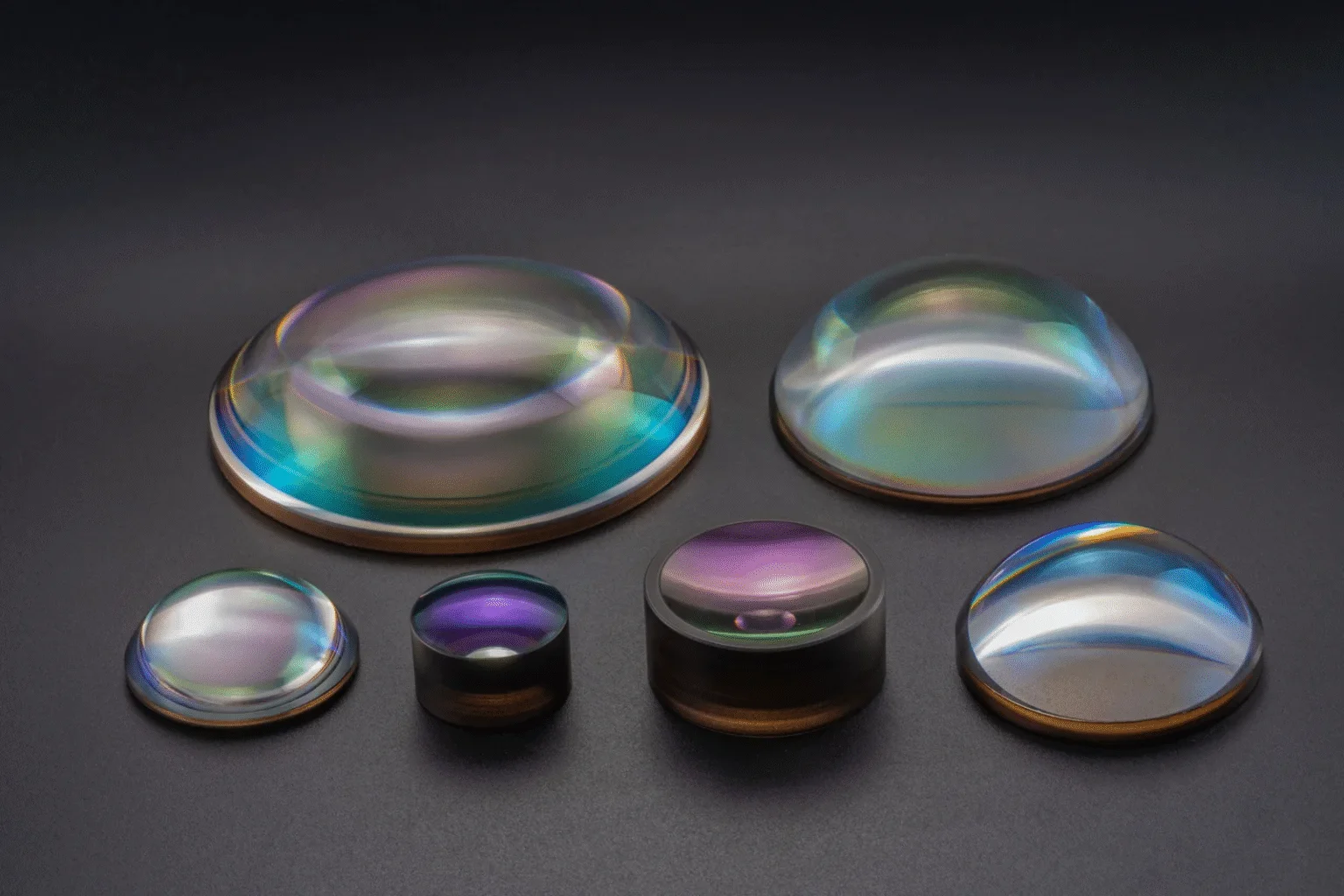
Understanding Glass Spherical Lenses
Optical lenses are fundamental components in technologies that manipulate, focus, redirect, or image light. From cameras and microscopes to scientific instruments and industrial systems, carefully engineered lenses help control how light travels through an optical assembly.
A glass spherical lens is an optical component with one or more surfaces shaped according to a spherical geometry. Its curved surface changes the direction of incoming light, allowing engineers to use it for focusing, magnification, imaging, and other optical functions.
How a Spherical Lens Works
When light passes from one transparent material into another, its direction can change because of differences in refractive index. This phenomenon is known as refraction.
The curved surface of a spherical lens causes different portions of an incoming light beam to change direction by different amounts. Depending on the lens geometry, this can cause light rays to converge toward a focal region or diverge away from a virtual focal point.
The behavior depends on factors such as surface curvature, glass composition, lens thickness, and the surrounding medium.
Convex and Concave Designs
Spherical lenses are commonly categorized according to their surface geometry. Convex lenses are generally thicker toward the center and can converge incoming light. Concave lenses are typically thinner toward the center and can cause light rays to diverge.
These different optical behaviors allow engineers to select appropriate lens configurations for particular imaging or light-management requirements.
Why Optical Glass Matters
The glass used in a lens can significantly influence its optical performance. Different glass compositions have different refractive indices and dispersion characteristics.
Optical designers consider these properties when developing lens systems. Selecting suitable glass can help achieve the required focal characteristics, transmission properties, and image quality for a particular application.
Precision Manufacturing
Producing a high-quality spherical lens requires careful manufacturing and inspection. Processes may include shaping, grinding, polishing, cleaning, and optical coating.
The quality of the finished surface is particularly important because imperfections can affect how light passes through the lens. Precise curvature and smooth surfaces help ensure that the component performs consistently within an optical system.
Applications of Spherical Lenses
Glass spherical lenses can be found in many optical applications. Cameras and imaging systems use lenses to form images, while scientific instruments may use them to control and measure light.
They can also be incorporated into industrial inspection equipment, laser-related systems, optical sensors, projection technologies, and specialized viewing devices.
Optical Design Considerations
Engineers must consider several factors when integrating a spherical lens into a larger optical assembly. These can include focal length, aperture, refractive index, surface curvature, material dispersion, lens diameter, and expected wavelength range.
The surrounding components also matter. A lens normally operates as part of a larger system in which multiple optical elements work together to achieve the desired result.
The Continuing Importance of Precision Optics
As imaging and photonics technologies continue to advance, precision optical components remain essential. Improvements in glass materials, manufacturing processes, coatings, and measurement technologies are helping manufacturers develop increasingly sophisticated optical systems.
Understanding the fundamentals of a glass spherical lens provides a useful foundation for exploring how modern optical devices control and manipulate light.

 English
 Arabic
 French
 Spanish
 Deutsch
 Turkish
 Dutch
Dutch
 Italiano
 Russian
 Romaian
 Portuguese (Brazil)
 Greek
Greek
