


How AI Agents Are Reshaping Modern Business Operations Today
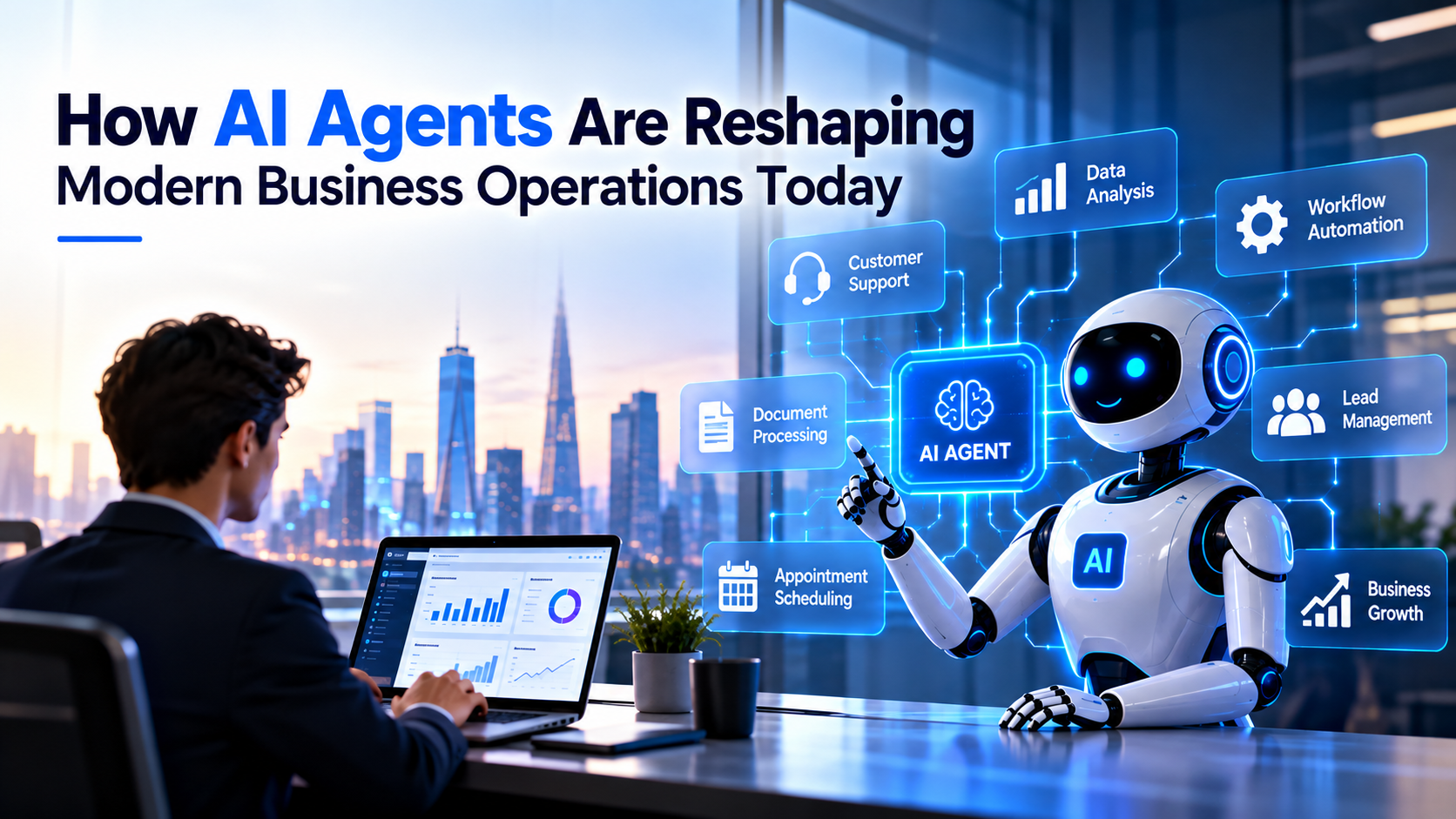
Artificial intelligence is moving beyond traditional automation and becoming an active part of everyday business operations. Modern organizations are using intelligent software systems to analyze information, make decisions, communicate with users, and complete repetitive tasks with minimal human intervention. As this technology matures, AI agent development services are becoming increasingly relevant for companies looking to improve productivity, customer experiences, and operational efficiency.
Unlike conventional software that simply follows predefined instructions, AI agents can understand context, process information, and determine the next appropriate action. This ability is changing how businesses approach automation and digital transformation.
What Are AI Agents?
An AI agent is a software system designed to perceive information, reason about a task, and take actions toward a specific objective. It can interact with databases, applications, APIs, communication platforms, and other digital tools to complete workflows.
For example, an intelligent customer support agent can receive a customer question, identify the intent, retrieve relevant information from a knowledge base, formulate a response, and escalate the issue when human assistance is required.
This makes AI agents different from basic chatbots and rule-based automation. They are designed to handle more dynamic workflows where decisions may change depending on the available information and circumstances.
Why Are Businesses Adopting AI Agents?
The growing adoption of intelligent automation is largely driven by the need to accomplish more without increasing operational complexity. AI-powered systems can support employees while reducing the amount of time spent on repetitive activities.
Businesses can use agents for tasks such as:
-
Customer support and ticket management
-
Lead qualification and sales assistance
-
Document processing
-
Data analysis and reporting
-
Appointment scheduling
-
Internal knowledge management
-
Workflow automation
-
Personalized recommendations
-
Software monitoring
-
Research and information gathering
Instead of replacing every existing system, AI agents can work as an intelligent layer that connects different business tools and coordinates activities between them.
How AI Agents Work
An intelligent agent generally operates through several interconnected stages. First, it receives an input from a user, application, database, sensor, or another system. It then interprets the information using artificial intelligence models and determines what needs to happen next.
The reasoning component evaluates available information and selects an appropriate action. Depending on its permissions, the agent may retrieve data, call an external API, update a database, send a message, generate a document, or request human approval.
Modern agent architectures may also include memory, allowing systems to maintain relevant context during interactions. Guardrails and access controls can further restrict what an agent is allowed to do.
This combination of reasoning, tools, memory, and controlled execution enables organizations to automate workflows that previously required several manual steps.
The Role of AI Agent Development in USA Businesses
Companies operating in competitive markets are increasingly exploring intelligent systems to improve response times and streamline internal processes. AI agent development in USA is therefore becoming an important area of enterprise technology adoption, particularly across industries such as healthcare, finance, retail, logistics, education, and professional services.
For businesses, the objective is not simply to add an AI feature. The greater opportunity lies in identifying processes where intelligent decision-making can create measurable value.
For example, a logistics company could use an agent to monitor delivery information, identify potential delays, communicate with customers, and alert operations teams when intervention is necessary.
Similarly, an online retailer could use an intelligent assistant to understand customer requirements, recommend products, check order information, and initiate support workflows.
Choosing the Right Development Approach
Every business has different processes, data sources, security requirements, and technology infrastructure. Consequently, an AI solution should be designed around a specific business objective rather than implemented simply because AI is trending.
A practical development process begins with identifying a suitable workflow. Teams should determine which tasks are repetitive, which decisions require contextual reasoning, and where automation could produce measurable improvements.
The next stage involves selecting appropriate AI models, data sources, tools, integrations, and deployment infrastructure. Security, privacy, authentication, monitoring, and human oversight should also be considered from the beginning.
Businesses seeking specialized expertise may work with an AI agent development company in USA to design solutions that integrate with their existing technology environment and operational requirements.
Benefits of Custom Intelligent Agents
Off-the-shelf AI tools can be useful for general tasks, but organizations with specialized workflows may require systems designed around their own processes.
Custom AI agent development allows businesses to create intelligent solutions that can work with proprietary information, internal applications, databases, and specialized workflows.
Some potential benefits include:
-
Greater workflow automation
-
Improved operational efficiency
-
Faster information retrieval
-
Better customer engagement
-
Reduced repetitive workloads
-
More consistent processes
-
Scalable digital operations
-
Personalized user interactions
Customization can also provide greater control over permissions and system behavior, which is particularly important when agents interact with sensitive business information.
How 75way Technologies Approaches AI Agent Solutions
Businesses exploring intelligent automation often need more than an AI model. They require a complete solution that connects models with business logic, applications, data, and user workflows.
75way Technologies works in this space by helping businesses explore AI-powered applications and intelligent agent solutions tailored to specific operational requirements. The focus can include workflow automation, conversational systems, AI integrations, and solutions designed to support business processes.
A well-designed agent should solve a clearly defined problem while remaining measurable, secure, and manageable as the organization grows.
Key Considerations Before Implementing AI Agents
Before deploying an intelligent agent, businesses should evaluate several factors.
Define the objective: Determine exactly what the agent is expected to accomplish.
Evaluate data: Identify the information the system needs and whether that data is accurate and accessible.
Plan integrations: Establish which software, APIs, databases, and platforms the agent must communicate with.
Set permissions: Define which actions the system can perform independently and which require approval.
Add monitoring: Track performance, errors, response quality, and unexpected behavior.
Keep humans involved: High-impact decisions should have appropriate human oversight, especially in sensitive industries.
These considerations can reduce implementation risks and create a stronger foundation for long-term adoption.
The Future of AI-Powered Business Automation
AI agents are likely to become increasingly integrated into everyday business software. Instead of interacting with individual applications separately, employees may increasingly rely on intelligent systems that coordinate multiple tools to complete an entire workflow.
For example, an employee could ask an agent to prepare a business report. The system might collect information from several databases, analyze the data, create a summary, generate visualizations, and prepare the final report for human review.
This shift represents a move from simple task automation toward goal-oriented digital assistance.
Conclusion
AI agents are changing the way organizations think about automation, productivity, and digital transformation. Their ability to interpret information, reason through tasks, use external tools, and execute workflows creates opportunities that extend beyond traditional chatbots and rule-based systems.
Organizations that identify the right use cases and implement intelligent systems responsibly can improve efficiency while creating better experiences for customers and employees. As AI technology continues to evolve, businesses that develop a clear strategy for intelligent automation will be better positioned to take advantage of the next generation of digital operations.
Frequently Asked Questions
What is an AI agent?
An AI agent is a software system that can understand inputs, reason about objectives, use connected tools, and perform actions to complete specific tasks.
How are AI agents different from chatbots?
Traditional chatbots generally respond to predefined interactions, while AI agents can reason about objectives, use external tools, maintain context, and execute multi-step workflows.
What are AI agent development services used for?
They can be used to create intelligent solutions for customer support, business automation, research, data processing, sales operations, workflow management, and other use cases.
Can AI agents integrate with existing business software?
Yes. AI agents can be connected with APIs, databases, CRM platforms, communication tools, enterprise applications, and other systems when appropriate integrations are available.
Is custom AI automation suitable for small businesses?
Yes. Small businesses can use focused AI solutions for specific tasks such as customer support, lead qualification, scheduling, reporting, and document processing without automating their entire operation.
What should businesses consider before deploying an AI agent?
Businesses should consider the intended objective, data quality, integrations, security, permissions, monitoring, scalability, cost, and the level of human oversight required.

 English
 Arabic
 Spanish
 Portuguese
 Deutsch
 Turkish
 Dutch
Dutch
 Italiano
 Russian
 Romaian
 Portuguese (Brazil)
 Greek
Greek
