


Understanding Parameters Hyperparameters and Model Complexity
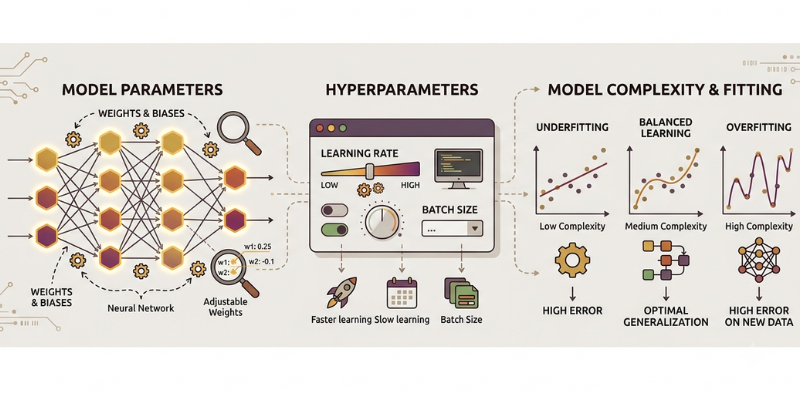
Artificial Intelligence models learn from data to identify patterns and make predictions. However, their performance depends on several important factors, including parameters, hyperparameters, and model complexity. Understanding these concepts helps beginners learn how machine learning models work and why some models perform better than others. If you want to build a strong foundation in modern AI technologies, consider enrolling in a Generative AI Course in Trivandrum at FITA Academy to explore these concepts and develop practical skills.
What Are Parameters in Machine Learning?
Values that a machine learning model acquires during the training process are known as parameters. They help the model understand relationships between input data and expected outputs. Weights and biases are common examples of parameters in neural networks.
For example, a model trained to predict house prices may learn how house size, location, and age affect the final price. Throughout the training process, it modifies its parameters to minimize the gap between its forecasts and the real prices.
A model usually learns its parameters by processing training data repeatedly. The learning process updates these values until the model produces reasonably accurate results. Models with more parameters can sometimes learn complex patterns, but a larger parameter count does not automatically guarantee better performance.
What Are Hyperparameters in Machine Learning?
Hyperparameters are settings chosen before or during the training process. Unlike parameters, they are not directly learned from the training data through the model's usual learning process. Instead, they control how the model learns.
Common examples include the learning rate, batch size, number of training epochs, and the number of hidden layers in a neural network. The learning rate specifies the extent to which the model adjusts its parameters with each update. Batch size controls how many training examples the model processes before updating its parameters.
Choosing suitable hyperparameters is important because poor settings can slow training or reduce prediction accuracy. Developers often test different combinations to identify the settings that produce better results on validation data.
Understanding Model Complexity
Model complexity describes how well a machine learning model can represent patterns in data. A simple model may capture basic relationships, while a complex model can represent more detailed and complicated patterns.
The number of parameters, model architecture, and learning process can all influence complexity. For example, a basic linear regression model is generally less complex than a deep neural network designed to recognize objects in images.
However, greater complexity is not always beneficial. A highly complex model may memorize its training examples instead of learning patterns that apply to new data. This problem is called overfitting. A model that lacks complexity may miss crucial relationships, a situation referred to as underfitting.
How Parameters, Hyperparameters, and Complexity Work Together
These three concepts are closely connected, but they serve different purposes. Parameters represent what a model learns, hyperparameters control how it learns, and model complexity describes the range of patterns it can represent.
Think about a neural network that has been trained to identify handwritten digits. Its parameters learn visual patterns from images, while its hyperparameters determine settings such as the learning rate and number of training epochs. Its architecture and learned representations influence how complex the model can become.
Finding the right balance requires testing the model on data it has not seen during training. Validation results help developers determine whether the model is learning useful patterns or simply memorizing examples. Techniques such as regularization, early stopping, and cross-validation can help improve generalization.
Why These Concepts Matter in Artificial Intelligence
Understanding parameters, hyperparameters, and model complexity is essential for developing reliable machine learning and Generative AI applications. These concepts influence training time, computational costs, prediction accuracy, and performance on unfamiliar data.
They are also relevant when working with large language models. Such models may contain billions of parameters, while their training and inference processes involve additional configuration choices. Knowing how these elements interact helps developers understand model behavior and make informed technical decisions.
Parameters, hyperparameters, and model complexity form an important foundation for understanding machine learning. Parameters are learned from data, hyperparameters guide the learning process, and model complexity affects how effectively a model captures patterns. Learning to balance these factors helps create models that perform well on new data rather than only on training examples. If you want to strengthen your technical knowledge and explore practical AI applications, take the next step with an Artificial Intelligence Course in Trivandrum to build your understanding of machine learning concepts and their real-world uses.

 English
 Arabic
 French
 Spanish
 Portuguese
 Deutsch
 Dutch
 Italiano
 Russian
 Romaian
 Portuguese (Brazil)
 Greek
