


10 Common CIPD Assignment Mistakes and How to Avoid Them
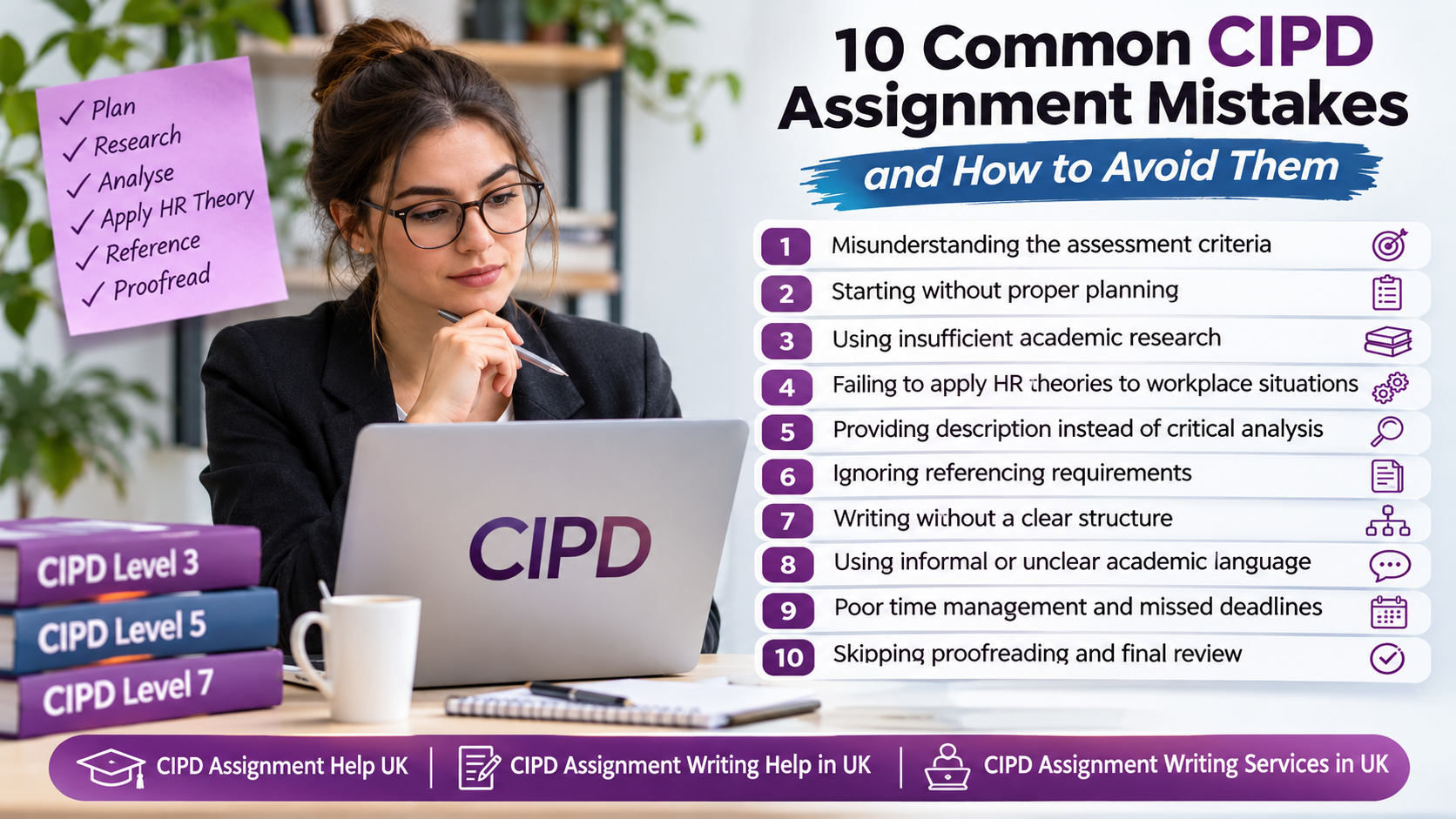
Completing CIPD assignments can be challenging, especially for students balancing their studies with professional responsibilities. Whether you are pursuing CIPD Level 3, Level 5, or Level 7, producing high-quality assignments requires strong research skills, critical thinking, and a clear understanding of human resource management principles.
Many students struggle with assessment criteria, referencing requirements, and applying HR theories to practical situations. Seeking CIPD Assignment Help UK can provide useful academic guidance and help learners improve their writing skills.
Understanding common mistakes is essential for producing well-structured assignments. Here are ten frequent CIPD assignment mistakes and practical ways to avoid them.
1. Misunderstanding the Assessment Criteria
One of the most common mistakes CIPD students make is failing to understand the assessment criteria. Each assignment includes specific learning outcomes that determine what students must demonstrate.
Ignoring command words such as analyse, evaluate, explain, or assess can lead to incomplete answers.
How to Avoid It: Carefully review the assessment brief before writing. Highlight each assessment criterion and identify the evidence required to address it effectively.
2. Starting Assignments Without Proper Planning
Many students begin writing immediately without preparing an outline. This often results in repetitive arguments, missing information, and poorly organised content.
Planning is particularly important for complex CIPD Level 5 and Level 7 assignments.
How to Avoid It: Create a structured outline based on the assessment criteria. Allocate an appropriate word count to each section and establish a realistic writing schedule.
3. Using Insufficient Academic Research
Strong CIPD assignments require credible research and evidence. Relying exclusively on general websites, personal opinions, or outdated information can weaken academic arguments.
Students should demonstrate an understanding of current HR practices and relevant research.
How to Avoid It: Use CIPD factsheets, peer-reviewed journals, academic textbooks, and reputable professional publications. Ensure your sources are relevant to the assignment topic.
4. Failing to Apply HR Theories to Workplace Situations
CIPD qualifications focus on connecting theoretical knowledge with professional HR practice.
Some students explain theories without demonstrating how they apply to real organisational challenges.
For example, discussing employee motivation without explaining its influence on workplace engagement may result in an incomplete analysis.
How to Avoid It: Connect HR theories to realistic workplace scenarios. Explain how different approaches influence recruitment, employee relations, performance management, or organisational development.
5. Providing Description Instead of Critical Analysis
Descriptive writing is another common weakness, particularly in higher-level CIPD assignments.
Students sometimes explain concepts without evaluating their effectiveness, limitations, or practical implications.
Critical analysis requires examining different perspectives and supporting conclusions with evidence.
How to Avoid It: Compare relevant HR approaches, discuss their advantages and disadvantages, and justify your conclusions using credible research.
Students seeking CIPD Assignment Writing Help in UK can benefit from academic feedback that helps them develop stronger analytical arguments.
6. Ignoring Referencing Requirements
Incorrect referencing can affect assignment quality and raise academic integrity concerns.
Many CIPD learning centres require Harvard referencing, although specific requirements may vary between providers.
Common mistakes include missing citations, incomplete reference lists, and inconsistent formatting.
How to Avoid It: Follow your learning centre's referencing guidelines. Record source information during research and verify that every in-text citation matches an entry in the reference list.
7. Writing Without a Clear Structure
Poor organisation makes assignments difficult to read and assess.
Some students combine multiple ideas into lengthy paragraphs or fail to use headings that correspond to assessment criteria.
A logical structure is essential for presenting professional arguments effectively.
How to Avoid It: Organise your assignment using relevant headings and focused paragraphs. Where appropriate, include an introduction, main discussion, conclusion, and reference list.
Ensure each section directly addresses the required assessment criteria.
8. Using Informal or Unclear Academic Language
CIPD assignments require professional and precise communication.
Informal expressions, vague statements, excessive jargon, and unnecessarily complicated sentences can reduce clarity.
For example, stating that "HR makes employees happy" does not adequately explain the relationship between HR practices and employee satisfaction.
How to Avoid It: Use clear academic language and appropriate HR terminology. Support important statements with evidence and explain concepts in a professional manner.
9. Poor Time Management and Missed Deadlines
Many CIPD learners are working professionals who manage employment, personal responsibilities, and academic commitments simultaneously.
Leaving assignments until the last minute can lead to rushed research, weak arguments, and incomplete proofreading.
How to Avoid It: Divide the assignment process into manageable stages, including research, planning, drafting, editing, and final review.
Students may also explore CIPD Assignment Writing Services in UK for appropriate support with research guidance, proofreading, and understanding academic requirements.
10. Skipping Proofreading and Final Review
Submitting an assignment without reviewing it is a mistake that can easily be avoided.
Grammar errors, missing citations, unclear explanations, and formatting inconsistencies can affect the overall quality of the work.
Students may also overlook assessment criteria when rushing to meet deadlines.
How to Avoid It: Review your assignment against the assessment brief before submission. Check grammar, spelling, referencing, structure, and word count.
Ensure your arguments are supported by evidence and that every required learning outcome has been addressed.
How Academic Support Can Improve CIPD Assignment Writing
Developing effective academic writing skills takes time and consistent practice. Students may encounter difficulties when interpreting complex HR theories, understanding assessment requirements, or organising research.
Reliable CIPD Assignment Help UK can support learners through constructive feedback, academic guidance, and explanations of difficult concepts.
However, students should choose support that promotes independent learning and follows their institution's academic integrity policies.
Building research, analytical, and professional communication skills can also benefit learners throughout their HR careers.
Conclusion
Avoiding common CIPD assignment mistakes is essential for producing well-researched, organised, and academically sound work. Understanding assessment criteria, applying HR theories, conducting credible research, and developing critical analysis can significantly improve assignment quality.
Whether studying CIPD Level 3, Level 5, or Level 7, students should focus on careful planning, effective time management, and thorough proofreading.
With consistent practice and appropriate CIPD Assignment Help UK, learners can strengthen their academic writing skills, approach challenging assessments with confidence, and develop valuable competencies for their future careers in human resource management.

 English
 French
 Spanish
 Portuguese
 Deutsch
 Turkish
 Dutch
 Italiano
 Russian
 Romaian
 Portuguese (Brazil)
 Greek
