


Understanding Tennis Head-to-Head Statistics on Lotus365
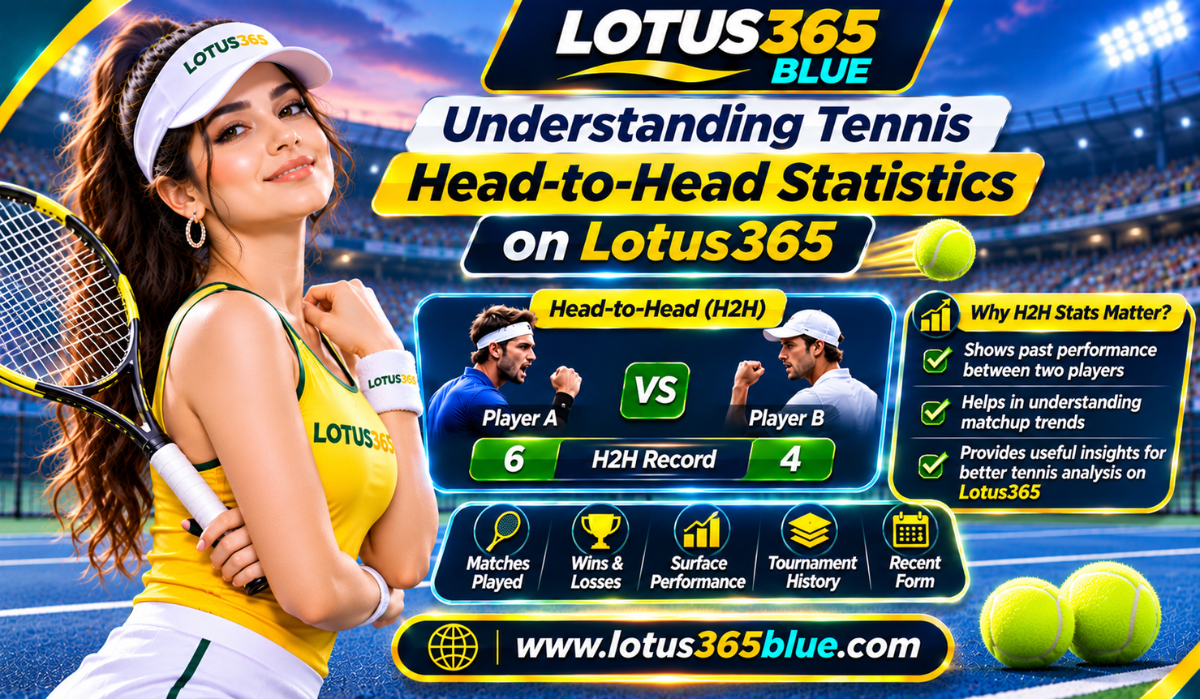
Head-to-head statistics are one of the most commonly used historical references in professional tennis. When two players meet, their previous matches can provide useful background about how their playing styles have interacted in the past. For readers following tennis through Lotus365, understanding how to interpret these records can make tournament coverage and player comparisons easier to follow. The Lotus365 Tennis Betting keyword is also relevant because head-to-head information can appear alongside other match statistics, although previous meetings should never be treated as a guarantee of what will happen in a future match.
Get lotus365 id-https://lotus365blue.com/
A head-to-head record normally shows how many times two players have competed against each other and how those matches were divided between them. However, a simple number such as 6–3 does not tell the whole story. The surface, tournament level, match format, age of the players, time since previous meetings and current form can all change the meaning of historical results.
What Does Head-to-Head Mean in Tennis?
Head-to-head, often shortened to H2H, refers to the competitive record between two players.
For example, imagine Player A and Player B have played nine professional matches. If Player A won six and Player B won three, their overall head-to-head record would be 6–3 in favour of Player A.
The statistic is straightforward, but interpreting it requires more detail.
The nine matches could have been played over several years, on different court surfaces and at different stages of the players' careers. One player might have been a teenager during the first meeting and a much more experienced professional during the latest encounter.
Therefore, H2H is best viewed as historical context rather than a standalone prediction.
Why Head-to-Head Records Matter
Tennis is an individual sport, which makes previous player-versus-player encounters particularly interesting.
Two players can have similar rankings and comparable overall records but produce very different results when they face each other.
This can happen because of playing styles.
One player may have a powerful serve, while another is an exceptional returner. A baseline player may prefer long exchanges, while an aggressive opponent may attempt to shorten points.
When these styles repeatedly meet, certain patterns can appear.
For Lotus365, H2H information can therefore help explain the background of a matchup instead of simply showing which player has the higher ranking.
Overall H2H vs Recent H2H
One of the most important distinctions is between an overall head-to-head record and recent head-to-head meetings.
An overall record includes every eligible historical match between the players.
Recent H2H focuses on their latest meetings.
Suppose two players have met twelve times and one leads 8–4. That appears to be a substantial advantage.
However, imagine that six of those matches occurred more than five years ago and the players have changed coaches, playing styles and physical condition since then.
The older results may still be part of the historical record, but they may have less relevance to the current matchup.
This is why recent meetings should be considered alongside the complete H2H record.
Surface-Specific Head-to-Head Records
Court surface is one of the most important factors when interpreting H2H statistics.
The ITF identifies clay, grass and hard courts as the three major surfaces used at Grand Slam level. It also notes that they have different playing characteristics. Clay is generally slower, grass is faster with a lower and sometimes less predictable bounce, while hard courts can vary in specification and speed. (itftennis.com)
Imagine two players have a 7–5 overall H2H record.
That number becomes more informative if broken down by surface:
-
Hard court: Player A leads 4–2
-
Clay: Player B leads 3–1
-
Grass: Player A leads 2–0
The overall record hides an important detail: the matchup may behave differently depending on the court.
For Lotus365 Tennis Betting research, this is one reason surface-specific H2H can be more useful than an overall number alone.
H2H on Clay
Clay can produce different tactical conditions from hard and grass courts.
The ITF describes clay as the slowest of the three major Grand Slam surfaces and notes that it often produces longer rallies. Players also need to be comfortable sliding on the surface. (itftennis.com)
As a result, a player's H2H record on clay may reveal a different pattern from their overall record.
A player who struggles to deal with heavy topspin or extended rallies might have a weaker record against a particular opponent on clay.
Another player might benefit from the slower conditions because they have more time to construct points.
These patterns can be useful to understand, but they should still be considered alongside current form.
H2H on Grass
Grass produces a different environment.
The ITF describes grass as a fast surface where the bounce can be low and less predictable. Wimbledon is the most prominent example of elite grass-court tennis. (itftennis.com)
Suppose two players have met many times on hard courts but only once on grass.
Their overall H2H may provide useful historical information, but it tells you relatively little about how their games interact on grass.
A player with a strong serve and fast attacking style may find certain conditions more comfortable, while another player may rely on extended baseline exchanges.
The surface therefore provides essential context when reading the H2H record.
H2H on Hard Courts
Hard courts are widely used across the professional tennis calendar, including at the Australian Open and US Open.
However, hard courts are not identical everywhere. The ITF's Court Pace Classification system categorises court surfaces from slow through fast, showing that surface pace can vary. (itftennis.com)
This means a player's H2H record on hard courts may still require tournament-specific context.
A meeting at one hard-court tournament may not create exactly the same conditions as a meeting at another.
Therefore, analysts should avoid treating every hard-court encounter as completely interchangeable.
Head-to-Head and Playing Style
Playing style is one of the most interesting reasons H2H records can develop.
Consider a player who relies heavily on powerful serving.
Against a weak returner, that player may consistently hold serve and control short points.
Now consider an opponent with an elite return game who can neutralise that serve.
The first player's general statistics may remain strong, but their record against that particular opponent could be less impressive.
The reverse can also happen.
A player who struggles against aggressive opponents may perform extremely well against defensive players because they have more opportunities to dictate rallies.
H2H can therefore reveal stylistic relationships that general rankings may not show.
H2H and Serve Performance
Serving statistics can help explain why certain H2H patterns exist.
Useful areas include:
-
First-serve percentage
-
First-serve points won
-
Second-serve points won
-
Aces
-
Double faults
-
Service games won
-
Break points saved
These statistics can provide additional context.
For example, if Player A repeatedly defeats Player B, one possible explanation may be that Player A consistently protects service games against Player B.
But a statistical relationship does not necessarily prove causation. Different matches can have different tactical circumstances.
H2H and Return Performance
Return statistics are equally important.
A player who consistently puts pressure on an opponent's second serve may create more break opportunities.
This can become particularly relevant when comparing two players with similar serving ability.
Suppose Player A has a strong first serve but struggles when the first serve does not land. If Player B is an excellent returner, the matchup may look very different from Player A's matches against weaker returners.
Therefore, H2H is often more informative when combined with serve and return data.
Head-to-Head and Match Length
Previous meetings can also provide clues about how competitive the matchup has been.
A 6–4 H2H record might look relatively close, but the individual matches could have been very different.
Perhaps several were decided in three sets.
Maybe others included multiple tiebreaks.
Or one player may have won several matches comfortably while losing narrowly in the others.
This is why simply counting wins and losses can hide the competitive nature of the rivalry.
Set scores and match duration can provide additional context.
H2H and Tiebreak Records
Tiebreaks are another interesting component of player matchups.
Two players may have similar overall H2H records but differ significantly in tiebreak outcomes.
For example, one player might have won most of the tiebreaks despite an otherwise balanced matchup.
However, tiebreak statistics should not be treated as evidence that the same pattern must continue.
Tiebreaks involve relatively small samples, and a few points can determine the outcome.
The ITF explains that standard tiebreaks are won by reaching seven points with a two-point margin, although the precise format can depend on the competition and rules. (itftennis.com)
H2H and Best-of-Three vs Best-of-Five
Match format can also influence how historical results should be interpreted.
The majority of standard tennis matches are best-of-three sets, while some men's matches, including Grand Slam singles matches, use best-of-five. (itftennis.com)
A player may perform particularly well in shorter matches but have a different profile in longer contests.
Best-of-five matches can test endurance, recovery and tactical adjustment over a longer period.
Therefore, when comparing H2H records, it can be useful to know whether the previous meetings were played under the same match format as the upcoming contest.
H2H at Different Tournament Levels
Not all previous meetings necessarily have the same competitive context.
Players may face each other at:
-
Grand Slam tournaments
-
Masters-level events
-
Other major tour events
-
Lower-level professional competitions
-
Team competitions
A Grand Slam meeting may involve different pressure and match conditions from a regular tour event.
Therefore, H2H should ideally be separated by tournament level when enough historical data exists.
A player's overall record might be balanced, while their Grand Slam record against the same opponent could tell a different story.
H2H and Tournament Experience
Experience can influence how players approach important matches.
A player with extensive experience at major tournaments may be familiar with large stadiums, extended media attention and the pressure associated with later rounds.
However, experience should not be confused with guaranteed performance.
Younger players can defeat experienced opponents, and previous Grand Slam experience does not determine the outcome of a future match.
H2H statistics should therefore remain one part of a wider player profile.
H2H and Current Form
Current form is often more relevant than a distant historical record.
Imagine Player A has dominated Player B over the previous five years.
Now imagine Player B has recently improved their serve, changed coaches and produced several strong tournament performances.
The historical H2H remains unchanged, but the competitive circumstances have changed.
This demonstrates why historical statistics should be updated with current information.
Recent results, fitness, playing level and surface performance can provide a more current picture of the matchup.
H2H and Player Rankings
Rankings provide another useful comparison.
A large ranking difference may suggest that the players have performed at different levels across the ranking period.
But rankings and H2H measure different things.
Ranking reflects a player's results across qualifying tournaments and ranking periods.
H2H measures the direct competitive relationship between two specific players.
A lower-ranked player can have a favourable H2H against a higher-ranked opponent because their playing style creates particular difficulties.
This is one reason H2H can be an interesting supplement to rankings.
Why Old H2H Records Can Mislead
Historical H2H records can become less informative as they age.
Players change.
Their serve may improve, their return patterns may evolve and their tactical preferences can shift.
Physical condition can also change.
A player who was dominant at age 22 may have a different game at age 30. Likewise, an opponent who once struggled against them may develop a new tactical approach.
Therefore, older matches should not automatically receive the same analytical weight as recent meetings.
Small Sample Sizes
Another major limitation is sample size.
Suppose two players have met only twice and Player A has won both matches.
A 2–0 record technically represents a perfect H2H advantage, but two matches are not enough to establish a reliable long-term pattern.
The same applies to surface-specific records.
If players have met once on grass, that one result should not be interpreted as definitive evidence of a permanent grass-court advantage.
Larger samples can provide more context, but even large H2H records need to be interpreted alongside changing player conditions.
H2H Does Not Equal Prediction
One of the biggest mistakes is treating H2H as a prediction formula.
A 7–2 record does not mean the player will automatically win the eighth meeting.
Each tennis match starts under new conditions.
The players may be healthier or less healthy than before. The surface may be different. The tournament may have different pressure. Weather can change. One player's tactics may have evolved.
Therefore, H2H should answer the question:
"What has happened between these players before?"
It should not automatically be used to answer:
"What must happen next?"
That distinction is essential.
Understanding H2H on Lotus365
For readers using Lotus365, a useful H2H record should ideally be examined alongside other information.
Start with the overall meetings.
Then separate the record by court surface.
After that, look at recent meetings and tournament level.
Next, consider serving and returning patterns, match length, tiebreaks and current form.
Finally, check whether the upcoming match has the same conditions as previous encounters.
This approach creates a more complete understanding than simply reading the headline H2H number.
H2H and Live Tennis
Head-to-head information can also remain relevant during a live match, but its importance should not be exaggerated.
Once a match begins, current performance becomes directly observable through the score and on-court action.
A player who has historically dominated an opponent may suddenly struggle with their serve or movement.
Similarly, a player with a poor historical H2H may start the match exceptionally well.
Live betting is also fast-moving. The Gambling Commission notes that in-play betting prices can be amended continuously as information about the event changes.
This means historical H2H should not override what is happening in the current match.
Common H2H Analysis Mistakes
Looking Only at the Overall Record
A 10–4 record sounds significant, but it may hide surface-specific differences.
Ignoring Recent Meetings
A five-year-old result may not represent the players' current abilities.
Forgetting the Surface
A clay-court meeting and a grass-court meeting can create very different conditions.
Ignoring Playing Style
The reason one player leads the H2H may be more important than the number itself.
Overvaluing Small Samples
A 2–0 record does not automatically establish a permanent advantage.
Ignoring Fitness
A previous meeting says little about how players will perform if their physical conditions are different today.
Treating H2H as a Guarantee
Historical results are evidence of the past, not certainty about the future.
A Simple H2H Analysis Framework
A practical way to study a tennis matchup is to use a sequence of questions.
Step 1: Check the overall record.
Identify who has won more previous meetings.
Step 2: Check recent meetings.
Determine whether the historical pattern has continued recently.
Step 3: Separate by surface.
Look at clay, grass and hard-court results separately where data is available.
Step 4: Compare playing styles.
Think about serve, return, rally patterns and attacking or defensive tendencies.
Step 5: Review tournament context.
Consider whether previous meetings happened at similar competition levels.
Step 6: Check match format.
Determine whether the previous matches used the same best-of-three or best-of-five structure.
Step 7: Add current form.
Compare recent performance instead of relying entirely on historical results.
Step 8: Keep uncertainty in mind.
Use H2H as context rather than a guaranteed forecast.
H2H and Lotus365 Tennis Betting
For people researching Lotus365 Tennis Betting, head-to-head statistics can be a useful part of tennis knowledge because they help explain the historical relationship between two players.
However, the most useful interpretation is not simply identifying who leads the H2H.
A better approach is to understand why the record looks the way it does.
Surface, playing style, serve and return performance, match format, recent form and tournament conditions can all help explain previous results.
This prevents a historical statistic from being taken out of context.
Final Thoughts
Tennis head-to-head statistics are valuable because they provide a direct historical record between two players. But the number alone is rarely enough to understand a matchup.
A strong H2H analysis considers the overall record, recent meetings, court surface, tournament level, match format, playing style, serving, returning, tiebreak performance and current form.
For Lotus365 readers, this broader approach makes H2H statistics easier to understand and compare. For those researching Lotus365 Tennis Betting, the same principle applies: historical information can provide context, but it cannot eliminate uncertainty or guarantee a particular match result.
The best way to use head-to-head data is therefore to treat it as one piece of the tennis picture. When combined with current information and an understanding of how the players' styles interact, H2H becomes a much more meaningful statistic.

 English
 Arabic
 French
 Spanish
 Portuguese
 Deutsch
 Turkish
 Dutch
 Italiano
 Russian
 Portuguese (Brazil)
 Greek
