


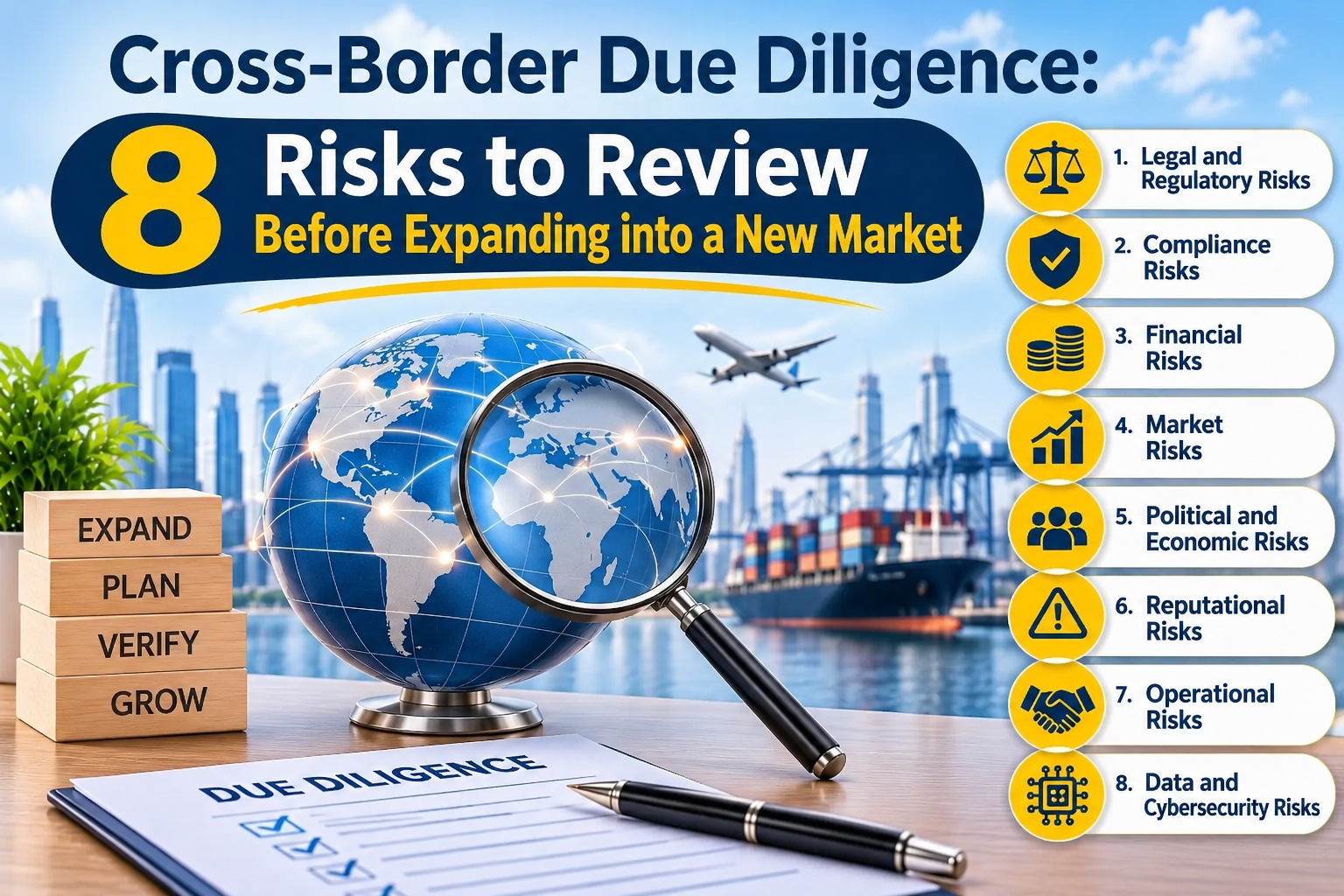
Cross-Border Due Diligence: 8 Risks to Review Before Expanding into a New Market
Expanding a business into another country can create new opportunities for growth. It can help companies reach new customers, build international partnerships, access new suppliers, and enter markets with strong demand. However, operating across borders also brings risks that may not exist in the company's home market.
Different countries have different laws, tax systems, licensing requirements, business practices, and financial regulations. A business structure that works in one country may not be suitable in another. Similarly, a potential overseas partner may appear reliable but could have financial, legal, or operational issues that are not immediately visible.
This is why cross-border due diligence is important before entering a new market. It involves reviewing the legal, financial, commercial, and operational position of a business, partner, or investment in another country. The process helps companies identify potential problems before committing significant resources.
Whether a company plans to establish a foreign subsidiary, acquire an overseas business, enter a joint venture, or work with an international supplier, understanding these risks can support better decisions.
What Is Cross-Border Due Diligence?
Cross-border due diligence is the process of investigating a business, investment, or commercial relationship that involves more than one country. It helps companies understand the risks associated with international expansion and verify important information before completing a transaction or entering a new market.
The process may involve reviewing:
-
Company registration and ownership records.
-
Financial statements and tax documents.
-
Local licences and regulatory approvals.
-
Commercial agreements and business relationships.
-
Employment arrangements and operational practices.
-
Litigation history and outstanding disputes.
-
Currency exposure and financial obligations.
-
Local market conditions and business risks.
The exact checks depend on the country, industry, transaction type, and structure of the proposed expansion.
For example, a company opening a subsidiary in the UAE may need to review licensing options, ownership requirements, tax obligations, and the activities permitted under its chosen structure. A business acquiring a company in another country may also need to investigate its existing debts, contracts, employees, and legal disputes.
Why Is Due Diligence Important Before International Expansion?
Entering a new market requires financial investment, planning, and a clear understanding of local business conditions. Without proper investigation, companies may face unexpected expenses, regulatory problems, or difficulties managing international operations.
A structured review helps businesses:
-
Confirm whether a potential partner or target company is legitimate.
-
Understand local laws and regulatory obligations.
-
Identify hidden financial liabilities.
-
Assess whether the proposed business structure is suitable.
-
Evaluate market demand and commercial opportunities.
-
Understand risks related to foreign suppliers and customers.
-
Plan for tax, currency, and operational challenges.
Due diligence does not remove every risk. However, it gives decision-makers better information and helps them determine whether the expected benefits justify the potential costs.
Cross-Border Due Diligence: 8 Risks to Review Before Expanding into a New Market
Before entering another country, businesses should examine the following eight areas.
1. Legal and Regulatory Compliance Risks
Every country has its own legal framework for setting up and operating a business. Requirements may differ based on the industry, ownership structure, location, and nature of the company's activities.
A business that operates legally in its home country may still need additional registrations, permits, or approvals before conducting similar activities abroad.
Important areas to review include:
-
Company incorporation and registration requirements.
-
Foreign ownership restrictions.
-
Business licensing conditions.
-
Industry-specific permits and approvals.
-
Data protection and privacy requirements.
-
Anti-money laundering and know-your-customer obligations.
-
Local reporting and record-keeping rules.
For example, a foreign company planning to establish operations in the UAE should understand the differences between mainland and free zone structures. The available activities, licensing conditions, and operational requirements can vary depending on the chosen jurisdiction and business activity.
Businesses should also check whether their intended activities are covered by the proposed licence. Registering a company does not automatically authorise it to carry out every commercial activity.
Ignoring these requirements can result in penalties, delays, restrictions, or difficulties maintaining business operations. Legal advice from professionals familiar with the destination country's regulations can help identify the relevant obligations before expansion.
2. Tax Exposure and International Tax Risks
Tax is one of the most important areas to assess when entering a new market. A company may become subject to tax obligations in another country because of its business activities, legal presence, employees, assets, or other relevant factors.
The tax position can also become more complicated when the business operates through multiple entities across different jurisdictions.
Investors and business owners should review:
-
Corporate income tax requirements.
-
VAT, GST, or other indirect taxes.
-
Withholding tax on certain payments.
-
Tax registration and filing deadlines.
-
Transfer pricing requirements.
-
Double taxation agreements.
-
Permanent establishment exposure.
-
Tax treatment of cross-border transactions.
For example, a company may establish a foreign subsidiary to serve customers in another country. However, if its employees or management activities create a taxable presence elsewhere, additional tax considerations may arise.
Businesses operating between the UAE and other countries should understand the applicable corporate tax rules in each jurisdiction. They should also review how intercompany transactions are priced and documented.
Poor tax planning can lead to unexpected liabilities, interest, penalties, and disputes with tax authorities. A cross-border tax review helps businesses understand their obligations before transactions and operations begin.
3. Financial Reporting and Hidden Liability Risks
Financial information is essential when assessing an overseas business or planning an international expansion. However, financial reporting practices, accounting standards, and disclosure requirements may differ between countries.
A company's financial statements may not provide a complete picture of its financial position unless supporting records are also reviewed.
Businesses should examine:
-
Historical financial statements.
-
Management accounts.
-
Cash flow records.
-
Bank statements.
-
Outstanding loans and credit facilities.
-
Accounts payable and receivable.
-
Tax liabilities.
-
Contingent liabilities and guarantees.
It is important to check whether financial information follows the relevant accounting standards and whether the records are supported by reliable evidence.
For example, a potential acquisition target may report strong revenue but have a high level of overdue customer payments. This could indicate cash flow pressure that is not immediately clear from its profit and loss statement.
Investors should also look for liabilities that may not be obvious in a short financial summary, such as shareholder loans, pending payments, or contractual commitments.
Financial due diligence helps businesses understand the target company's actual financial position and identify issues that may affect its value or future performance.
4. Ownership, Shareholder, and Business Partner Risks
Choosing the right business partner is an important part of international expansion. However, a company should not assume that a potential partner is reliable simply because it has a registered business or an established website.
Ownership and control structures may be complicated, particularly when several companies or individuals are involved.
Before entering a partnership or investment arrangement, review:
-
Company registration records.
-
Current shareholder information.
-
Beneficial ownership details.
-
Shareholder agreements.
-
Director and management information.
-
Previous ownership changes.
-
Related-party relationships.
-
Existing restrictions on share transfers.
The purpose is to identify who ultimately owns or controls the business and whether the individuals involved have the authority to enter into the proposed arrangement.
Businesses should also assess whether the potential partner has a history of legal disputes, regulatory problems, or commercial disagreements.
For UAE-related transactions, beneficial ownership information and applicable disclosure requirements may form part of the review.
A clear understanding of ownership can help prevent disputes, reduce the risk of dealing with unauthorised representatives, and support better partnership agreements.
5. Currency and International Payment Risks
Operating in another country often means dealing with different currencies, international banking arrangements, and payment systems. These factors can affect the cost of expansion and the profitability of cross-border transactions.
Currency exchange rates can change between the time a contract is signed and the time payment is received. This may increase expenses or reduce the value of revenue when converted into the company's reporting currency.
Businesses should assess:
-
Currency exchange rate fluctuations.
-
International transfer costs.
-
Payment processing arrangements.
-
Foreign currency bank accounts.
-
Restrictions on moving funds.
-
Customer payment behaviour.
-
Foreign exchange exposure in contracts.
-
Availability of suitable banking services.
For example, a company that earns revenue in one currency but pays suppliers in another may experience changes in its profit margins when exchange rates move.
It is also important to understand the banking requirements of the destination country. Opening a corporate bank account may involve independent checks, documentation, and approval by the bank. Company incorporation does not guarantee account approval.
Businesses should consider how they will receive customer payments, pay suppliers, manage cash reserves, and transfer funds between related entities.
A financial risk assessment can help companies prepare for currency movements and identify practical payment arrangements before launching operations.
6. Commercial and Market Entry Risks
A business opportunity that looks attractive from a distance may not perform as expected in a different market. Customer preferences, pricing, competition, purchasing power, and local business practices can all influence commercial success.
Before entering a new country, businesses should review:
-
Local market demand.
-
Competitor activity.
-
Target customer groups.
-
Pricing and profit margins.
-
Distribution channels.
-
Supplier availability.
-
Industry trends.
-
Local business practices.
Companies should also examine whether their products or services meet local customer needs. A product that sells well in the home market may require changes to its pricing, packaging, distribution, or marketing approach.
For example, a company planning to expand into the UAE should understand whether its intended customer base is concentrated in a particular emirate, free zone, or industry. It should also assess the competition and the commercial costs of reaching those customers.
Businesses entering through an acquisition or joint venture should review the target company's customer relationships, market position, and revenue concentration.
Commercial due diligence can help management assess whether the proposed market offers a realistic opportunity and whether the expansion strategy is supported by evidence.
7. Employment and Operational Risks
International expansion can create new workforce and operational responsibilities. Employment laws, workplace requirements, payroll systems, and employee benefits may differ significantly from those in the company's home country.
Businesses should understand the local requirements before hiring employees or transferring existing staff.
Important areas to review include:
-
Employment contracts.
-
Minimum wage and working-hour rules, where applicable.
-
Employee benefits and leave entitlements.
-
Payroll and social security obligations.
-
Work permits and visa requirements.
-
Employee termination procedures.
-
Health and workplace safety requirements.
-
Outsourcing and contractor arrangements.
Operational risks also extend beyond employment. Businesses should assess whether they can maintain reliable suppliers, manage inventory, deliver products, and provide customer support in the new market.
For example, a company may secure a local business licence but still face delays because it has not arranged suitable premises, staff, logistics, or supplier agreements.
A review of these areas helps management estimate the actual resources needed to operate in another country. It also reduces the risk of entering a market without a practical operating plan.
8. Reputation, Litigation, and Third-Party Risks
A company's reputation can influence its ability to attract customers, secure partnerships, and maintain relationships with regulators and financial institutions.
When expanding internationally, businesses may also become exposed to risks linked to suppliers, distributors, agents, and other third parties.
Before entering a new commercial relationship, investigate:
-
Existing and past legal disputes.
-
Regulatory investigations and penalties.
-
Publicly available adverse information.
-
Sanctions and restricted-party exposure, where relevant.
-
Anti-bribery and corruption concerns.
-
Supplier and distributor background.
-
Previous business failures or misconduct.
-
Contractual and reputational concerns.
These checks are particularly important when a business plans to work with local agents or intermediaries. A partner's actions may create legal, financial, or reputational problems for the expanding company.
Businesses should also review how potential disputes would be handled under the proposed agreement. Important points include governing law, dispute resolution procedures, jurisdiction, and termination rights.
A professional review of third-party relationships can help identify concerns that may not appear in standard company registration or financial documents.
How to Conduct Cross-Border Due Diligence Before Expansion
Reviewing risks is only one part of the process. Businesses should also follow a clear approach to collect information, assess findings, and make decisions.
Step 1: Define the Expansion Plan
Start by identifying the purpose of entering the new market. Decide whether the company plans to establish a subsidiary, acquire an existing business, form a joint venture, or appoint a local distributor.
The proposed structure will determine which documents and risks require the most attention.
Step 2: Identify the Relevant Countries and Regulations
List every jurisdiction involved in the transaction or expansion. Consider where the company is incorporated, where customers are located, where employees will work, and where management decisions will be made.
This helps identify which legal, tax, and reporting requirements may apply.
Step 3: Collect and Verify Documents
Request relevant financial statements, tax records, incorporation documents, ownership details, contracts, and regulatory approvals.
Check whether the information is complete, current, and consistent. Where possible, verify important details through reliable independent sources.
Step 4: Assess and Prioritise Risks
Not every issue will have the same impact. Separate critical risks from matters that can be managed through additional controls or contractual arrangements.
For example, an unresolved licensing issue may prevent a business from operating, while a minor administrative gap may require correction but not necessarily stop the expansion.
Step 5: Prepare a Due Diligence Report
Record the findings, supporting evidence, outstanding questions, and recommended actions.
The report should explain the main risks and their potential effect on the investment or expansion plan. It should also identify matters that require specialist legal, tax, or financial advice.
Step 6: Make an Informed Decision
Use the findings to decide whether to proceed, renegotiate, change the proposed structure, request additional information, or stop the transaction.
Due diligence should inform the final decision rather than simply confirm a decision that has already been made.
Final Thoughts
Expanding into another country can support long-term business growth, but it also introduces legal, financial, tax, commercial, and operational challenges. These risks should be understood before a company commits capital or enters into international agreements.
A structured cross-border due diligence process helps businesses verify important information, assess potential liabilities, and understand the conditions of their target market. It also provides a stronger foundation for selecting business partners, choosing an appropriate structure, and planning international operations.
For companies considering expansion into the UAE or managing business interests across multiple jurisdictions, professional due diligence services, financial reviews, and corporate structuring advisory can help identify important issues before major decisions are made. Dubai Business and Tax Advisors (DBTA) supports businesses with due diligence and related financial and business advisory services.
The most effective international expansion plans are built on verified information, realistic financial expectations, and a clear understanding of local requirements. Reviewing these eight risk areas before entering a new market can help businesses prepare more carefully and make better-informed decisions.

 English
 Arabic
 French
 Spanish
 Portuguese
 Deutsch
 Turkish
 Dutch
 Italiano
 Russian
 Romaian
 Portuguese (Brazil)
