


Formic Acid Market Share: Why Feed Preservation Drives Demand
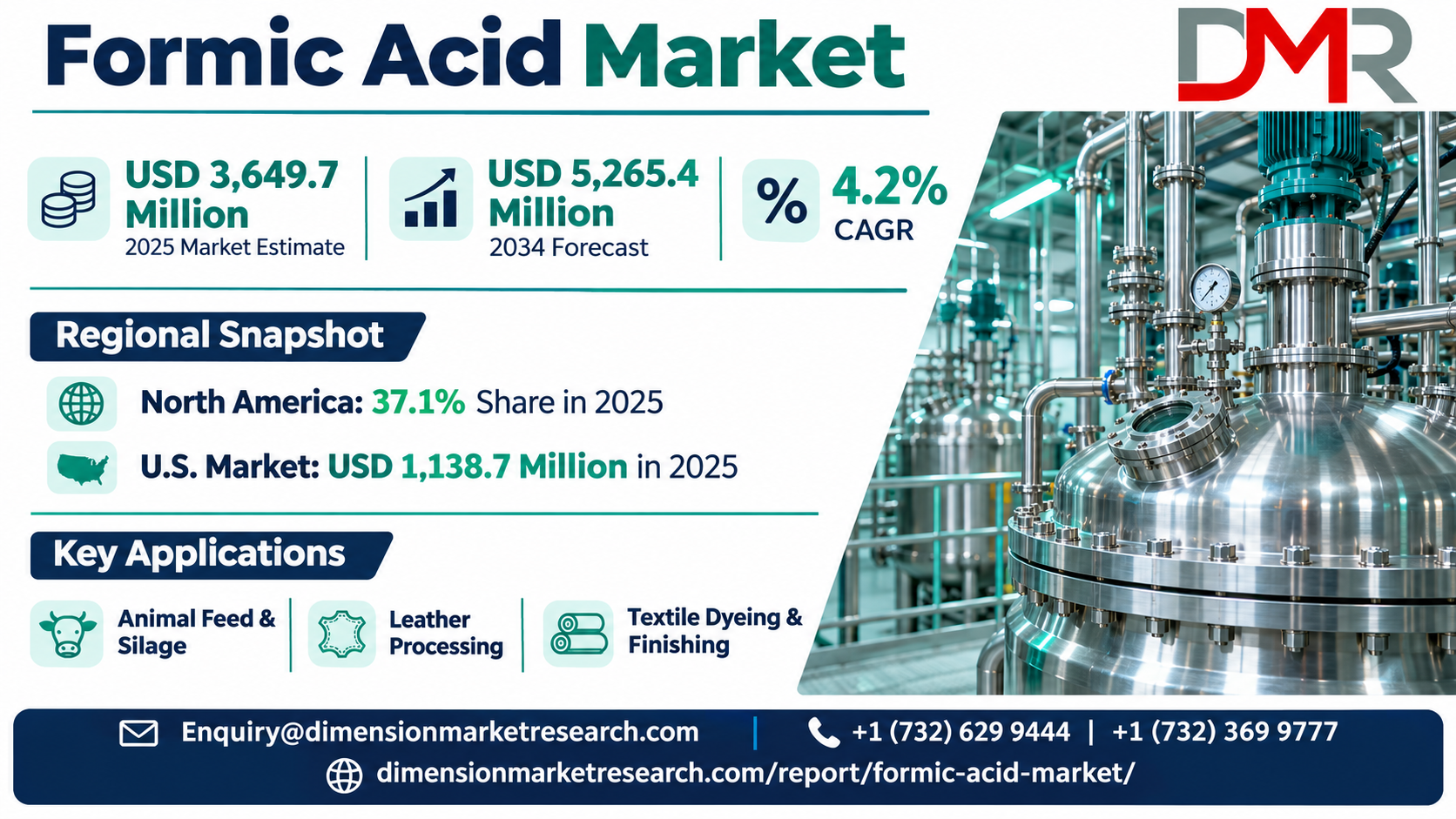
The Formic Acid Market Share outlook is closely tied to how livestock producers preserve feed. Formic acid helps control spoilage during silage storage, making it useful to dairy and meat producers that rely on stored forage. Textile mills and leather processors buy it for a different reason. They use it to control acidity during manufacturing.
According to Dimension Market Research, the global market was estimated at USD 3,649.7 million in 2025 and is forecast to reach USD 5,265.4 million by 2034, at a CAGR of 4.2%. North America was projected to lead by share in 2025, while Asia-Pacific is expected to grow fastest over the forecast period. The two regions illustrate different sources of demand, from established livestock and chemical industries to expanding manufacturing and feed production.
What Is the Formic Acid Market?
The market covers formic acid sold for applications such as animal feed preservation, leather tanning, textile dyeing and finishing, and pharmaceutical manufacturing. The report groups products by concentration, including Grade 85%, Grade 94%, and Grade 99%. Buyers select a grade according to the concentration and other specifications their process requires.
Grade 85% is projected to lead because it offers a balance between performance and cost across several high-volume uses. Its role in feed preservation is especially important, and it also serves textile and leather processors. For a bulk buyer, the relevant question is which grade meets the process specification at a workable delivered cost.
Get a Free Customized Sample of This or Any Other Market Research Report
https://dimensionmarketresearch.com/request-sample/formic-acid-market/
Where Does Formic Acid Demand Come From?
● Animal feed and silage. Livestock producers use formic acid to help limit spoilage and preserve stored forage. Reliable preservation matters when fresh forage is seasonally unavailable and farms depend on silage for a consistent feed supply.
● Textile dyeing and finishing. Textile mills use formic acid to manage pH during processing. Consistent acidity helps maintain repeatable dyeing conditions when mills produce multiple batches to the same specification.
● Leather processing. Tanneries use formic acid for pH control. This gives the market another source of industrial demand, with purchasing tied to leather production and the requirements of individual processing operations.
These applications give suppliers several routes to market. Feed demand follows livestock production and forage storage needs, while orders from textile mills and tanneries depend on manufacturing activity. A regional sales plan built around agriculture can therefore look quite different from one built around industrial customers.
Why Does North America Lead While Asia-Pacific Grows Faster?
North America was projected to account for 37.1% of global market revenue in 2025. The report points to cattle and dairy operations in the United States and Canada, as well as an established chemical manufacturing base. The U.S. market alone was estimated at USD 1,138.7 million in 2025 and is forecast to reach USD 1,613.4 million by 2034.
Asia-Pacific is expected to post the fastest growth as livestock production and industrial activity expand in China, India, and Southeast Asia. More demand for meat and dairy supports the feed additives business, while manufacturing creates demand for processing chemicals. For distributors, the mix matters. Serving livestock producers and serving textile or leather processors can call for different customers, order sizes, and delivery arrangements.
What Could Change How Buyers Source Formic Acid?
Raw material cost volatility and production expenses can put pressure on suppliers and buyers. Handling requirements can also affect storage and delivery, while competing preservatives give feed producers other options. The report covers companies such as BASF SE, Eastman Chemical, Perstorp AB, and GNFC. For bulk buyers, consistency of grade and availability can matter alongside the quoted price.
Interest in renewable production provides another avenue for growth. The Succinic Acid Market and Bio-Acetic Acid Market show how that interest extends across several industrial chemicals, with applications ranging from resins and coatings to solvents and polymers. The Hypochlorous Acid Market illustrates a separate purchasing need, centered on sanitation and water treatment. Together, the reports show why the intended application matters when assessing demand for a particular acid or production route.
Explore the Complete Formic Acid Market Analysis
https://dimensionmarketresearch.com/checkout/formic-acid-market/
Frequently Asked Questions
How large is the Formic Acid Market?
It was estimated at USD 3,649.7 million in 2025 and is forecast to reach USD 5,265.4 million by 2034.
What is the projected growth rate?
The report lists a CAGR of 4.2% from 2025 to 2034.
Which grade is expected to lead the market?
Grade 85% is projected to lead, supported by its use in silage preservation, textile processing, and leather tanning.
Which region holds the largest share?
North America was projected to lead with a 37.1% share in 2025.
Which region is expected to grow fastest?
Asia-Pacific is expected to grow fastest, supported by expanding livestock production and industrial activity.
Conclusion
Feed preservation is a major source of formic acid demand through 2034, with textile and leather processing providing additional industrial uses. Asia-Pacific’s expansion offers suppliers opportunities to serve growing agricultural and manufacturing customers. Renewable production could broaden sourcing options as buyers assess grade, cost, and availability.
Related Industrial Acid Market Insights
The Succinic Acid Market Size report projects growth from USD 329.6 million in 2025 to USD 808.6 million by 2034, at a CAGR of 10.5%. Demand for resins, coatings, and bio-based materials supports the outlook.
The Hypochlorous Acid Market Share report covers demand from water treatment and disinfection. It projects global market revenue of USD 7.8 billion by 2033, up from an estimated USD 5.2 billion in 2024.
The Bio-Acetic Acid Market Growth report estimates the market at USD 233.3 million in 2023 and projects a CAGR of 5.8% through 2032. Applications include solvents, textiles, and polymer production.

 English
 Arabic
 French
 Spanish
 Portuguese
 Deutsch
 Turkish
 Dutch
 Italiano
 Russian
 Romaian
 Greek
