


Farmhouse Lighting & Automation in Delhi NCR
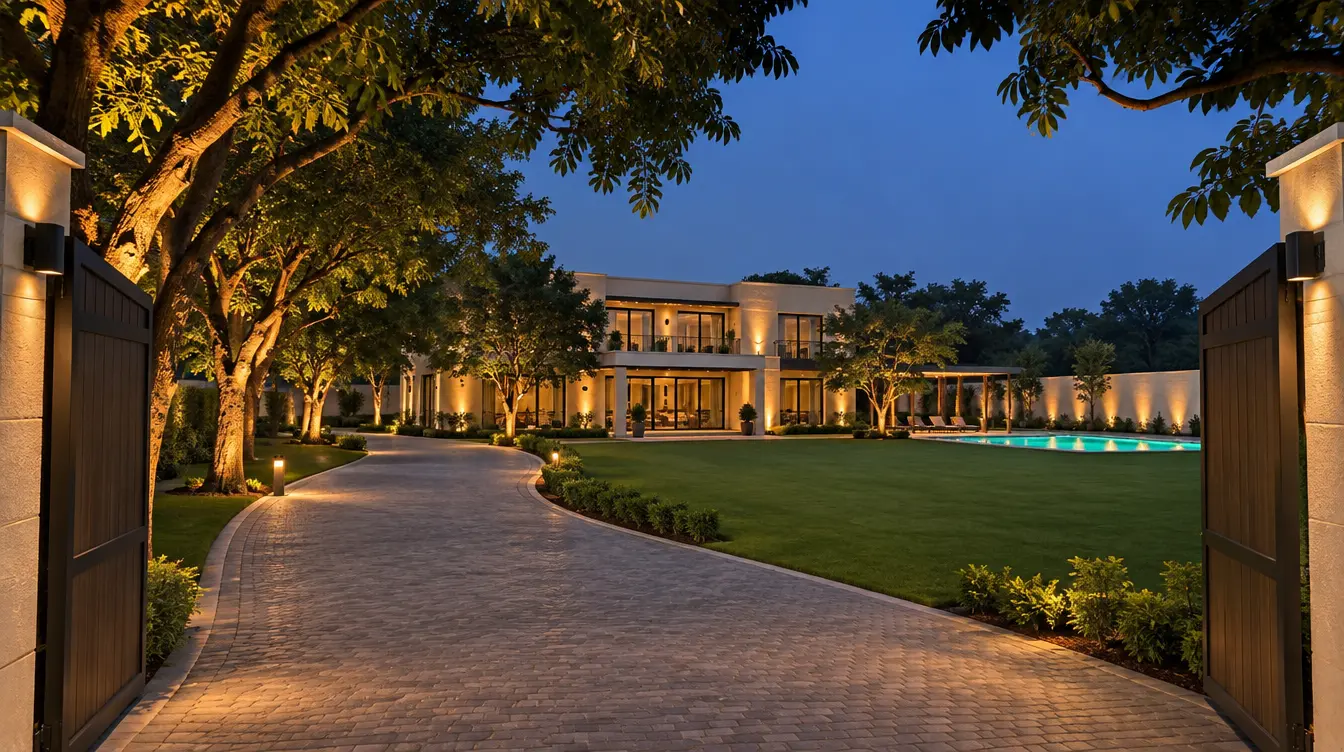
Farmhouse lighting and automation in Delhi NCR should be planned in zones (gate, driveway, lawn, facade, pool and perimeter) and controlled remotely, because most owners aren't there midweek. Lay conduits and cable routes before landscaping, put security lighting on backup power, and use timers and app scenes so the property looks lived in even when it's empty.
A farmhouse in Chhatarpur, Sainik Farms, Westend Greens, Rajokri or a Gurgaon farm belt isn't a large villa. It sits on one to five acres. The family may use it on weekends and for parties. The caretaker lives in a staff block 80 metres from the main house. And after sunset, everything outside the walls is dark.
So the lighting has to cover far more ground, and it has to work when nobody is home.
Why is farmhouse lighting different from villa lighting?
Three things set a farmhouse apart: distance, absence and events.
Distance. A villa's garden might be 2,000 sq ft. A farmhouse driveway alone can run 150 metres. That changes cable sizing, the number of circuits and where you put the control panel.
Absence. Many Delhi NCR farmhouses sit empty from Monday to Friday. A dark property tells everyone it's unoccupied. Lights have to switch on by themselves, and the owner needs to see and control them from a phone in Delhi, Mumbai or Dubai.
Events. Lawn parties, family functions, a sangeet for 300 guests. If the lawn has no permanent power and dimmable circuits, you'll hire a decorator with a generator every single time.
If you're planning a villa instead, our guide to smart lighting solutions for villas in India covers the indoor side in more depth.
Which lighting zones does a farmhouse need?
Plan by zone, with each zone on its own circuit so you can control it separately.
| Zone | What it needs | Typical fixtures |
|---|---|---|
| Gate and entry | Clear face lighting for the guard and CCTV, a welcoming first view | Pillar lights, wall washers, signage light |
| Driveway | Safe guidance without glare | Low bollards, tree uplights along the route |
| Lawn and trees | Depth and mood, not floodlight | Spike spotlights, in-ground uplights |
| Facade | The house as the centrepiece at night | Wall washers, grazers, linear lights |
| Pool and deck | Safety at the edge, glow in the water | IP68 underwater lights, step lights |
| Perimeter wall | Security, with no dark corners | Motion-sensor wall lights, wall washing |
| Staff and service areas | Simple, reliable, low maintenance | Bulkheads, sensor lights |
For fixture costs in each of these, see our garden lighting cost guide and facade lighting cost guide.
How do you light a long driveway without the "runway" look?
The usual mistake is a row of identical bollards every 3 metres on both sides. At night it looks like an airport.
What works better is lighting the things beside the driveway. Uplight the trees that line it, add a few low bollards only at curves and junctions, and let the drive itself catch the spill. Keep everything at 2700K to 3000K. Cool white on a long drive feels like a highway.
The gate and the porch should be the two brightest points. Everything between them can be softer, because your eyes adjust as you drive in.
Why must cables be planned before landscaping?
This is where many farmhouse projects lose time and money.
The landscaper usually starts as soon as the civil work ends. Grass goes down, trees get planted, and the paths are laid in stone. Then the lighting team arrives and has to dig it all up again.
Before the lawn goes in, get these in place:
- Conduits under the lawn along every planned light route, with spare conduits for later additions
- Junction pits at regular intervals so cables can be pulled without digging
- Correct cable sizing for long runs. Over 100 metres or more, voltage drop is real. Lights at the far end of an undersized cable can look dimmer or flicker, especially on 12V or 24V landscape systems.
- Weatherproof distribution boxes placed between zones, not one panel at the house for everything
Agree a one-page cable route drawing with the landscaper. All outdoor fittings should carry a proper IP rating for Delhi's monsoon. We've covered that in outdoor smart lighting and monsoon protection.
What automation does a farmhouse owner actually need?
Not a hundred features. Four scenes cover most farmhouses:
- Arrival. The gate opens and the driveway, porch and facade lights come on in sequence.
- Party. Lawn, trees, pool and deck at full mood, with the facade dimmed slightly so the garden leads.
- Night security. Decorative lights off, perimeter and gate lights on, motion sensors active.
- Away. Lights switch on at sunset and go off in a natural pattern, so the house never looks empty.
An astronomical timer works out sunset for your location every day, so you don't need to reset timers when the season changes. App control lets you check and switch any zone from wherever you are.
For a large property with many zones, a wired system like KNX handles the scale and long distances well. For smaller farmhouses, a good wireless system can do the job. Our KNX vs Zigbee comparison explains the difference.
How should security lighting and gate automation work together?
The perimeter wall is the zone people forget, and it's the one that matters most when the house is empty.
- Motion-sensor lights along the boundary wall, so any movement gets lit
- Lighting linked to CCTV, so the camera always has enough light for a clear image at the gate and corners
- The gate automation linked to the Arrival scene
- A caretaker panel in the staff block to switch security lights manually if needed
If you're adding cameras, read our motion sensor vs CCTV guide first.
What happens to lighting during a power cut?
Power cuts are routine on many farm roads around Delhi and Gurgaon. So decide in advance which circuits go on backup.
On inverter or generator backup: gate, perimeter, porch, staff area, CCTV and the automation controller itself.
Off backup: decorative tree uplights, facade grazers and pool colour effects.
One more thing. Generator power can arrive with voltage swings that shorten the life of cheap LED drivers. Use good-quality drivers and add surge protection on outdoor circuits. It's a small cost next to replacing 40 fittings across a lawn.
How do you plan the lawn for parties?
If you host events, build for them once:
- Weatherproof power points around the lawn edge for caterers and decorators
- Dimmable lawn and tree circuits, so the same lights work for a quiet dinner and a 300-guest function
- Anchor points on trees or poles for festoon lights
- Outdoor speakers wired during construction. Our guide to outdoor speakers for your home covers options.
Pool lighting needs its own planning. See pool lighting types and ideas.
What does farmhouse lighting and automation cost in Delhi NCR?
These are estimated ranges only. The real cost depends on land size, number of zones, fixture brands and the control system.
| Scope | Estimated cost |
|---|---|
| Outdoor lighting (driveway, lawn, trees), 0.5 acre and above | ₹5 lakh to ₹25 lakh+ |
| Perimeter and security lighting | ₹1 lakh to ₹5 lakh |
| Astronomical timers for outdoor circuits | ₹3,000 to ₹10,000 per timer |
| Smart outdoor control with scenes and app | ₹25,000 to ₹1 lakh+ |
| Whole-property automation (indoor and outdoor) | Quoted after a site survey |
A site visit and a zone plan give you a firm number.
Plan your farmhouse lighting with Brightmatic
Brightmatic designs, supplies and installs outdoor lighting and lighting controls for farmhouses in Noida, Delhi NCR & across India. We'll visit the site, map the zones and give you a cable plan before the landscaper starts.
Originally Published at: https://www.brightmatic.in/insights/farmhouse-lighting-automation-delhi-ncr

 English
 Arabic
 French
 Portuguese
 Deutsch
 Turkish
 Dutch
 Italiano
 Russian
 Romaian
 Portuguese (Brazil)
 Greek
