


Non-Comedogenic Moisturizer: What It Means and Why It Matters for Acne-Prone Skin
If you have acne-prone skin, choosing a moisturizer can be confusing. You may want to keep your skin hydrated, but at the same time, you may worry that moisturizer will clog your pores and lead to more pimples.
This is where the term non-comedogenic moisturizer becomes important.
Non-comedogenic products are generally formulated with ingredients that are less likely to contribute to clogged pores. For people who frequently experience blackheads, whiteheads, or acne, choosing a non-comedogenic moisturizer can be a useful part of a well-balanced skincare routine.
However, "non-comedogenic" does not mean that a product is guaranteed to work for every person or that it can prevent acne on its own.
In this guide, we'll explain what non-comedogenic means, why it can matter for acne-prone skin, how to choose a suitable moisturizer, which ingredients to look for, common mistakes to avoid, and how to use moisturizer correctly.
What Does Non-Comedogenic Mean?
The word "comedone" refers to a clogged pore.
There are two common types of comedones:
-
Open comedones, commonly known as blackheads
-
Closed comedones, commonly known as whiteheads
A product described as non-comedogenic is generally formulated to have a lower likelihood of contributing to clogged pores.
This is particularly relevant for people whose skin is prone to congestion.
However, it is important to understand that non-comedogenic does not mean "cannot cause acne."
Skin reacts differently to products. A moisturizer that works well for one person may not suit another person.
Therefore, the term should be viewed as a useful consideration rather than a guarantee.
Why Does Pore Clogging Matter for Acne-Prone Skin?
Acne often begins when hair follicles become clogged with oil and dead skin cells.
When a pore becomes blocked, it can develop into a comedone. In some cases, the clogged follicle can become inflamed and develop into a papule, pustule, nodule, or other type of acne lesion.
For people who are already prone to clogged pores, skincare products that feel heavy or do not suit their skin may be uncomfortable or potentially contribute to congestion.
This is why choosing products carefully can be useful.
A moisturizer should provide hydration without unnecessarily compromising the comfort of acne-prone skin.
Does Acne-Prone Skin Need Moisturizer?
Yes.
Having acne does not mean you should avoid moisturizer.
In fact, moisturizer can be especially useful when your acne routine includes treatments that cause dryness or irritation.
Common acne treatments such as:
-
Salicylic acid
-
Benzoyl peroxide
-
Topical retinoids
-
Other exfoliating ingredients
can sometimes leave the skin dry, tight, or irritated.
A suitable moisturizer can help support the skin barrier and improve comfort.
The American Academy of Dermatology recommends moisturizers for people using acne treatments that can dry or irritate the skin, and suggests looking for products labeled oil-free, non-comedogenic, or "won't clog pores."
Non-Comedogenic vs. Oil-Free: Are They the Same?
No.
These terms describe different characteristics.
Non-Comedogenic
A non-comedogenic product is formulated to be less likely to contribute to clogged pores.
Oil-Free
An oil-free product does not contain oils as part of its formulation.
A moisturizer can be:
-
Non-comedogenic but not oil-free
-
Oil-free but not necessarily labeled non-comedogenic
-
Both non-comedogenic and oil-free
Neither label alone tells you whether the product will work perfectly for your skin.
If you have oily, acne-prone skin, you may prefer a lightweight, non-comedogenic formula that does not leave an excessively greasy finish.
What Should You Look for in a Non-Comedogenic Moisturizer?
Choosing a moisturizer becomes easier when you know what characteristics to prioritize.
1. Look for a Lightweight Texture
A lightweight texture can be more comfortable for oily and acne-prone skin.
Gel, gel-cream, lotion, and fluid textures are often popular choices because they can provide hydration without feeling as heavy as some rich creams.
However, texture is only one factor.
A lightweight product should still provide enough hydration for your skin.
2. Look for Hydrating Ingredients
A non-comedogenic moisturizer should still be able to hydrate the skin.
Useful ingredients can include:
-
Glycerin
-
Hyaluronic acid
-
Panthenol
-
Ceramides
-
Beta-glucan
These ingredients can help maintain hydration while supporting a comfortable skincare routine.
3. Consider Your Skin Type
A moisturizer should match more than just your acne concerns.
For example:
Oily and acne-prone skin:
Look for lightweight textures and a comfortable finish.
Dry and acne-prone skin:
You may need a more hydrating formulation with barrier-supporting ingredients.
Combination and acne-prone skin:
A lightweight moisturizer may work well across the face, while drier areas may require additional hydration.
Sensitive and acne-prone skin:
You may want to keep the formula simple and avoid ingredients that your skin consistently finds irritating.
Ingredients Commonly Found in Moisturizers for Acne-Prone Skin
Glycerin
Glycerin is a humectant that helps attract water to the skin.
It is widely used in moisturizers because it can provide hydration without requiring a heavy or oily texture.
Hyaluronic Acid
Hyaluronic acid helps the skin retain water and is commonly found in lightweight moisturizing products.
It can be particularly useful when you want hydration without a thick cream.
Ceramides
Ceramides are naturally occurring lipids that play an important role in the skin barrier.
Moisturizers containing ceramides can help support the skin barrier, particularly when your routine includes potentially drying acne treatments.
Panthenol
Panthenol is a moisturizing ingredient that can help improve skin hydration and comfort.
It is commonly used in formulations designed for sensitive or irritated skin.
Niacinamide
Niacinamide is a form of vitamin B3 commonly used in skincare.
Depending on its concentration and formulation, it can support the skin barrier and may be useful in routines for oily or blemish-prone skin.
Does Non-Comedogenic Mean It Will Not Cause Acne?
No.
This is one of the most important things to understand about the term.
Non-comedogenic means that a product is formulated with a lower likelihood of contributing to clogged pores. It does not mean that the product is guaranteed to be completely acne-free for every individual.
Acne can have many contributing factors, including:
-
Hormonal changes
-
Genetics
-
Excess sebum
-
Follicular plugging
-
Inflammation
-
Certain medications
-
Other individual factors
A moisturizer is only one part of your skincare routine.
If a product consistently causes irritation or appears to worsen congestion, stop using it and reassess your routine even if the packaging says "non-comedogenic."
Can Non-Comedogenic Moisturizer Still Feel Greasy?
Yes.
Non-comedogenic and lightweight are not interchangeable terms.
A product can be formulated to be less likely to clog pores while still having a rich or heavy texture.
If you have oily skin, you may prefer a non-comedogenic moisturizer that also has a lightweight texture.
The finish is important because you want a product that you can comfortably use every day.
Non-Comedogenic Moisturizer for Oily, Acne-Prone Skin
If your skin is both oily and acne-prone, choosing a moisturizer requires a little more attention.
You may want to prioritize:
-
Lightweight texture
-
Non-comedogenic formulation
-
Hydrating ingredients
-
Comfortable finish
-
Minimal irritation
-
Compatibility with your acne treatments
Avoid assuming that oily skin does not need hydration.
Instead, focus on finding a moisturizer that gives your skin enough hydration without making it feel excessively greasy.
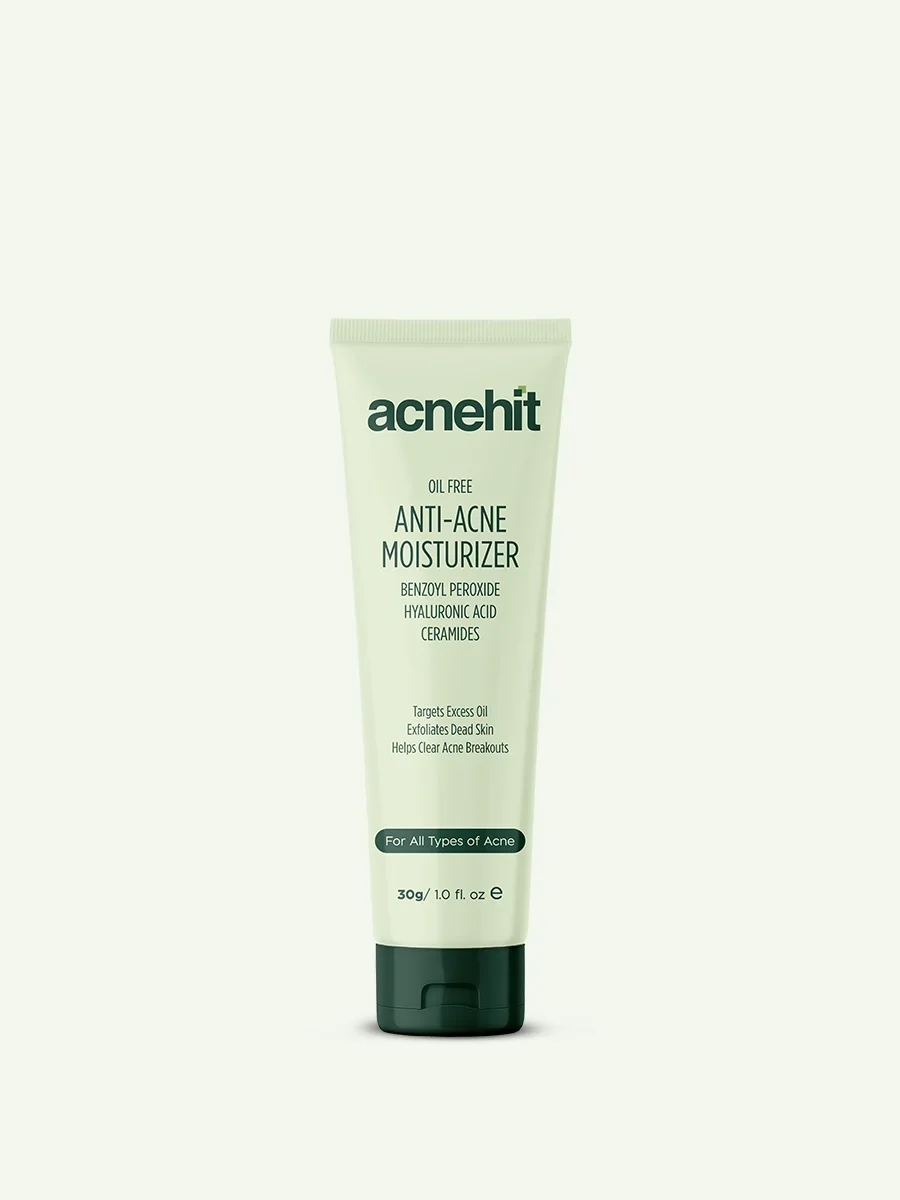
AcneHit Anti-Acne Moisturizer
For people looking to add a moisturizer to an acne-focused skincare routine, AcneHit Anti-Acne Moisturizer can be used as the moisturizing step.
A moisturizer should not be treated as a replacement for acne treatment. Its role is to provide hydration and support a comfortable skincare routine.
This can be particularly useful when your routine contains acne-focused products that may cause dryness or irritation.
A simple routine can include cleansing, appropriate acne treatment, moisturizer, and daytime sunscreen.
The goal is to keep the routine consistent without overwhelming the skin with unnecessary products.
How to Use a Non-Comedogenic Moisturizer
Using a suitable moisturizer is only part of good skincare. Applying it correctly can also help.
Morning
A basic morning routine can be:
-
Cleanse with a gentle cleanser.
-
Apply any appropriate treatment or serum.
-
Apply your moisturizer.
-
Finish with broad-spectrum sunscreen.
Evening
At night:
-
Cleanse your face.
-
Apply your acne treatment if you use one.
-
Apply moisturizer.
You do not need a thick layer.
A small amount spread evenly across the face is generally enough. If your skin feels dry, you can adjust the amount according to your needs.
When Should You Apply Moisturizer?
Moisturizer can be applied after cleansing and other appropriate skincare treatments.
If you use an acne treatment that causes dryness, applying moisturizer can help improve comfort.
Some people also use the "sandwich" approach with certain topical treatments: moisturizer, treatment, and moisturizer again. Whether this is appropriate depends on the treatment and your skin's tolerance.
If you are using a prescription acne treatment, follow the instructions provided by your dermatologist or healthcare professional.
Common Mistakes When Choosing a Non-Comedogenic Moisturizer
Assuming Non-Comedogenic Means Acne-Proof
It does not.
The term indicates a lower likelihood of pore clogging, not a guarantee against acne.
Choosing a Product Only Because of the Label
The rest of the formula matters.
Consider the texture, ingredients, fragrance, and how your skin responds.
Using Too Much Moisturizer
Applying a large amount can leave your skin feeling greasy even if the product itself is lightweight.
Start with a small amount.
Skipping Moisturizer Because You Have Acne
This can make an acne routine unnecessarily drying.
If your treatment causes dryness, a suitable moisturizer may help your skin remain more comfortable.
Introducing Several Products at Once
If you add a new moisturizer, cleanser, serum, exfoliant, and treatment simultaneously, it becomes difficult to identify what is causing irritation or breakouts.
Introduce products gradually whenever possible.
Can Moisturizer Help Prevent Acne?
A moisturizer is not an acne treatment by itself.
However, choosing an appropriate moisturizer can support a consistent skincare routine.
This is particularly relevant if your acne treatments cause dryness or irritation.
When your skin becomes excessively dry, you may be more likely to stop using your acne treatment or overcompensate with other products.
A comfortable moisturizer can help make your routine easier t

 English
 Arabic
 French
 Spanish
 Portuguese
 Deutsch
 Dutch
 Italiano
 Russian
 Romaian
 Portuguese (Brazil)
 Greek
