


How to Choose a Press Release Distribution Service That Delivers Real Pickup
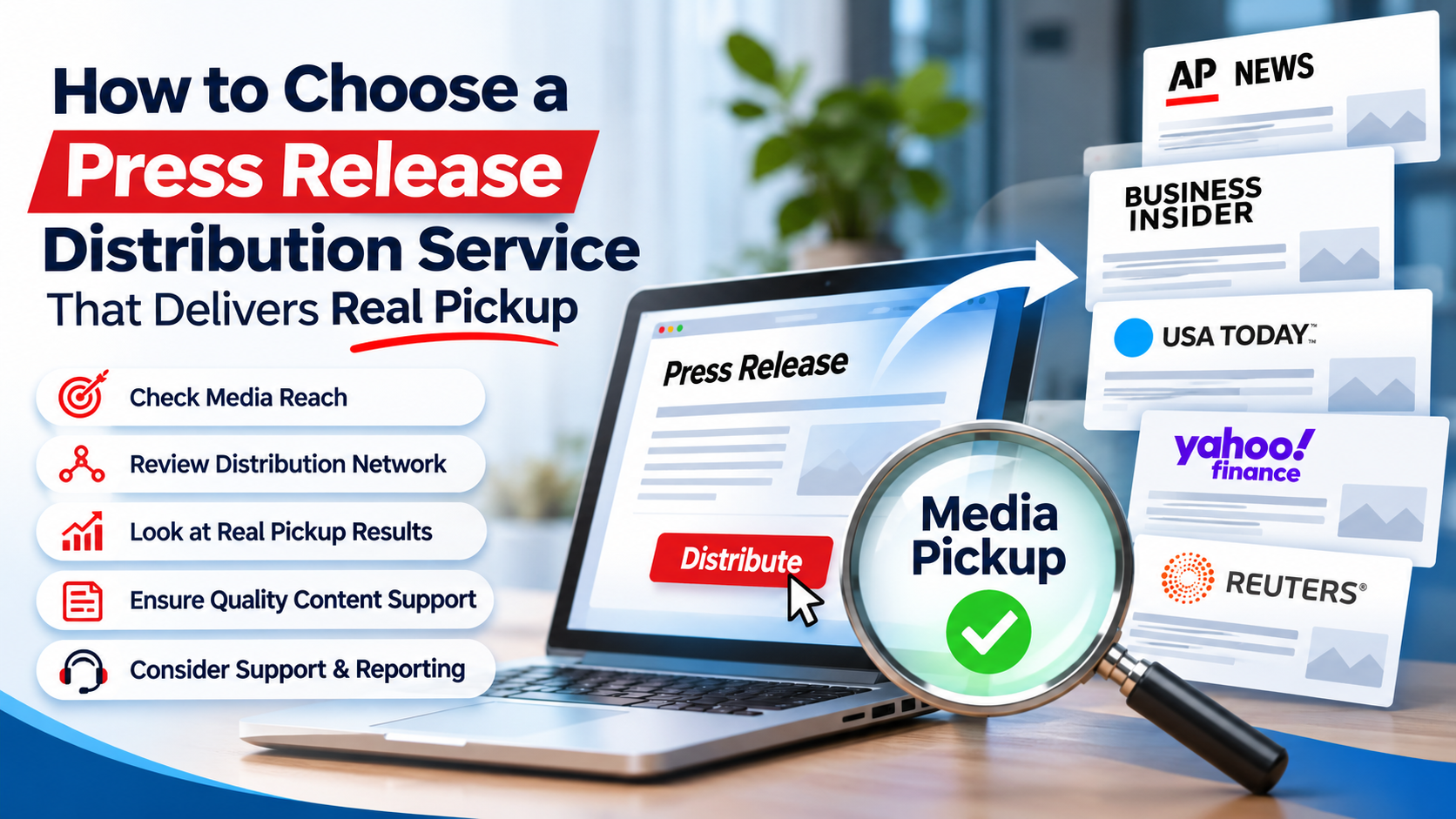
"Pickup" is the word that sells press release services. Providers advertise hundreds of pickups, guaranteed placements, and impressive-looking reports. Yet many businesses finish a campaign with a long list of URLs and no idea whether anyone read the story.
The problem is that "pickup" means different things to different providers. Choosing a service that delivers the kind of pickup you actually want starts with understanding what the word covers, what influences it, and how to test a provider's claims before you spend money. This guide walks through that process for U.S. businesses, without promising outcomes that no service can control.
What "Pickup" Really Means
In press release distribution, pickup generally means that a website published or referenced your release. But that single word hides several very different outcomes.
Syndicated placement. Your release is automatically republished on partner sites in the provider's network. This is the most common kind of pickup and the easiest to deliver. It makes your release findable, but it does not mean anyone chose to feature it.
Aggregator inclusion. News aggregators and feeds list your headline and link. Visibility varies widely.
Editorial pickup. A journalist or editor reads your release and writes an article, quotes you, or mentions your company. This is the outcome most people actually want, and it is the one no provider can guarantee.
Social or newsletter mentions. Someone shares the release or includes it in a newsletter. These are harder to count and often go unreported.
When a provider promises "guaranteed pickup," ask which of these it means. In most cases it means syndicated placement, which has value, but not the value of editorial coverage.
What Actually Influences Real Pickup
Before evaluating providers, it helps to be honest about what drives editorial pickup.
- The news itself. A genuine launch, a verifiable milestone, or useful data earns attention. Routine updates do not.
- Relevance to the outlet's audience. A trade site covering software will not run a story about a new bakery.
- Clarity and accuracy. A release that states facts plainly is easier to use than one full of adjectives.
- Timing. Fresh news gets more attention than old news.
- Supporting material. Images, data, and a named contact make a story easier to write.
- Personal outreach. A short note to a reporter who covers your area often does more than distribution alone.
A distribution service can help with reach and targeting. It cannot supply newsworthiness, and it cannot make an editor say yes.
Step 1: Ask How the Provider Defines Pickup
Make this the first question. Ask for a written definition, and ask what the report will show. A trustworthy provider will explain the difference between syndicated placements and editorial coverage, and will not blur them in marketing language.
Watch for answers that skip the question, such as "we deliver hundreds of pickups" with no detail on what those are.
Step 2: Ask for a Sample Report
A sample report is the single most useful document a provider can show you. Look for:
- Named sites, not only a total count
- Live links you can click and check
- Dates, so you can see how fast placements went live
- Relevance, meaning whether the sites relate to the industry or topic of the sample release
- Any engagement data, such as views or clicks, with a clear source
Open several of the links. If most lead to pages that look unrelated, unreadable, or nearly empty, the pickup is thin.
Step 3: Check Where Past Releases Actually Appeared
Search for a recent release from the provider's own newsroom or from a past client, and see where it shows up. Check whether the headline appears on recognizable, relevant sites, or only on pages that exist to host press releases. Placement on a site that real people visit is worth more than ten placements on sites no one reads.
Step 4: Look at Targeting, Not Just Network Size
Pickup improves when a release reaches the right readers. Ask whether you can target by:
- Industry or topic, such as technology, health, finance, or real estate
- Region, such as a state or metro area
- Audience, such as business readers or consumers
A smaller, targeted network often produces more relevant pickup than a huge general one. For technology brands, this look at tech PR distribution basics explains how targeting and timing work together for launch announcements.
Step 5: Compare Pricing in Terms of What You Get
Price should follow features, not the other way around. A package that costs more should add something concrete: a wider network, targeting, better reporting, or support. Ask for a written quote that lists the base price, word limit, images, and any extras.
Many small and mid-sized businesses spend roughly $150 to $1,000 per release, and prices vary by reach and reporting. As one example, SP Tech Solutions explains how those costs break down in its press release distribution cost guide, which is the kind of transparency worth looking for when you compare providers.
Step 6: Read the Terms and the Guarantees
Guarantees deserve the closest reading. A promise of "guaranteed pickup" or "guaranteed coverage" should come with a clear definition, and no provider can honestly guarantee that a journalist will write about you. Check:
- What exactly is guaranteed, and in what form?
- What happens if the guarantee is not met?
- What is the policy for corrections or removal?
- Are there extra fees for words, images, or reports?
Vague guarantees are a warning sign.
Step 7: Run a Small Test
If you are unsure, test a provider with a modest package and a real announcement. Tag the link in the release so you can see visits from it. After two weeks, review:
- Where did it appear, and were those sites relevant?
- How many people clicked?
- Did any reporter or editor reply?
- Did branded searches or referral visits change?
- Did the report match what you were promised?
A small test costs far less than committing to a large package based on marketing claims.
Red Flags to Watch For
- Guaranteed coverage, rankings, or traffic
- Pickup counts with no list of sites
- Reports full of unrelated or low-quality pages
- Reach described as "up to" a large number without examples
- Hidden fees for extra words, images, or reports
- No independent reviews
- Pressure to buy immediately
Any one of these is a reason to ask more questions. Several together are a reason to look elsewhere.
How to Improve Your Chances Regardless of Provider
A good provider helps, but your own work decides most of the result.
- Write about real news. Launches, partnerships, awards, and research work best.
- State facts early. Put who, what, when, where, and why in the first paragraph.
- Include a quote and contact details. Reporters need something to quote and a way to reach you.
- Follow up personally. Email two or three relevant reporters with a link and one sentence on why it matters to their readers.
- Keep one natural link. Google's spam policies warn against large-scale distribution that relies on keyword-heavy links.
- Measure and adjust. Learn which topics and headlines draw interest.
A Simple Scorecard
When you compare two or three providers, score each from one to five on these questions:
- Is pickup defined clearly in writing?
- Does the sample report show named, relevant sites?
- Can I target by industry or region?
- Is pricing transparent, with extras listed?
- Are guarantees honest and specific?
- Do independent reviews support the claims?
The provider with the best total is usually the safest choice, even if it is not the cheapest.
Final Thoughts
Real pickup comes from relevant reach, clear writing, and news that someone wants to read, not from a bigger number on a sales page. Ask how pickup is defined, check the sample report, look at where past releases appeared, and test with a small package before committing. A provider that answers those questions plainly is more likely to be worth your money than one that simply promises more.

 English
 Arabic
 French
 Spanish
 Portuguese
 Deutsch
 Turkish
 Dutch
 Italiano
 Russian
 Romaian
 Greek
