


The Real Cost of a Food License in Pakistan: A Complete Breakdown
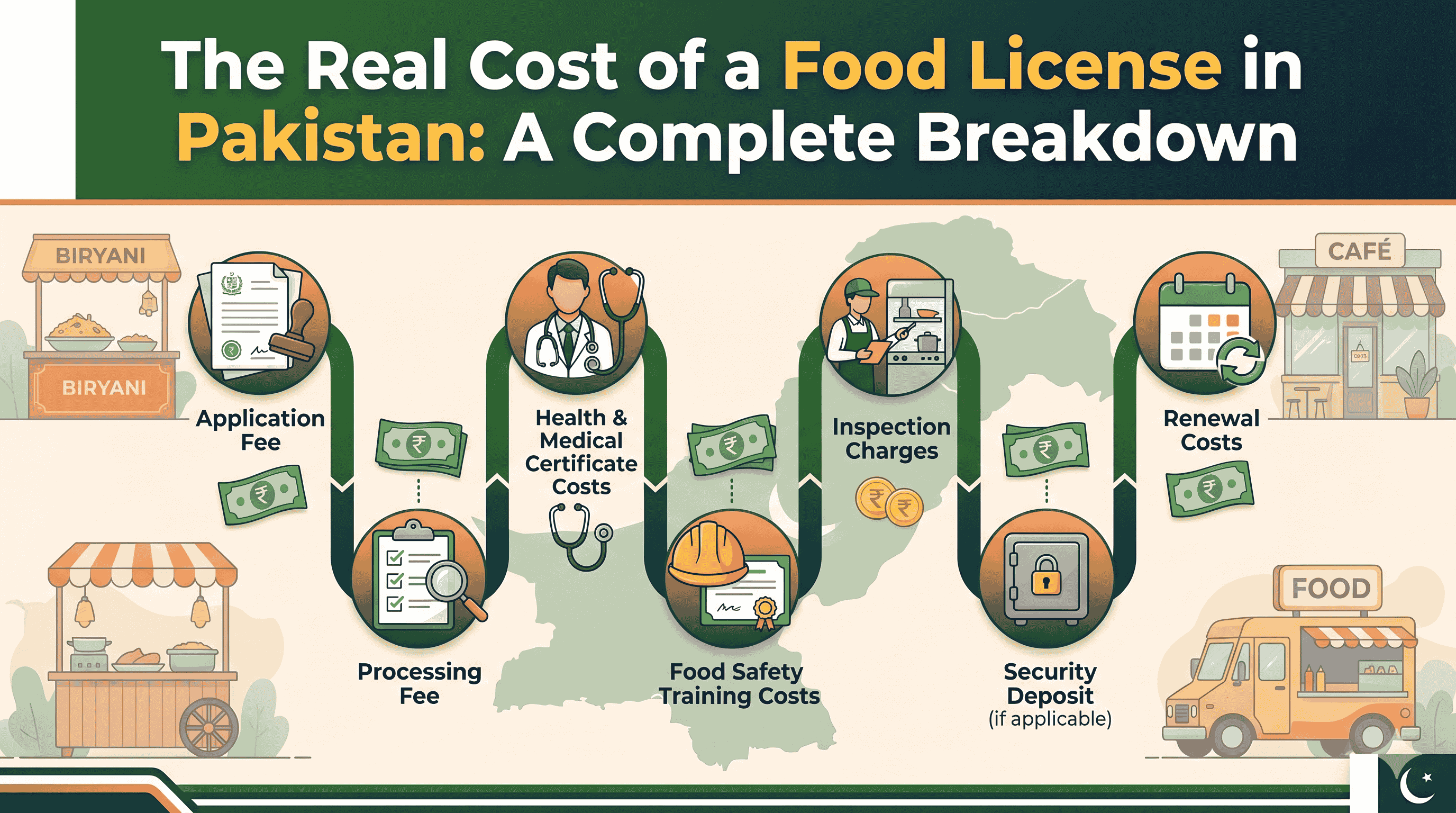
You've perfected your biryani recipe, your karahi is legendary, and your business plan is a work of art. You're ready to launch your food venture, but what about the legal hurdles? The cost of a food license in Pakistan is a detail many new entrepreneurs tragically underestimate, often planning only for the number they see on a government website.
The problem is that most online guides only mention the official government fee. This leaves passionate entrepreneurs completely unprepared for the significant hidden costs that can derail a budget and delay an opening. This incomplete picture creates stress, confusion, and financial strain right when you need to be focused on your launch.
This guide provides the first-ever complete breakdown of all the expenses involved. We will cover the official fees, the often-ignored hidden costs, and the province-specific requirements you need to know to get your food business legally licensed across Pakistan. Consider this your definitive financial roadmap to legal compliance.
Key Takeaways
- Official Fees Are Not Universal: The government license fee varies significantly based on your province, business type (e.g., restaurant vs. home kitchen), and the scale of your investment.
- Hidden Costs Are Substantial: The real cost includes mandatory medical certificates for all staff, necessary kitchen upgrades to meet hygiene standards, and potential consultant fees.
- Compliance is Cheaper Than Fines: The penalties for operating without a license are severe, including fines up to PKR 500,000 and the risk of your business being permanently sealed by authorities.
- A License Builds Trust: Beyond legality, a food license is a powerful marketing tool that signals safety and quality to your customers, building essential brand trust from day one.
- Documentation is Key: Preparing your documents in advance—CNIC, NTN certificate, property agreements, and staff medicals—will dramatically streamline the application process.
- Inspection is Pass/Fail: Your kitchen must be prepared to pass a physical inspection that covers everything from pest control to food storage protocols.
Why a Food License is Non-Negotiable for Your Business
Viewing a food license as just another bureaucratic checkbox is a critical mistake. It's a foundational pillar of your business, ensuring its legality, credibility, and longevity. Without it, you are operating on borrowed time.
Legal Mandate
In Pakistan, food safety is regulated at the provincial level. Each province has its own governing body, such as the Punjab Food Authority (PFA), the Sindh Food Authority (SFA), and the Khyber Pakhtunkhwa Food Safety & Halal Food Authority (KPFS&HFA). These organizations are legally empowered to set standards, conduct inspections, and issue licenses to ensure that all food sold to the public is safe for consumption.
Building Customer Trust
A displayed food license is more than just a piece of paper; it's a seal of quality and safety. In an age of heightened health awareness, customers actively look for proof that an establishment adheres to hygiene standards. A report by the World Health Organization, which estimates that unsafe food causes 600 million cases of foodborne diseases globally each year, underscores the public's concern for food safety.
The High Cost of Non-Compliance
Operating without a valid license is a high-risk gamble with severe consequences. Food authorities conduct regular surprise inspections, and the penalties for non-compliance are harsh. They range from hefty fines, which can be as high as PKR 500,000, to the immediate sealing of your premises, which can lead to permanent business closure and irreparable damage to your reputation.
The Official License Fee: A Province-by-Province Comparison
One of the first things entrepreneurs discover is that there is no single, nationwide fee for a food license. The cost is highly variable and depends on three main factors: your province, your business category (restaurant, street food cart, food manufacturer, home-based chef), and your total investment.
Punjab Food Authority (PFA) License Costs
The Punjab Food Authority (PFA) has a well-defined and transparent fee structure based on different business categories. Their system is designed to be equitable, with larger operations paying more than smaller ones. For example, a small restaurant or café with an initial investment of up to Rs. 500,000 can expect an annual license fee of approximately Rs. 20,000.
The PFA has made it relatively easy for business owners to determine their exact fee. They offer an official online fee calculator on their website, which removes guesswork from the process. Simply input your business type and investment details to get an accurate estimate.
Sindh Food Authority (SFA) License Costs
The Sindh Food Authority (SFA) follows a similar category-based model. Fees are structured for different types of food businesses, including restaurants, bakeries, caterers, and food manufacturers. The costs are generally comparable to Punjab's, but it's essential to check the latest official schedule.
The most reliable way to find the current fee is to visit the SFA's official website. They typically publish a detailed fee schedule in a PDF document that outlines the costs for each license category. This ensures you are working with the most up-to-date information.
KP, Balochistan, and Other Regions
For businesses in Khyber Pakhtunkhwa and Balochistan, the process is managed by the KPFS&HFA and the Balochistan Food Authority (BFA), respectively. While these authorities are actively working to streamline their processes, finding a single, centralized fee schedule online can sometimes be challenging.
The best approach is to directly contact their regional offices or visit their official websites for the most current fee structures. This direct engagement will provide the accurate information needed for proper financial planning.
Quick-View Comparison Table
To give you a clearer picture, here is an estimated comparison for a 'Small Café' with an investment of under PKR 1 Million.
Province Authority Estimated Annual License Fee (PKR)
Punjab
PFA
18,000 - 25,000
Sindh
SFA
15,000 - 22,000
Khyber Pakhtunkhwa
KPFS&HFA
12,000 - 20,000
Note: These are estimates. Always verify with the respective authority for the current official fee.
Beyond the Sticker Price: Uncovering the REAL Hidden Costs of Licensing
Here is where most budgets fail. The official license fee is often less than 25% of the total cost of becoming compliant. Neglecting these "hidden" costs can put your entire business plan in jeopardy.
Mandatory Medical Fitness Certificates
Provincial food laws mandate that every single person who handles food—from the head chef to the dishwasher—must be medically certified as fit and free from contagious diseases. This requires a series of tests, typically including screening for Hepatitis B & C and Typhoid. The estimated cost is between PKR 1,000 to PKR 2,500 per employee, and this amount adds up quickly if you have a team.
Pre-Inspection Infrastructure & Hygiene Costs
Before a food inspector ever steps foot in your establishment, your kitchen must meet a long list of food safety standards. This often requires significant upfront investment. These costs can include installing stainless steel countertops, putting in a three-compartment sink for proper dishwashing, ensuring adequate ventilation with commercial-grade exhaust hoods, implementing a professional pest control contract, and setting up a proper waste disposal system.
Laboratory Testing Fees for Food Samples
If you plan to sell packaged food items with a shelf life, such as sauces, baked goods, or frozen meals, you may be required to have them tested by an accredited laboratory. This is part of the product registration process. Lab testing verifies nutritional information and ensures the product is free from harmful microbes, with costs typically ranging from PKR 5,000 to PKR 15,000 per sample.
Consultant & Agent Fees
The bureaucratic process of licensing can be overwhelming for a new business owner. Many entrepreneurs choose to hire a consultant or agent who specializes in food license applications. These professionals can ensure your paperwork is correct and guide you through the inspection process, saving you valuable time and preventing costly mistakes.
While this service is an added expense, typically ranging from PKR 15,000 to PKR 50,000, it can be a worthwhile investment. The peace of mind and time saved often justify the cost. A good consultant helps you get it right the first time.
Additional Municipal & Trade Licenses
A food license from the provincial authority is just one piece of the legal puzzle. You will likely also need a general trade license from your local municipal corporation or cantonment board. This separate license registers your business with the local government and comes with its own fee, so be sure to budget for it as well.
Your Step-by-Step Guide to Getting Licensed (And Passing the Inspection)
Follow these steps methodically to ensure a smooth and successful licensing experience.
Step 1: Essential Documentation Checklist
Gathering all your paperwork before you start the application is the most important first step. You will need:
- Copy of the owner's/proprietor's CNIC
- FBR NTN (National Tax Number) certificate for your business
- Proof of ownership or a valid rent/lease agreement for the premises
- Medical fitness certificates for all food-handling staff
- A basic layout map of the kitchen/premises
- Partnership deed or company registration documents (if applicable)
Step 2: Application Submission (Online vs. In-Person)
Most modern food authorities, like the PFA, have robust online portals where you can fill out the application, upload your documents, and track your progress. For other authorities, you may need to visit a regional office to submit a physical application. The online method is generally faster and more transparent.
Step 3: Preparing for and Passing the On-Site Inspection
The physical inspection is the most critical stage. An inspector will visit your premises to verify that you meet all hygiene and safety standards. Be prepared by creating your own inspection checklist:
- Personal Hygiene: Are there designated hand-washing sinks with soap and towels? Do staff wear hairnets/caps and clean uniforms?
- Food Storage: Is raw meat stored separately from and below ready-to-eat foods? Is the FIFO (First-In, First-Out) system being used for inventory?
- Pest Control: Is there evidence of a recent pest control service? Are there any signs of rodents or insects?
- Cleanliness & Sanitation: Are food preparation surfaces, equipment, and floors clean? Is there a proper system for waste disposal?
Step 4: Fee Payment and License Issuance
Once you have successfully passed the inspection, the authority will issue a challan or payment slip for the official license fee. You can typically pay this at a designated bank. After payment is processed, you will be issued your official food license, which must be prominently displayed at your place of business.
Real-World Examples: Total Licensing Costs for Different Businesses
Let's break down the total expected costs for two common food business models.
Case Study 1: A Home-Based Bakery in Lahore
A home-based baker needs to be just as compliant as a large restaurant. The scale is smaller, but the rules still apply.
- PFA License Fee (Home Kitchen Category): ~ PKR 5,000
- Medical Certificate (1 person): ~ PKR 1,500
- Basic Kitchen Upgrades (Food-grade storage, fire extinguisher): ~ PKR 10,000
- Total Real Cost Estimate: ~ PKR 16,500
Case Study 2: A Small Café in Karachi
A small café involves staff, a commercial location, and higher public traffic, increasing the complexity and cost. To succeed, a new café has to offer a fantastic experience to compete with the hundreds of other Restaurants in Karachi.
- SFA License Fee (Small Restaurant Category): ~ PKR 15,000
- Medical Certificates (4 staff @ PKR 1,500 each): ~ PKR 6,000
- Inspection Prep (Pest control contract, new signage, etc.): ~ PKR 25,000
- Consultant Fee (Optional but recommended): ~ PKR 20,000
- Total Real Cost Estimate: ~ PKR 66,000
Conclusion
The real cost of a food license in Pakistan clearly goes far beyond the official fee printed on a government website. Budgeting properly for staff medicals, essential infrastructure upgrades, and potential consulting fees is absolutely essential for a smooth and successful launch. Without this foresight, you risk facing unexpected financial burdens that can halt your progress.
Think of this process not as an expense, but as a foundational investment. Investing properly in licensing protects your business legally, builds immediate trust with your customers, and sets you up for long-term success. It is the first and most important ingredient in your recipe for a thriving food business.
Have questions about getting a food license for your specific situation? Ask in the comments below! We're here to help.
Frequently Asked Questions
How much does a food license cost in Pakistan?
The cost varies widely. A home-based business might pay a total of PKR 15,000 - 20,000, while a small restaurant's total compliance cost could be between PKR 60,000 and PKR 100,000 after including all hidden costs like medicals and infrastructure upgrades.
How can I check a food license online in Pakistan?
Most provincial food authorities, like the PFA, have sections on their websites or dedicated mobile apps where you can enter a license number to verify its validity. This is a great way to check the authenticity of a license.
What are the documents required for a food license?
The core documents include the owner's CNIC copy, the business's FBR NTN certificate, a rent or ownership agreement for the property, and mandatory medical fitness certificates for all food-handling employees.
What is the renewal fee for a food license?
Food licenses are typically issued on an annual basis. The renewal fee is generally the same as the initial annual license fee for your specific business category, and the renewal process often requires a new inspection.
Do I need a separate license for each branch of my business?
Yes. A food license is issued for a specific physical address. If you operate multiple branches, each location must have its own separate food license and undergo its own independent inspection process.

 English
 Arabic
 French
 Spanish
 Portuguese
 Deutsch
 Turkish
 Dutch
Dutch
 Italiano
 Romaian
 Portuguese (Brazil)
 Greek
Greek
